Char bytes is based on a series of uniformly creasing addresses, to which each address has a binary value and that value corresponds to character in the ASCII table.
What is the difference between character array and character pointer ?
Consider the following example:
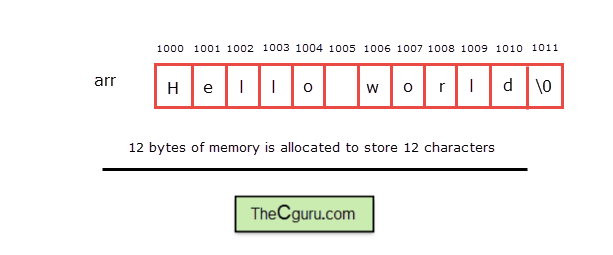
char arr[] = "Hello World"; // array version
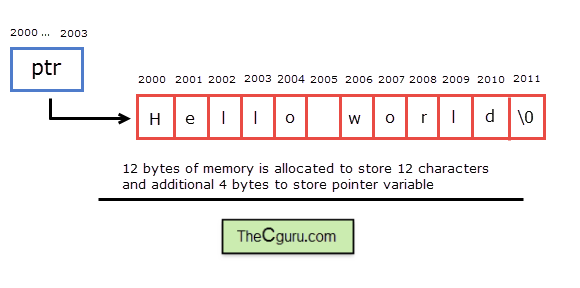
char ptr* = "Hello World"; // pointer version
The type of both the variables is a pointer to char or (char\*), so you can pass either of them to a function whose formal argument accepts an array of characters or character pointer. In C programming, the name of an array always points to the base address, roughly speaking, an array is a pointer.
Here are differences:
- 1
arris an array of12characters. When compiler sees the statement:It allocateschar arr[] = "Hello World";
12consecutive bytes of memory and associates the address of the first allocated byte witharr.On the other hand when the compiler sees the statement.
It allocateschar ptr* = "Hello World";
12consecutive bytes for string literal"Hello World"and4extra bytes for pointer variableptr. And assigns the address of the string literal toptr. So, in this case, a total of16bytes are allocated.
In this library we have the following functions for manipulating strings:
length: get the length of a string.equal: check if two strings are the same.copy: copy characters from one string to another string.subcopy: copy a specific portion of a string, using the starting index and an ending index, to another string.subcopy_len: copy a specific portion of a string, using the length, to another string.subcopy_index_len: copy a specific portion of a string, using the starting index and the length, to another string.