





⚠️ Photosensitivity Warning Patternflow displays rapidly changing light patterns that may trigger seizures in people with photosensitive epilepsy. Viewer discretion is advised. If you experience any discomfort, stop use immediately.

▶ the reel — 400k+ views on Instagram · ▶ the film — the whole story, on YouTube
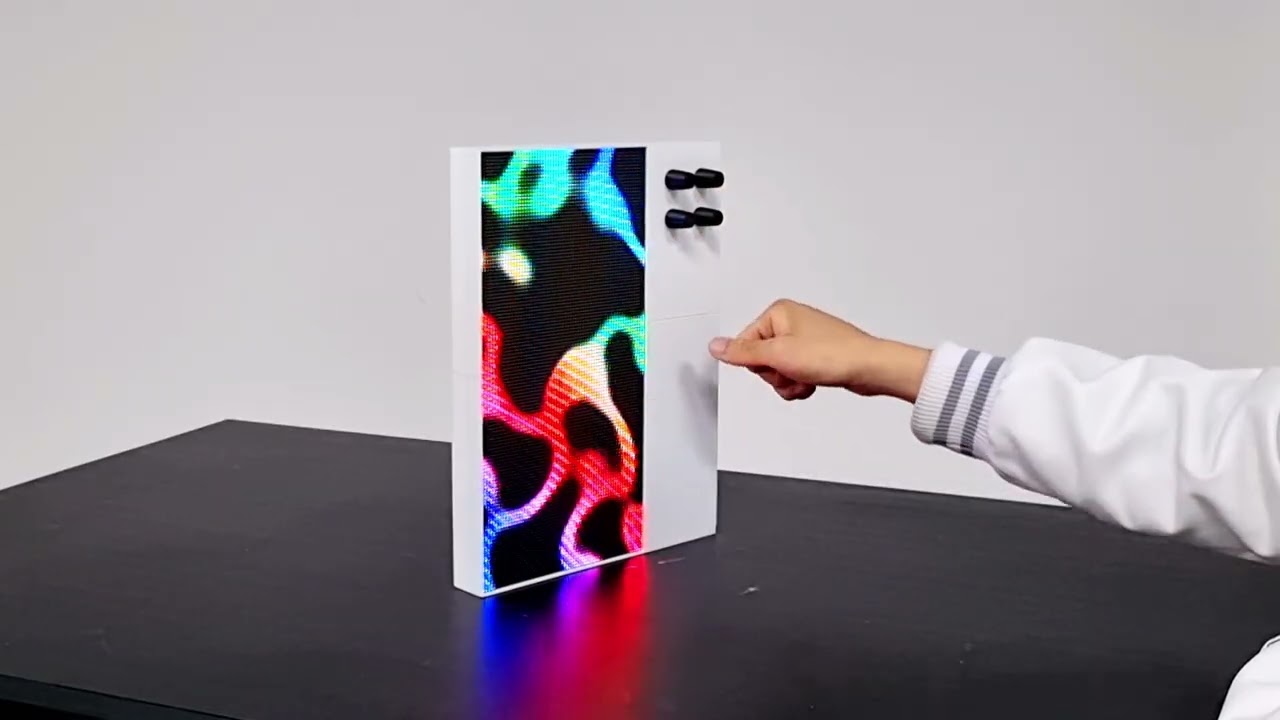
Patternflow is an open-source LED synthesizer. Play light patterns with your fingertips — four physical knobs reshape generative light on an LED matrix in real time. A pattern is just a small file, so every Patternflow plays every pattern we make.
- 🔨 Build it — the Full Build Guide (official PCB + 3D-printed enclosure), or solder-free with the Breadboard Build Guide. Every other route is in the Assembly Map. Never soldered before? You'll be fine — it's all big through-hole joints, every first-timer who has built one finished it without trouble, and most of them came back saying the soldering was the fun part. One build on the map was its maker's first-ever soldering job.
- 📦 Get one ready-made — the Crowd Supply campaign launches Q4 2026. Subscribe on the page and you'll hear the moment it opens.
- 🎛️ Try it right now — the Live Editor is a working Patternflow in your browser. No hardware, no install, no account.
- 🌀 Share what you make — the Community is where patterns get published, remixed and forked. The Pattern Guide walks the whole loop: make a pattern, verify it on your device, share it back.
Moving fast. v3.3.0 is out — the panel's color is tunable while you look at it, and ramps interpolate in OKLab instead of collapsing to grey. v3.2.0 made patterns install over Wi-Fi as
.pfmmodules, no reflash. The v3 generation also brought hybrid USB-C / screw-terminal power, zero SMD passives, a snap-fit enclosure, and a video-first build guide. On v2.x hardware? Everything you need stays bundled at v2.1.0. Follow the changelog and the journal for what's current.
Hardware, website, community, and where people actually talk — the whole ecosystem on one napkin:

| Display | 128 × 64 HUB75 RGB LED matrix, P2.5 (320 × 160 mm) |
| Brain | ESP32-S3-WROOM-1 N16R8 (16 MB flash, 8 MB PSRAM) — standalone, no sending card |
| Input | 4× EC11 rotary encoders with push-switch; long-press encoder 4 to switch patterns |
| Power | 5 V over USB from any power bank — about 4 h per 10,000 mAh at max brightness (see runtime) |
| Size / weight | 245 × 325 × 36 mm (9.6 × 12.8 × 1.4 in) · 933 g (2.06 lb) |
| Firmware | Arduino-compatible C++, modular pattern architecture, runtime switching (no reflash) |
| Flashing | Everything from the browser — one USB flash the first time, then it's all Wi-Fi: patterns install as modules in seconds, full firmware builds land wirelessly too. Arduino IDE only for firmware development or other matrix resolutions |
| Connectivity | Wi-Fi — bidirectional OSC (Ableton/Max/TouchDesigner), MQTT, and audio-react WebSocket · USB |
| Build | ~1 h hands-on (≈30 min soldering + ≈30 min assembly — first-build friendly) + ~10 h 3D printing · US$100–200 in parts (BOM) |
| License | MIT (firmware & web code) · CC-BY-SA 4.0 (hardware, docs, bundled patterns) · community patterns are licensed by their authors (summary) |
Patternflow runs off any standard USB power bank that can supply a couple of amps at 5 V — no wall adapter needed, so it stays portable. Rule of thumb: about 4 hours per 10,000 mAh at maximum brightness, and most patterns draw less.
Measured runtimes
In testing, a 40,000 mAh bank dropped about 13% over 2 hours at full brightness, which is roughly 15 hours on a full charge:
| Power bank | Approx. runtime (max brightness) |
|---|---|
| 10,000 mAh | ~4 hours |
| 20,000 mAh | ~8 hours |
| 40,000 mAh | ~15 hours |
These are worst-case numbers measured with a bright pattern at maximum brightness. Lowering the brightness (long-press encoder 1) extends runtime well beyond these figures.
The Live Editor opens with a preset library of 42 patterns — months of daily pattern-making, each loadable in one click and remixable right in the browser. The stock firmware flashes to the device straight from the browser; your own remixes travel through Pattern Lab and land on the device as Wi-Fi modules (see below).
On the device, patterns live on the filesystem rather than inside the program. The firmware compiles in Origin alone, as the failsafe a board can always boot into, and everything else installs as .pfm modules over Wi-Fi — up to 128 of them, no reflash needed. Keeping the set out of the image is what freed the internal memory the rest of the firmware needed, and it means adding a pattern never costs a firmware update.
A new board is therefore nearly empty, so a set ships with it: the Basics pack, 33 patterns, at the top of the decks shelf. One click installs the lot — no account and no build queue. Drop the .zip on your board's Patterns page yourself if you'd rather, and any deck someone publishes installs the same way.
- It boots into Origin — concentric sine waves sampled by an emergent grid.
- Long-press encoder 4 to cycle through the patterns on the device.
patternflow.work is not a companion page — it's half the instrument. The whole journey from idea to hardware runs in the browser, no toolchain: prompt templates designed for AI coding assistants (Claude, ChatGPT, Gemini, etc.) do the writing, you do the deciding. The Live Editor is where you start, Pattern Lab is where a pattern becomes firmware, and the Community is where it goes when it's done.

Start in the Live Editor — a full Patternflow simulator, and the quick taste. Turn the virtual knobs and the on-screen device behaves exactly like the real one, down to the encoder detents. You don't need the hardware to begin:
- Click Copy creation prompt and paste it into your AI assistant along with a description of the look you want.
- Paste the JavaScript it returns into the editor and turn the virtual knobs to test the pattern live.
The Live Editor is where you find out you want to make patterns. It stays deliberately light — the stock firmware flashes straight from it, and everything below is where the making happens.
Go deeper in Pattern Lab — the full studio, and where patterns reach the hardware:
- Generate variations in batches, in-app (bring your own free Gemini key) or via copy-paste prompts.
- Shape color ramps, retune knob ranges, and compose for custom matrix sizes — the ranges you set ride along into the device and the shared code.
- Send to your device in seconds — a pattern builds into a small
.pfmmodule on the server and installs over Wi-Fi: no cable, no reflash, no IDE. Firmware updates are their own thing now, at patternflow.work/update — a pattern never needs one. - Verify, then share — try the pattern on your own device first, then publish it with its hardware header attached. It lands on the wall wearing the
.hbadge, and the next person can flash it without thinking. The Pattern Guide covers the whole flow.
From the Arduino IDE — only needed for firmware feature development or targeting an LED matrix with a different resolution. Open firmware/patternflow/patternflow.ino, drop the C++ into presets/preset_<name>.h as-is, add the namespace to presetPatterns[] in pattern_registry.h, and flash — that compiles the pattern into the image, which is now reserved for the failsafe rather than the usual way in. (For just adding a pattern you don't need any of this — build it as a .pfm module and send it over Wi-Fi.) See firmware/patternflow/README.md.
No GLSL or rendering pipeline knowledge needed. The template handles the encoder mapping, brightness curve, and HUB75 buffer interface; you describe the visuals.
Patterns installed as .pfm modules sit on their own partition and survive any reflash — a firmware update rewrites the program and leaves your patterns, your Wi-Fi and your storage untouched. To rebuild the shipped pack from the repo's own preset sources, see firmware/toolchain/make_pack.py.

The Community is where patterns live — and the wall plays them live. Hover a card and the pattern runs; scroll on it and its knobs turn, the same four knobs as the hardware. Open one to read its code, take it into Pattern Lab to remix, and publish it back — the fork is recorded, so you can always see what grew out of what. All of this works without an account.
From the wall to your device in seconds. Collect patterns into a deck — a setlist of up to twenty — and SEND TO MY BOARD builds them into Wi-Fi modules and installs them with no cable, no reflash. Decks can be shared too: browse the sets other people curated and send one straight to your own device. Patterns carrying a hardware-verified .h header are badged, with a filter for when you want something to flash right now. The Pattern Guide walks every step.
The Workshop is where the project's future is worked out — in the open. It's a map of directions Patternflow could take — a wired OSC version, laser-cut enclosures, bigger panels — and anyone can pin themselves to a direction, say what they're working on, and start a thread. Not a roadmap handed down; a map people stand on. It's young and evolving fast, and it matters more than its size suggests: it's how this project decides where to go next.
Signing in is username and password only — no email — so it never routes through a service that might be blocked where you are.
New pattern studies also go up on Instagram almost daily, and the Discord patterns channel remains a good place to hang around and talk about them. Come for a pattern you saw on a post, stay to share your own.
Two public records show the project working — who is building, and what it costs to keep alive.

Build map — a globe of Patternflows built around the world, each pin carrying its build's story, and the goal is simple: cover it with pins. The build map is also what we means in "every pattern we make": every pin is a person who built one from these files, in their own material, wherever they are. If you've made one, share it in Discord and it goes on the map.
Journal — Patternflow is treated as art, so the whole process is documented transparently: the events, the emotions, and the thinking behind every step, written up at least once a week since the beginning. Including the parts that went badly. If you want to know why this project exists — and what it costs to keep it alive — start there.
Bidirectional OSC. Over Wi-Fi, Patternflow speaks OSC in both directions: knob turns, button presses, and pattern switches stream out to a remote host (Ableton Live, Max/MSP, TouchDesigner — anything that speaks OSC), and incoming OSC messages drive the device exactly like physical encoder motion. Play Patternflow as a controller for your set, let your set drive the light, or both at once. If you play MIDI instruments, this will feel like home. For Ableton Live Suite there's a ready-made Max for Live bridge in integrations/ableton — click Connect, map the four knobs to any Live parameters, done. The wire protocol is documented in docs/osc-spec.md.
MQTT. Patternflow also speaks MQTT, both ways, on the broker you already run. Knob turns and pattern changes publish as they happen; messages coming the other way move the knobs and switch patterns exactly as a hand on the encoder would. Two boards pointed at the same broker follow each other, which is the short version of why it exists — and it puts the device on the same bus as the rest of a home or venue setup, so Home Assistant, Node-RED or a lighting desk can drive it without anything Patternflow-specific in the middle. Point it at a broker on the device's own MQTT page; a pattern can be addressed by name or by slug. Contributed by @SimonePDA (Simone Majocchi), along with the browser-side zip unpacking that makes pattern packs install in one click.
Audio-react. Patternflow can also react to browser audio: the experimental Chrome/Edge extension in tools/patternflow-audio-extension captures the current tab's audio, analyzes four FFT bands, and sends lightweight WebSocket knob values to the device. The firmware converts those into virtual encoder motion, so every encoder-driven pattern responds — no audio code needed in the patterns themselves.
Patternflow is built around a standalone ESP32-S3 driving a HUB75 RGB LED matrix at low resolution — each pixel reads as a discrete point of light, with its own brightness and color. Four rotary encoders feed firmware written in Arduino-compatible C++ around a modular pattern architecture: each pattern is a self-contained module with its own setup, update, and draw routines, while the shared framework handles input, LED rendering, mode transitions, and color calibration. The PCB was designed by the artist; the enclosure is 3D-printed by default, with stainless steel, transparent acrylic, and laser-cut variations in progress.
Make it easy. Make it fun. Make it yours. Interactive media art usually demands serious capital, custom engineering, and years of specialized skill — an entry fee paid long before anyone gets to participate in anything. Patternflow removes it: the hardware files, firmware, 3D models, browser editor, and AI prompts are all public, so anyone can build their own, make their own patterns, test them in the browser, and load them onto the device.
This is a contemporary reinterpretation of Nam June Paik's Participation TV (1963). Paik let the audience change the image; Patternflow lets you make it — and give it away. That is the step after participation: from intervening in a work to making, modifying, and sharing it.

The device is instrument no. 1 of a longer practice — a lab for interactive visual patterns. The same pattern that runs on a hand-built device can run on a bigger panel, a laser-cut variant, an installation wall: the same pattern, any surface. Solid lines exist today; the dashed ones are directions, drawn in the open on the Workshop.
So Patternflow is not a single luminous object. It is a living system in which a physical experience extends outward into open-source making and community creation. We're not making art easier to watch. We're making it easier to make. The longer version lives in the manifesto and the journal.
| Folder | Contents |
|---|---|
firmware/ |
Arduino code for ESP32-S3, the custom pattern template, and the toolchain that builds patterns into .pfm modules and packs |
hardware/ |
Enclosure files and electronics source files (case, PCB, Gerbers, schematic PDF) |
web/ |
Next.js site (landing, Live Editor, Pattern Lab, community, browser flasher & build server, journal) |
docs/ |
Assembly map, build-guide media, manifesto, license summary |
tools/ |
Desktop-side helpers, including the audio-react browser extension |
integrations/ |
Host-software bridges — Ableton Live / Max for Live (OSC knob mapping) |
Docs: Full Build Guide · Pattern Guide · Assembly Map · Custom Patterns · Changelog · License Summary
Links: patternflow.work · Community · Crowd Supply · Releases · Discord · Instagram
Builds, documentation fixes, part sourcing tips, and custom patterns are all welcome — see CONTRIBUTING.md for how contributions flow (including the inbound = outbound pattern licensing).
Patterns go to the Community, builds and questions to Discussions or the Discord — whichever you can reach. Show a build in Discussions or Discord to get it pinned on the build map.
| When | Milestone |
|---|---|
| Jan 2026 | Patternflow: Origin — the first work as a new media artist, built around 3D-printed forms and the seed of what became Patternflow · visited the Nam June Paik Art Center |
| Mar 2026 | The Origin pattern ran on a physical LED matrix with four knobs for the first time |
| Apr 2026 | Instagram and the Arduino subreddit responded strongly — 150,000+ views and 3,700 upvotes — and the community asked for the files, not a product, so Patternflow went open source · first PCB fabricated (sponsored by PCBWay) · website live |
| May 2026 | Reached 100 GitHub stars · the first collaborator joined · Crowd Supply agreement · Discord community growing |
| Jun 2026 | Crowd Supply pre-launch page live, backed by countless refinements toward mass production · Instagram passed 1,000 followers · first community-made pattern shared |
| Jul 2026 | Refining the design for mass production · growing an active community · outreach and promotion |
| Aug 2026 | Community rebuilt end to end — the live wall, decks, and the Workshop — patterns now install as Wi-Fi modules, and the Pattern Guide documents the whole loop · Crowd Supply launch prep in full swing |
| Next | Launch the Crowd Supply campaign (Q4 2026) at the lowest sustainable price · send Patternflow further out into the world · collaborate with more artists · earn academic recognition |
| 2028 | Grow Patternflow into a self-sustaining community and ecosystem — then move on to the next project |
📖 Longer write-ups and the full story behind each step live on the journal.

Patternflow's PCB fabrication and 3D-printed enclosure are sponsored by PCBWay. The first PCB came back clean and on-spec, ordering was straightforward, and the team has been genuinely responsive throughout — the support that made these milestones possible.

The first Patternflow PCB, fabricated by PCBWay.
The SPDX header inside a file is the authority — folders are not license boundaries. Full breakdown in the License Summary.
- Firmware & web code — MIT (LICENSE-MIT)
- Hardware, designs & docs — CC-BY-SA 4.0 (LICENSE-CC-BY-SA)
- Bundled patterns (the presets shipped in the firmware and the editor) — CC-BY-SA 4.0, per-file SPDX headers.
- Patterns contributed to the repository — inbound = outbound: by sending a pattern as a PR, issue or Discord post you license it under CC-BY-SA 4.0, attribution kept in the code header (no CLA). See CONTRIBUTING.md.
- Patterns published to the Community — licensed by their author, either CC-BY-SA 4.0 (default) or CC-BY-4.0. Both permit commercial use with credit; CC-BY-SA additionally requires adaptations to stay under the same license. A fork can never be looser than what it came from, and carries a
Based on:credit to the original author in its source.
"Patternflow" is a trademark of SeungHun Lee.
The Patternflow series: LED Synthesizer (2026) · Origin (2026)