This is the performance test of Arion Agent working with ebpf/XDP as downstream programming module and ArionMaster grpc streaming server as upstream metadata source as an entire system.
This test is between 2 machines of the same lab, they don't belong to the same IP range (means not located on the same rack but same data center):
1. Arion master server

2. Arion agent (launched on the same machine of Arion Wing which is XDP as gateway network functionality)
-
Arion Master - For 100 gateway nodes cluster
- Single-digit us watch latency per state
- Average 0.3 ms remotely get latency per neighbor
- Average 1 ms write latency per neighbor
-
Arion Agent List/Get data latency (data were already in DB)
- Start time – when ArionWing calls server for getting/listing neighbor updates (from scratch, or from a specific revision)
- End time – when ArionWing gets and finish all neighbors programming in ebpf
- Less than 20us E2E latency (watch + eBPF programming) per state for small sized configuration (1 < state size < 100)
- Less than 10us E2E latency per state for medium to large sized configuration (100 < state size < 1 million)
E2E programming (list batch data + programming) latency:
- 1 neighbor
- overall latency 15us
- per neighbor latency 15us
- 5 neighbors
- overall latency 61us
- per neighbor latency 12.2us
- 100 neighbors
- overall latency 1004us = 1ms
- per neighbor latency 10us
- 500 neighbors
- overall latency 4803us = 4.8ms
- per neighbor latency 9.6us
- 1k neighbors
- overall latency 9.5ms
- per neighbor latency 9.5us
- 5k neighbors
- overall latency 49.1ms
- per neighbor latency 9.8us
- 10k neighbors
- overall latency 93.6ms
- per neighbor latency 9.36us
- 50k neighbors
- overall latency 354.1ms
- per neighbor latency 7.08us
- 100k neighbors
- overall latency 601.4ms (and if we compare with the watch only 100k neighbors latency of 380ms, we know the overhead of 100k ebpf rule programming is 220ms)
- per neighbor latency 6.01us
- 500k neighbors
- overall latency 2924.6ms = 2.9 seconds
- per neighbor latency 5.85us
- 1 million neighbors
- overall latency 5,893 ms = 5.9 seconds
- per neighbor latency 5.89us
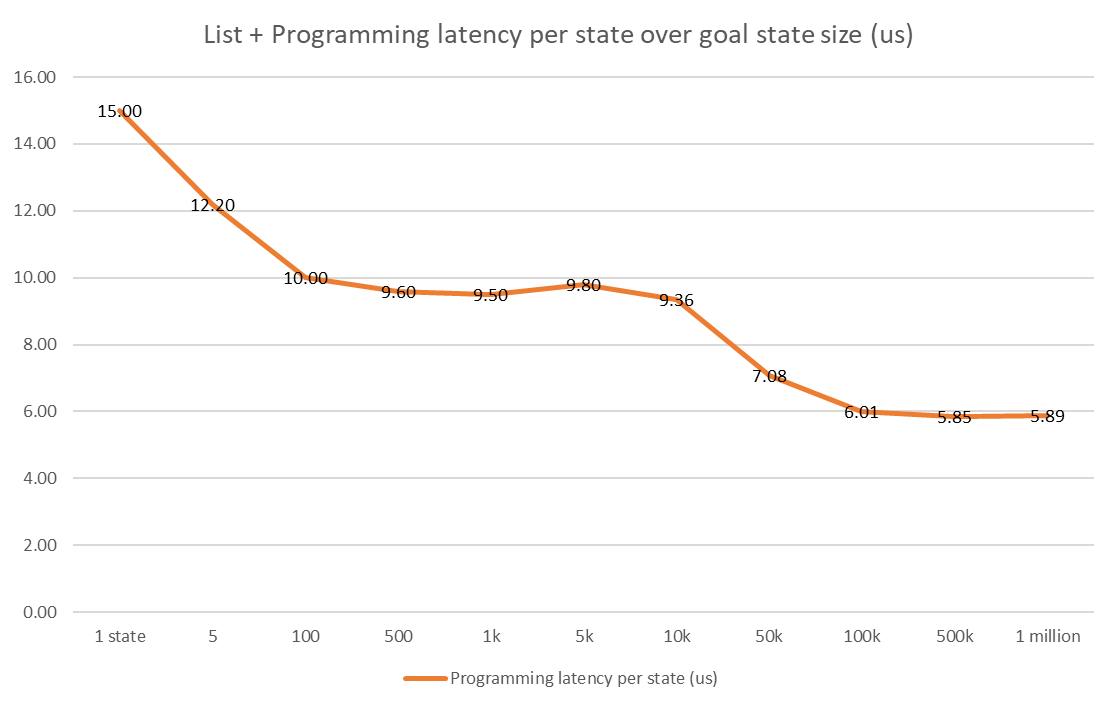
As we can see, over the increasing goal-state sizes (in one version of update) the latency for each state was lowered, due to the saved/shared gRPC communication overhead across all goal-states.
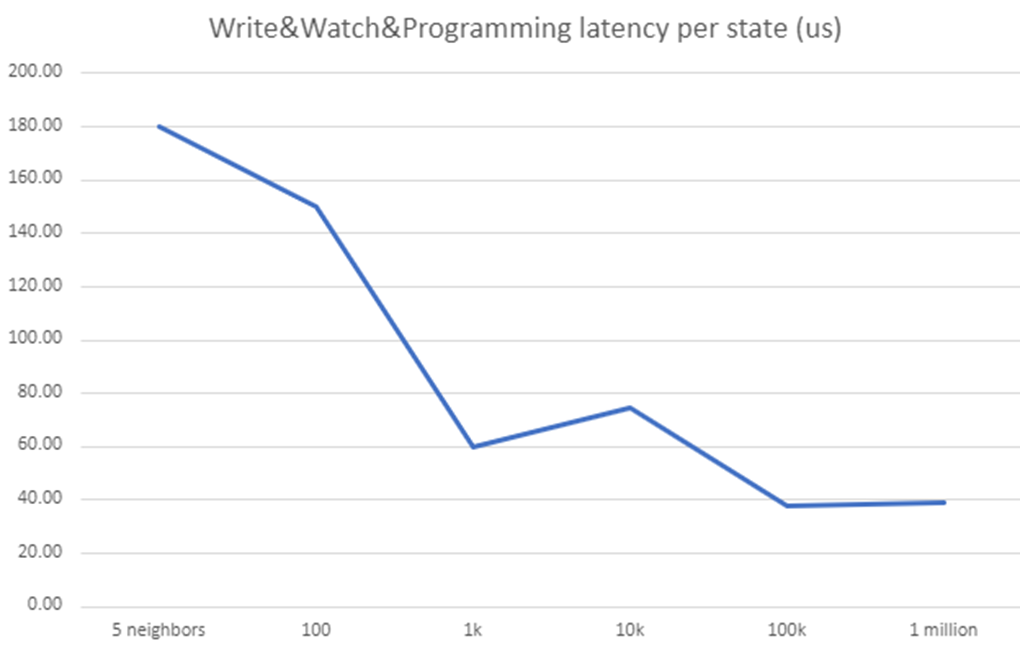
Arion CP performance test scenario #2 - User update neighbors to server to gateway programming E2E latency
- Arion Agent Watch Latency (user simultaneously updates neighbors to server/DB)
- Start time – when the 1st neighbor insert/update (to server aka. ArionMaster) is called by user
- End time – when the Nth neighbor (last in this update) is programmed in Arion Wing ebpf, means all neighbors are programmed on gateway node
- Average 1 ms write latency per neighbor
E2E programming (write to server db + watch + programming) latency:
- 5 neighbors
- overall 0.9ms
- per neighbor latency 180us
- 100 neighbors
- overall 15ms
- per neighbor latency 150us
- 1k neighbors
- overall 60ms
- per neighbor latency 60us
- 10k neighbors
- overall 748ms
- per neighbor latency 74.8us
- 100k neighbors
- overall 3.8s
- per neighbor latency 38us
- 1 million neighbors
- overall 0.9ms
- per neighbor latency 39us