-
An engineering approach focused on decomposing applications into single-function modules with **well-defined ** interface which are independently deployed and operated by small teams who own the entire lifecycle of the service.
-
It accelerate delivery by minimizing communication and coordination between people while reducing the scope and risk of change.
-
Similar to concept of file as in Linux kernel Development. Every thing is a file.
-
These services are independent and do not rely on each other.
-
Based on the idea of distributed system
Well defined Interface imply the service should define it's construct i.e what type of input and output the microservice operates on.
Entire lifecycle is governed and operated by the same team thus faster debugging and testing unlike traditional separate team which has to start from learning and then testing.
Minimizing Communication imply reduces complex team with larger count by dividing up into small team which only interact when the decide common ground for interface to interact.
Each Microservices are under constant development and each service may have difference versions running unlike monolithic architecture where entire application has only one version.
A Microservices is a throwaway thing, an instance is created when it's required and may be destroyed when not needed anymore.
- Thus allowing us to reduce cost both computational and financially since microservices are deployed in cloud and destroying / scaling down microservices reduces cost.
- Scaling down or up is independent to other and without user intervention.
Advantage
-
The microservice architecture makes it easier to scale development.
-
The microservice architecture also improves fault isolation.
- For example, a memory leak in one service only affects that service. Other services will continue to handle requests normally.
- In comparison, one misbehaving component of a monolithic architecture will bring down the entire system.
-
Last but not least, the microservice architecture **eliminates any long-term commitment to a technology stack. **
-
In principle, when developing a new service the developers are free to pick whatever language and frameworks are best suited for that service.
-
Of course, in many organizations it makes sense to restrict the choices but the key point is that you aren’t constrained by past decisions.
-
Moreover, because the services are small, it becomes practical to rewrite them using better languages and technologies.
-
Drawbacks
- First distributed system must be carefully planned.
- It increases operational complexity since there are too many moving parts which involve careful co-ordination .
Communication between Microservices
-
In monolithic architecture, the program for ex web application interacts via standard HTTP request but in microservices interact via REST HTTP request.
-
Even for a simple application it may require 100s of call to microservices which may prove inefficient resulting in poor experience.
- Amazon.com, for example, describes how some pages require calls to 100+ services.
-
A much better approach is for clients to make a small number of requests per-page, perhaps as few as one, over the Internet to a front-end server known as an API gateway,
-
The API gateway sits between the application’s clients and the microservices. It provides APIs that are tailored to the client.
- In this example, the desktop clients makes multiple requests to retrieve information about a product, where as a mobile client makes a single request.
Inter-service communication mechanisms
- In a monolithic application, components call one another via regular method calls.
- But in a microservice architecture, different services run in different processes. Consequently, services must use an inter-process communication (IPC) to communicate.
- A consequence of decomposing the application into services is that the database is also partitioned. To ensure loose coupling, each service has its own database (schema).
-
Several components of deploying a code
-
- Business Logic or Application
-
- The code and the data execute in a runtime environment, which contains the state required by program execution as well as object instances used to execute the services required by the program.
-
Middleware
- Software that mediate between runtime and the OS.
- Ex. Webservers
-
O/S
- Software that links computer hardware .
-
Visualization
- The use of software simulation of software or hardware or storage.
- Used to run multiple instant of O/S on same hardware.
-
- Access services to the all the network.
-
Networking
- Firewalls,load balancing
-
| Stack Form |
|---|
| Code |
| Data |
| Runtime |
| Middleware |
| O/S |
| Visualization |
| Server |
| Storage |
| Networking |
- Traditional IT will manage all the component.
- Called as On premise IT
- Requires weeks to deploy the application as dedicated staff and and resource are needed.
- The cloud service provider will manage the
- Visualization
- Servers
- Storage
- Networking
- This will still take days to deploy since Middleware O/S up-gradation is client's responsibility.
-
The cloud provider along with Iaas will manage
- Runtime
- Middleware
- O/S
-
Faster Deployment but less control to the development environment.
-
Vendor Manages everything.
-
Components in Saas
- Code
- Data
-
Instead, the applications reside on a remote cloud network accessed through the web or an API. Through the application, users can store and analyze data and collaborate on projects.
-
Users do not have to manage, install or upgrade software; SaaS providers manage this.
- The continuous changes in software must be deployed quickly and continuously integrated i.e referred as CI/CD
- It is an automatic process.
- Performed by DevOps.
- CD uses a technique call blue-green technique which takes the application offline for upgrades and then back online.
- When a new upgrade takes place then all the new users for that services are re-routed to new upgrade whereas the existing user are still services with the older micro-services.
- Once there is no more user using old service then it is removed from production.
- When microservices stop working due to some issues it's may return incorrect or no result to the client.
- In order to identify and monitor it all the request must pass through **circuit breakers ** which handle the client request and route to microservices.
- If the microservices fail then the circuit breaker will inform the client and will take appropriate action.
| Client | Circuit Breaker | Microservices |
|---|
- Microservice architectures will use libraries, but their primary way of componentizing their own software is by breaking down into services.
- We define libraries as components that are linked into a program and called using in-memory function calls, while services are out-of-process components who communicate with a mechanism such as a web service request, or remote procedure call.
- (This is a different concept to that of a service object in many OO programs .)
- One main reason for using services as components (rather than libraries) is that services are independently deployable.
- If you have an application that consists of a multiple libraries in a single process, a change to any single component results in having to redeploy the entire application.
- But if that application is decomposed into multiple services, you can expect many single service changes to only require that service to be redeployed.
A microservice should have a single responsibility.
- Microservice should take a “share nothing” philosophy. This applies to implementation as well as its data.
- If a microservice is relying on a shared library for it’s functionality, that becomes harder to enforce. These libraries can be in the form of domain specific business login not common utilities.
- Moreover a microservice may defer in functionality from other in case if it write intensive or read only thus having different database will increase modularity .
-
- If client want to interact with microservices directly then it must know the URL of the microservice.
- But since in cloud microservices are under constant development as a result keeping track of there address is difficult.
-
Thus mobile client communicate with microservices with the help of **API GATEWAY** - API GATEWAY is an server that act as a API front-end .
- It passes the request to the appropriate service at the back-end and then passes the response back to the requester.
- API GATEWAY allows to modify the request which allow to implement security policies and other throttling.
- It must be less changes than individual microservices.
Communication b/w services can be synchronous ( HTTP ) as REST or as asynchronous communication.
-
In asynchronous communication is preferred as request and response queue is used where the request & response is stored .
-
More preferable as failure at any end does not need to start the communication again.
- Specify how microservices to locate each other and communicate.
- Since multiple instances of microservices can be present in the cloud. Some microservices may be dead or broken or failed .
- Requester needs to find the instance of service to communicate which it is not failed.
- To Find this microservices use registry of instances which keeps record of all the instances of the microservices there status and the requester request is passed through registry.
- When microservices instance is created it may try to register itself directly or through other microservice known as third party registration.
- The instance which has failed is being flagged in the registry. This means that a reference to that instance will not be handed back in response to a request.
- If the requested microservice is running then it's instance is returned to the requester.
-
Traditional Software were written in monolithic architecture i.e
-
- Ex. Send rocket to moon,airplane
-
Single Autonomous Unit
-
They are still essential when application are written for environment and run on local computer.
-
Disadvantage
-
- A modification made to a small section of code might require building and deploying an entirely new version of software.
- Scaling specific functions of an application, also means you have to scale the entire application.
-
-
Monolith application can be divided into model view controller.
-
MVC architecture is based upon monolith.
| Monolithic Architecture |
|---|
| Services ( Model View Controller ) |
| Repositories |
Conversion of monolithic architecture to microservice can be done by splitting the model view controller into different entities.
Challenges in microservices
-
The complexity does not goes away.
-
Complexities shift to operational environment as
- services needs to deploy,text and manage many inter-acting services.
- check for service fails
-
Monolithic in comparision is less complex
- Location of resources are **well known and relatively static **.
- Monolithic applications are upgraded as a single unit.
- Deployment involves fewer monothilic code segments.
- They tend to have single database and hard coded configuration file in well known location.
-
Microsevices complexity shifts to operational environment
- Required services could be in different clouds such as public or private cloud , VMs , containers, or servers.
- Operational environment is dynamic in nature as it has to work with dynamic number of instances.
- Thus it does not have traditional configuration files.
- Easily upgraded.
-
Challenges of Microservices
- How to find the service I need?
- Which instance do I use if there are multiple instances?
- How does the failure of one service affect other instances of the same service?
- How does the failure of one service affect other related services?
- Extra Complexity of creating a distributed systems
- Network Latency
- As more services/instances are launched network latency might become an issue.
- Fault tolerance
- Hardware failure will happen so fault tolerance is needed.
- Message Serialization
- Ex. difficult to orchestrate a distributed transaction which requires managing correlations IDs and parallelism.
- Maintaining availability and consistency with partition data.
- Network Latency
- How to find the service I need?
Distributed systems are an order of magnitude more difficult to develop and test against, so again the bar is raised vs building that unsexy monolithic application.
-
- Ability to deploy server in hours i.e Cloud Computing.
- Requires a lot of automation or full automation.
-
- As the number of loosely coupled microservices increase they must be constanly monitored for fault, latency..etc
-
- Quikly deploy microservices both in test and production environment.
- Deployment-Pipeline is required.
- Microservices belong in a DevOps environment.
- Based on lean and Agile Principles.
| Customer | Agile | Development | DevOps | Operations |
|---|---|---|---|---|
| Linked | Linked |
- Required For Continous Integration , Continuous Delivery, Continuous Deployment (CI/CD/CD).
- A culture of delivering a small, well designed, high quality,increment of software to customers.
- Creating a packaged builds of the latest code changes as soon as they they're available.
- Release as immutable images. Immutable means that the images are not patched in operation environment. If any modifications are needed, the entire components is replaced with an upgraded version.
- Frequent perform of operations like
- Development
- Source Code Management
- Build ( to compile and make binaries )
- Packaged Repository ( contains builds and other assests )
- Progressing each new packaged build through the deployment lifecycle stages as rapidly as possible.
- Must have automated tools for deploys.
- Stages include
- Packaged Repo
- Deploy
- Test
- Stage (Perform Integration Testing)
- Production ( Make Build available to the user.)
Continuous Delivery is achieved through combination of Continuous Deployment and Continuous Integeration.(CI/CD)
- It's an automated sequence of steps to perform continous delivery.
- Deployment pipelines are a central part of ContinuousDelivery.
- A deployment pipeline is a way to deal with this by breaking up your build into stages. Each stage provides increasing confidence, usually at the cost of extra time.
- It Enables faster feedback.
- Stages
- First Stage :
- compilation and providing binaries for the later stages.
- Later stages :
- Automatic or manual testing.
- Final Stage :
- Deploying into production.
- First Stage :
- More broadly the deployment pipeline's job is to detect any changes that will lead to problems in production.
- These can include performance, security, or usability issues.
- Deloying the new version of the application to replace the older version incurring a service outage.
- Application is always available, first the old verison and then the new version.
- User should not experience an outage or downtime.
- Also known as BLUE GREEN DEPLOYMENT.
- The term service mesh is often used to describe the **network of microservices ** that make up the applications, and the interactions between them.
- As a service mesh grows in size and complexity, it can become harder to understand and manage.
- Its requirements can include discovery, load balancing, failure recovery, metrics and monitoring, and often more complex operational requirements such as A/B testing, canary releases, rate limiting, access control, and end-to-end authentication.
- Ex. Istio, Netflix OSS
-
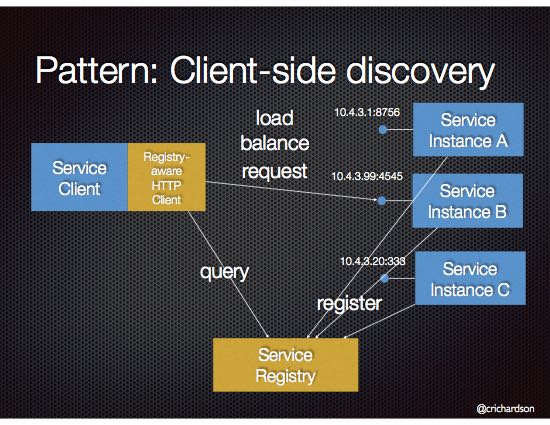
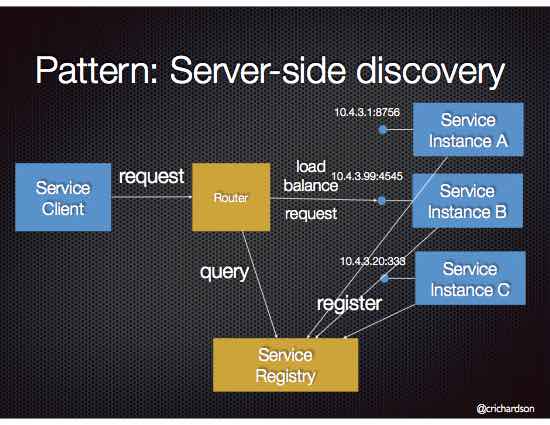
- Used for **finding the service, to checks if that service is up and running **.
- It allows to choose between different instances as direct interaction with the services is not possible due to their constant change in locations and count.
- Service registry assign service when requested.
- To detect failure each service reports their status after fixed interval of time to service registry also known as heart beat.
- If a service failed to report then it is not assigned.
- Also holds location of service.
-
-
Uses Service Registry.
-
As there are many instance of the same service, choosing among them can be done through two ways
-
The main reason for two approach is Load balancing.
-
Server-side -> load balancing.
-
Client-side has to interact with service registry to make the decision whereas the server side load balancing by decouples the service registry from the client.
- Ex:
- AWS Elastic Load Balancer (ELB) : server side discovery.
- Netflix OSS : client side discovery
-
-
- If the needed microservice isn't available then it must be handled to prevent wider performance impact if requested by too many client result in traffic jam.
- Circuit breaker is used and it sends service message so the service can move on and find a new working instance.
- Ex. After a threshold request is reached i.e even after these request the service is not available then the circuit breaker trips and send message without calling the service for the current and all the new request.

-
- It is used for isolating failures.
- Like ships hull which contains several bulkheads so that even if one is flooded damage is limited and not cause entire ship to sinking.
- Ex: if single connection pool is used to connect all the other system records then it's failure result in blocking all the connection whereas in bulkheads approach multiple connection pools are used to minimize risk and the services are still available though in part.

- Large monolithics are broken down into many small services
- Each service runs in it's own process
- The applicable cloud rule is on service per container.
- Services are optimized for a single function
- There is only one buisness function per service.
- Communication via REST API and message brokers
- Avoid tight coupling introduced by communication through a database
- Per service continuous integration and continuous deployment
- Services evolve at different rates
-
Intially identify decomposable services and adopt microservices strategy at the begining.
- But this does not help in keeping track record.
- Additional Cost and complexities as why pay the premium until you know that you need it.
-
Start with monothilic and then break it into microservices.
- Each REST services is potentially a microservice.
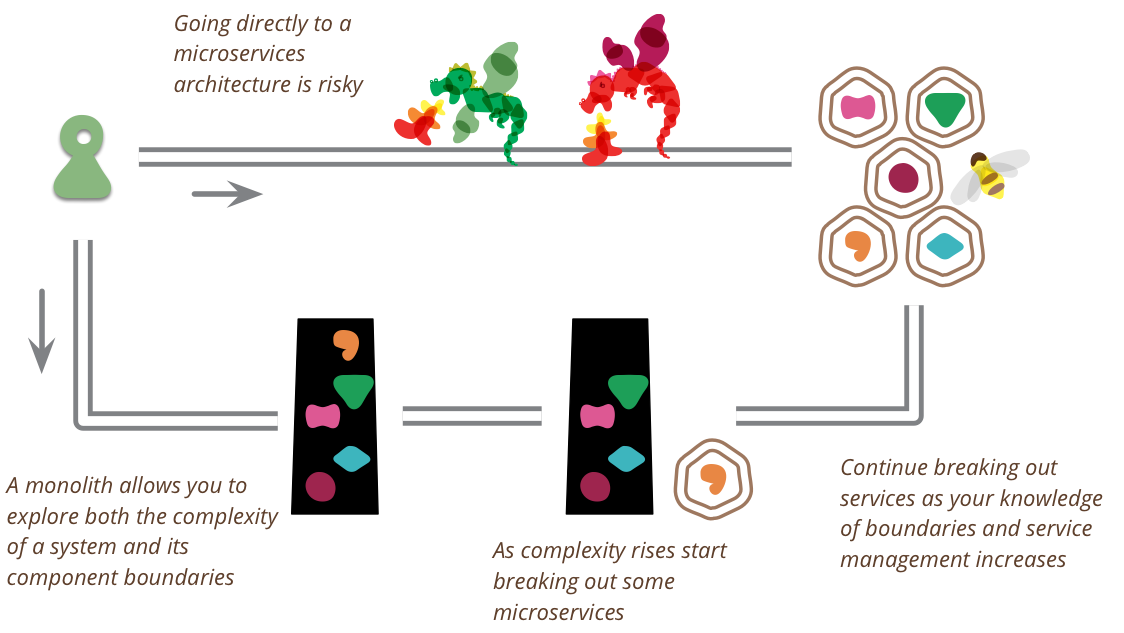
- A more common approach is to start with a monolith and gradually peel off microservices at the edges. Such an approach can leave a substantial monolith at the heart of the microservices architecture, but with most new development occurring in the microservices while the monolith is relatively quiescent.
- Another common approach is to just replace the monolith entirely. Few people look at this as an approach to be proud of, yet there are advantages to building a monolith as a SacrificialArchitecture. Don't be afraid of building a monolith that you will discard, particularly if a monolith can get you to market quickly.
