
1⃣ The most common mistake when someone tries to solve a programming problem is they try to start writing code ASAP.
make sure to take enough time to think before starting code.
2⃣️ Another mistake is trying to solve all the problems the first time.
Just broke the big problem into pieces (small problems).
- Read the problem completely twice
most important step
- Solve the problem manually with 3 sets of sample data.
- Optimize the manual steps.
- Write the manual steps as comments or pseudo-code.
- Replace the comments or pseudo-code with real code.
- Optimize the real code.
- 70% of our time should be spent in steps >>>(1-3)

- Because it’s the more effective way for problem-solving.
-
The best way involves : a) having a framework and b) practicing it.
-
Here are the steps:
- Understand
- Most hard problems are hard because you don’t understand them.
- When you can explain the problem in plain, you understood it.
- you should write down your problem, doodle a diagram, or tell someone else about it.
- Plan
- 'In programming, this means don’t start hacking straight away. Give your brain time to analyze the problem and process the information'
- Divide
- it's important step
- break (one big problem) into sub-problems. These sub-problems are much easier to solve.
- If Stuck ?
-
here are three things to try when you stuck :
- Debug: Go step by step through your solution trying to find where you went wrong. (debugging)
- Reassess: Take a step back. Look at the problem from another perspective.
- Research: No matter what problem you have, someone has probably solved it. Find that person/ solution.
-
Practice to get the experience.
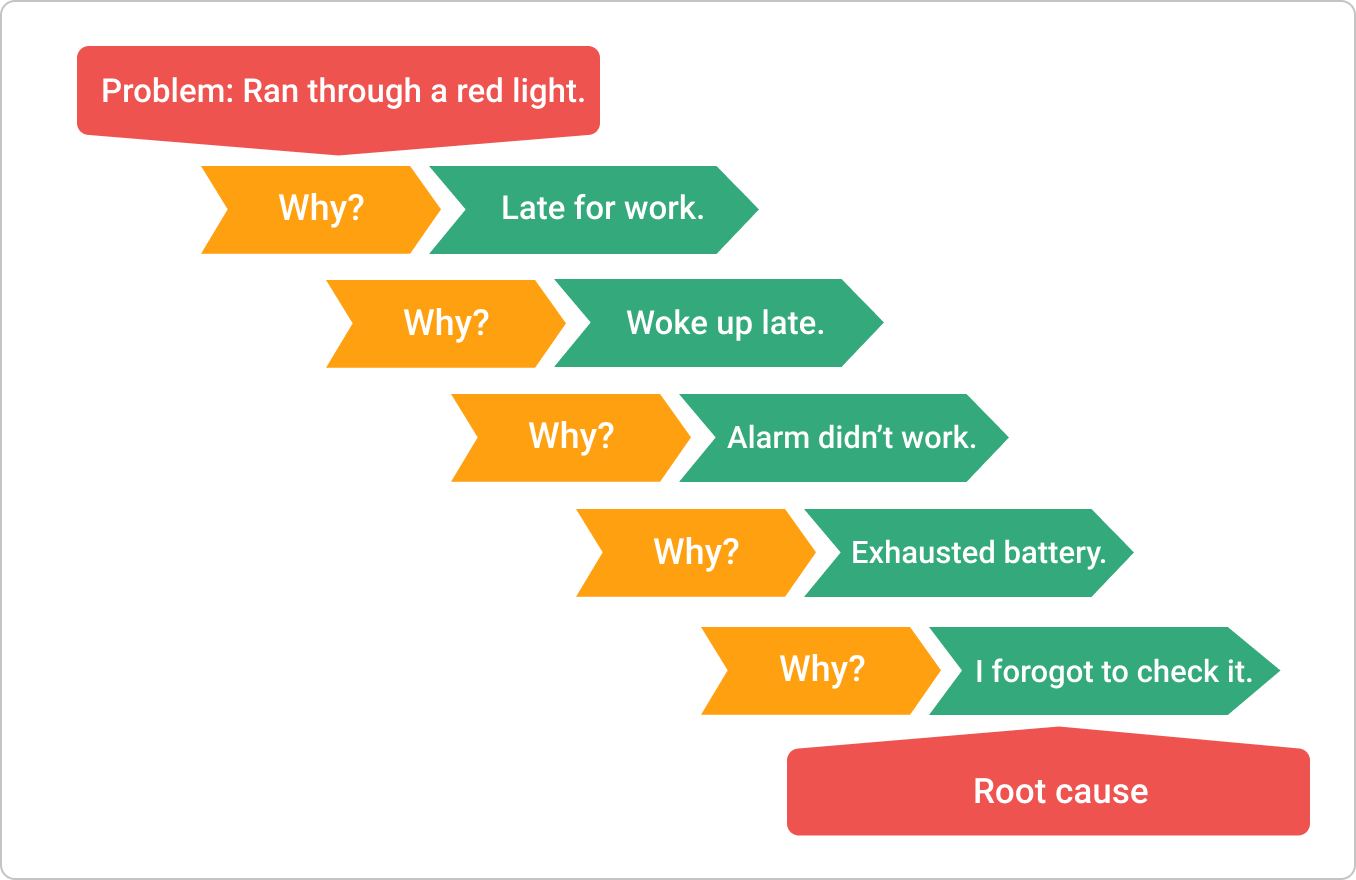
- Assemble a Team
- Include someone to act as a facilitator , who can keep the team focused on identifying effective counter-measures.
- Define the Problem
- Discuss it with your team
- write a brief
- clear problem statement that you all agree with it
- Ask the First "Why?"
- many questions (Why's)
- Ask "Why?" Four More Times
- For each of the answers that you generated in Step 3, ask four further "whys" in succession.
- Know When to Stop
- you may reach this point before you ask your fifth "Why?" If you do, make sure that you haven't stopped too soon
- The important point is to stop asking "Why?" when you stop producing useful responses.
- Address the Root Cause(s)
- you need to discuss and find the solutions for the problem.
- Monitor Your Measures
- keep watching
- 'You have very few hours here on on this earth.'
- “Being busy is a form of mental laziness.” -Tim Ferriss
It takes discipline to not become “busy.”