Home
A modern home for the 3D format the industry left behind.
MVC Blu-rays, packed stereo, MV-HEVC and ordinary 2D video — decoded honestly, rendered natively, and never asked to pretend that one eye is two.
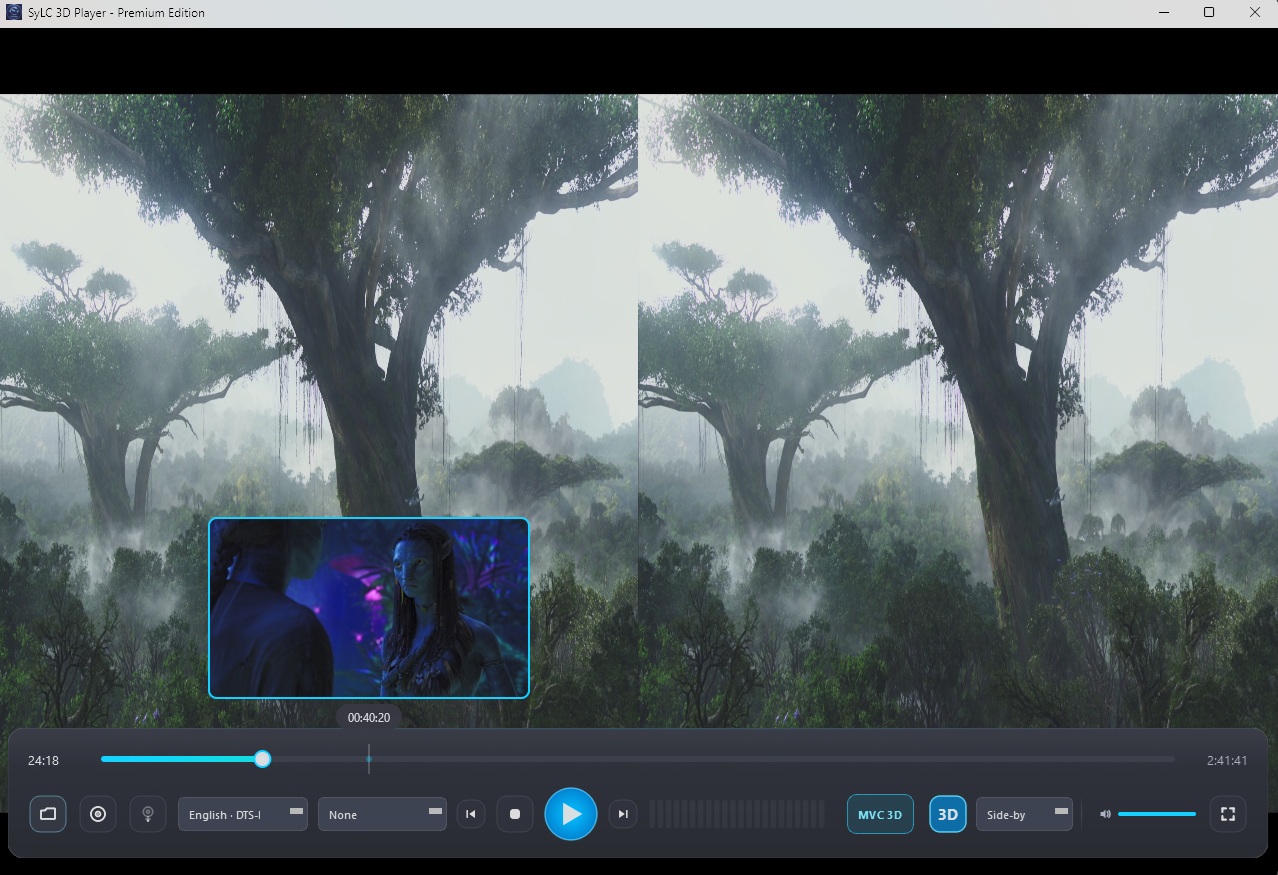
SyLC is a free, open-source stereoscopic player for Windows. It reconstructs both views of H.264/MVC content with its own decoder, handles modern HEVC and MV-HEVC sources, preserves HDR through a native Direct3D 11 renderer, and can even synthesize stereo depth from an ordinary 2D film in real time.
That is the short version. The longer version contains decoded-picture buffers, optical flow, scRGB swapchains and at least one bug caused by a Windows macro. In other words: welcome to the wiki.
| You want to… | Start here |
|---|---|
| Watch a film without first earning a degree in video compression | Getting started |
| Know whether a file is MVC, SBS, MV-HEVC or merely wearing a suspicious trench coat | Media formats and 3D modes |
| Open a disc, BDMV folder or ISO — or rescue one before the optical drive develops opinions | Blu-ray, ISO and disc archiving |
| Turn a flat film into live stereoscopic 3D | Real-time 2D→3D AI pipeline |
| Understand how HDR reaches the display without an SDR detour | HDR and native rendering |
| Follow a compressed frame from container bytes to two synchronized eyes | Architecture: from bits to two eyes |
Stream to a Quest or export an Apple-compatible spatial .mov
|
SyLC Cast and MV-HEVC export |
| Compile the decoder, native module and portable application | Building from source |
| Diagnose a stubborn source or collect a useful bug report | Troubleshooting and diagnostics |
| See what “correct” means when pixels, timing and regressions are involved | Engineering standards and validation |
“3D video” is not one format. It is an extended family that only agrees on the number of eyes.
| Source | What is stored | What SyLC does |
|---|---|---|
| H.264 MVC | A full base view plus a dependent view predicted from it | Demuxes and decodes both views in lockstep with the extended edge264 pipeline |
| MV-HEVC | Two HEVC views in one multiview bitstream | Requests both signalled views, pairs them by timestamp and sends them to the same stereo renderer |
| SBS / TAB | Both eyes packed into one ordinary frame | Detects the layout, splits the frame and preserves each eye's intended aspect |
| 2D video | One perfectly respectable eye | Plays it as 2D, or feeds the optional real-time depth pipeline when you ask for synthesis |
| Blu-ray / BDMV / ISO | Playlists, clips, metadata and sometimes interleaved MVC streams | Finds the main feature, prefers its real 3D path and falls back honestly when only 2D is available |
All of those paths eventually meet the same native renderer. This matters more than it sounds: subtitles, frame-packed output, Dual Projector, Glasses output and SyLC Cast should all see the same frame pair — not five slightly different interpretations of it.
SyLC follows a simple hierarchy:
- Keep playback alive. Optional features may fail; the film should not.
- Keep the eyes together. A plausible frame pair with mismatched timing is not valid stereo.
- Preserve the signal. HDR, colour metadata, aspect ratio and authored subtitle depth are part of the picture.
- Measure before optimizing. “The GPU looks busy” is not a timing model.
- Make the fallback visible. Silent 2D is how this whole problem started.
The result is technical software with a user-facing conscience: fast paths are native, fallbacks are deliberate, diagnostics describe the actual pipeline, and correctness gates are treated as features rather than paperwork.
- Getting started
- Media formats and 3D modes
- Blu-ray, ISO and disc archiving
- Troubleshooting and diagnostics
- Architecture: from bits to two eyes
- HDR and native rendering
- Real-time 2D→3D AI pipeline
- SyLC Cast and MV-HEVC export
Version note: the wiki explains architecture as well as released behaviour. When a detail is package-specific, the release page and its notes remain the authority. Code moves quickly; photons remain distressingly punctual.
Because 3D still matters.