





IBM SkillsBuild × AICTE Internship 2026 — Problem Statement #22
"Don't just prepare for interviews — simulate them with AI."
- About ARIA
- Demo
- Features
- Architecture
- Tech Stack
- AI Tools Used in Building ARIA
- Installation
- Deployment
- Project Structure
- Token Optimisation
- Resume Feature
ARIA (AI Readiness Interview Agent) is an intelligent conversational agent that conducts full end-to-end mock interviews for job seekers targeting top IT companies like TCS, Infosys, Wipro, Accenture, and Cognizant.
Unlike generic Q&A tools, ARIA runs a complete structured interview across three rounds, scores every answer in real-time, adapts difficulty as you progress, and hands you a personalised Final Report Card with a 7-day study roadmap — all powered by Meta Llama 3.3 70B Instruct via IBM watsonx.ai.
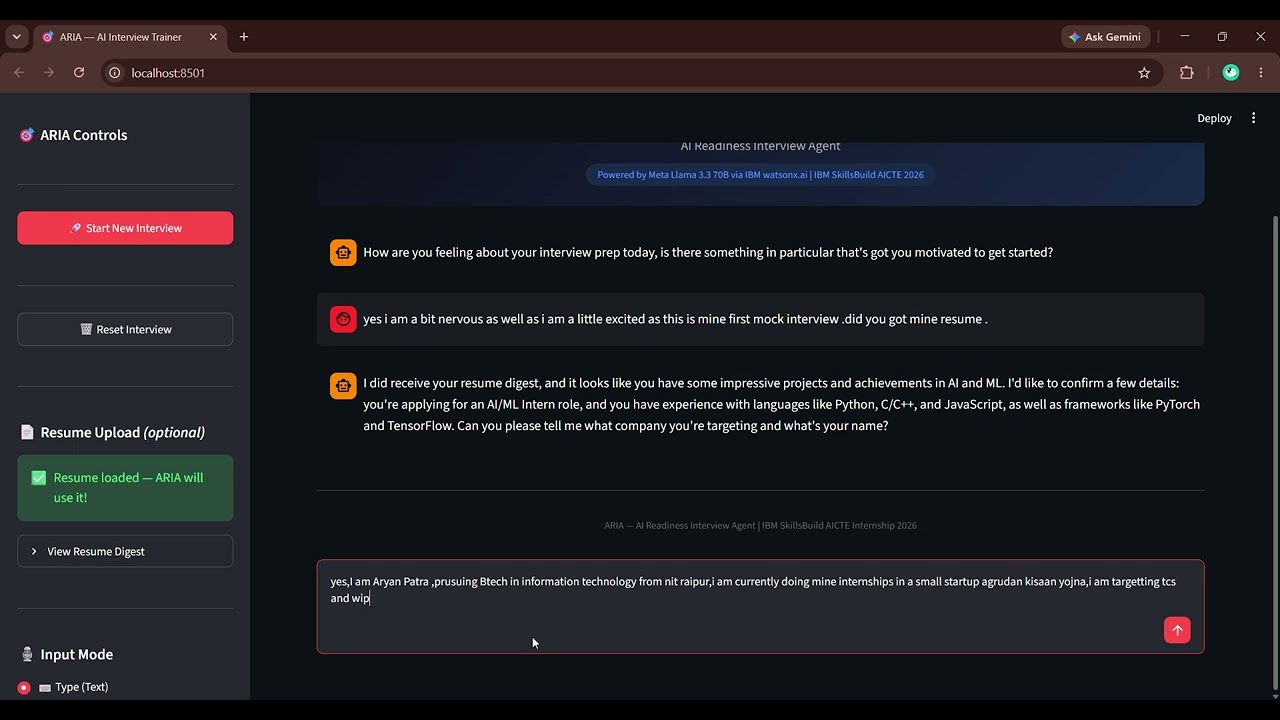
Now with Resume-Aware Interviews — upload your PDF/DOCX resume once and ARIA will ask questions directly tied to your real projects, skills, and achievements.
| Feature | Description |
|---|---|
| 🎯 Role-Based Questions | Tailored questions for any IT role and target company |
| 📄 Resume-Aware Interviews | Upload your PDF/DOCX/TXT resume — ARIA asks about your real projects, skills & achievements |
| 📊 Real-Time Evaluation | Score (X/10) + concise feedback after every answer |
| 💡 Confidence Tracking | Measures confidence growth from start to finish |
| 🔄 Adaptive Difficulty | Questions get progressively harder as you perform better |
| 🎙️ Voice Input | Speak your answers using your microphone (Chrome/Edge) |
| 📋 Final Report Card | Overall scores, top strengths, improvement areas + Resume Alignment score |
| 🗺️ 7-Day Study Roadmap | Personalised preparation plan based on your performance |
| 💬 Multi-Turn Chat | Natural conversational interview flow — no forms or dropdowns |
| 🏢 Multi-Company Support | TCS, Infosys, Wipro, Accenture, Cognizant and more |
| ⚡ Token-Optimised | Server-side session store — flat token cost regardless of interview length |
┌──────────────────────────────────────────────────────────┐
│                    User (Browser)                        │
│           Chrome / Edge  (voice input supported)         │
└─────────────────────────┬────────────────────────────────┘
                          │
┌─────────────────────────▼────────────────────────────────┐
│           Streamlit Frontend  (app.py · :8501)           │
│                                                          │
│  • Chat UI — displays messages                           │
│  • Voice widget — Web Speech API (browser-native STT)    │
│  • Resume uploader — PDF / DOCX / TXT (optional)         │
│  • Sends only: { session_id, message }                   │
│    ↳ NO conversation history in the HTTP body            │
└─────────────────────────┬────────────────────────────────┘
                          │  POST /chat        { session_id, message }
                          │  POST /session/new
                          │  POST /resume/upload { session_id, file }
┌─────────────────────────▼────────────────────────────────┐
│           FastAPI Backend  (main.py · :8000)             │
│                                                          │
│  • Server-side session store  (_SESSIONS dict)           │
│    ↳ { history: [...], resume_digest: str | None }       │
│  • Resume parser — PyMuPDF (PDF) + python-docx (DOCX)    │
│  • One-shot digest call → compact ~120-word summary      │
│  • History trimming + dynamic token budget               │
│  • ARIA system prompt engine (digest injected when set)  │
│  • Background model warmup at startup                    │
└─────────────────────────┬────────────────────────────────┘
                          │  ibm-watsonx-ai SDK
┌─────────────────────────▼────────────────────────────────┐
│           IBM watsonx.ai                                 │
│           Meta Llama 3.3 70B Instruct                    │
│           (Free Lite tier — Dallas region)               │
└──────────────────────────────────────────────────────────┘
Key design decision — server-side sessions: The frontend never sends conversation history. Only session_id + message travels over HTTP. The backend holds all history, trims it to a rolling window, and sends a fixed-size context to the LLM — keeping input token cost flat at every turn of the interview.
Resume design decision — one-shot digest: The raw resume is never stored or re-sent. One LLM call converts it to a ~120-word structured digest on upload. That digest (~130 tokens) is injected into the system prompt on every subsequent call — keeping the per-call overhead flat and the raw file off the wire entirely.
| Layer | Technology | Purpose |
|---|---|---|
| LLM | Meta Llama 3.3 70B Instruct | Interview agent brain — question generation, scoring, report card |
| LLM Platform | IBM watsonx.ai | Hosted inference, API access, token usage tracking |
| Backend | FastAPI + Uvicorn | REST API, session management, prompt engineering |
| Frontend | Streamlit | Chat UI, sidebar controls, real-time display |
| Voice Input | Browser Web Speech API | Microphone-to-text (zero external dependencies) |
| Resume Parsing | PyMuPDF + python-docx | Extract text from PDF and DOCX resumes |
| SDK | ibm-watsonx-ai | Official Python SDK for watsonx.ai model calls |
| Language | Python 3.10+ | Core language |
| HTTP Client | requests | Frontend → Backend API calls |
ARIA was built using a combination of human engineering and AI-assisted development:
| Tool | Role in This Project |
|---|---|
| IBM watsonx.ai | Hosts Meta Llama 3.3 70B — the LLM that powers ARIA's interview agent at runtime |
| IBM Bob (AI Software Engineer) | Used throughout development to architect, debug, and optimise the entire codebase — from designing the server-side session store and token budget system, to fixing prompt behaviour bugs, implementing the voice input feature, and writing all deployment configuration |
| Meta Llama 3.3 70B Instruct | The foundation model ARIA uses to conduct interviews, score answers, and generate report cards |
ARIA was designed and developed with IBM Bob as the primary engineering assistant — responsible for the full architecture, all code optimisations, the voice feature, and the token-reduction work that brought input cost from ~1,400 tokens/call down to ~505 tokens/call.
- Python 3.10+
- IBM Cloud account — free at cloud.ibm.com
- IBM watsonx.ai project + API key
- Chrome or Edge browser (for voice input)
# 1. Clone the repository
git clone https://github.com/yourusername/interview-trainer.git
cd interview-trainer

# 2. Create virtual environment
python -m venv ml
ml\Scripts\activate        # Windows
source ml/bin/activate     # Mac/Linux

# 3. Install dependencies
pip install -r requirements.txt

# If upgrading an existing install, add the two new resume packages:
pip install pymupdf==1.24.9 python-docx==1.1.2

# 4. Create .env from template
copy .env.example .env     # Windows
cp .env.example .env       # Mac/Linux
# Open .env and fill in your IBM credentialsIBM_API_KEY=your_ibm_cloud_api_key
WATSONX_PROJECT_ID=your_watsonx_project_id
WATSONX_URL=https://us-south.ml.cloud.ibm.comGet your credentials at:
- API Key → cloud.ibm.com/iam/apikeys
- Project ID → watsonx.ai dashboard → your project → Manage tab
Open two terminals (both with ml\Scripts\activate):
Terminal 1 — Backend:
uvicorn main:app --reload✅ Wait for: Application startup complete.
Terminal 2 — Frontend:
streamlit run app.py✅ Opens at http://localhost:8501
Open in Chrome or Edge for voice input support.
ARIA has two services — deploy them separately:
| Service | File | Recommended Platform |
|---|---|---|
| FastAPI backend | main.py |
Render (free) |
| Streamlit frontend | app.py |
Streamlit Community Cloud (free) |
- New Web Service → connect GitHub repo
- Build:
pip install -r requirements.txt - Start:
uvicorn main:app --host 0.0.0.0 --port $PORT - Add env vars:
IBM_API_KEY,WATSONX_PROJECT_ID,WATSONX_URL - Copy your service URL:
https://aria-api-xxxx.onrender.com
- New app → select repo → main file:
app.py - Settings → Secrets → add:
API_URL = "https://aria-api-xxxx.onrender.com"interview-trainer/
│
├── main.py # FastAPI backend — ARIA agent, session store, resume upload, LLM calls
├── app.py # Streamlit frontend — chat UI, voice input, resume uploader
├── watsonx_client.py # Standalone IBM watsonx.ai smoke-test helper
├── prompt_templates.py # Prompt builders — resume digest, interview questions, difficulty
├── sample_prompts.py # Pre-written test conversations for 5 companies/roles
│
├── good_interview.gif # Demo — high-scoring interview run
├── bad_interview.gif # Demo — weak answers with ARIA's feedback
│
├── requirements.txt # Python dependencies (pinned)
├── Procfile # Process file for Render / Railway / Heroku
├── .env.example # Credentials template — safe to commit
├── .env # Your live credentials — NEVER commit this
├── .gitignore # Excludes .env, ml/, videos, logs, uploaded resumes
└── README.md # This file
ARIA was heavily optimised to stay within IBM watsonx.ai's free Lite tier limits.
| Metric | Before Optimisation | After Optimisation |
|---|---|---|
| Input tokens / call | ~1,400 | ~505 |
| History payload | Sent from browser (unbounded) | Held server-side (fixed window) |
| System prompt size | ~650 tokens | ~200 tokens |
| Truncation method | Character-count (inaccurate) | Word-count (token-accurate) |
| Output budget | 280 tokens (fixed) | 50 / 180 / 400 (dynamic per turn) |
| Full session cost | ~18,000 tokens | ~6,500 tokens |
| Sessions / month (free tier) | ~2–3 | ~7–8 |
Key changes: server-side session store, compressed system prompt, word-count truncation, dynamic output caps per interview phase, background model warmup at startup.
ARIA supports optional resume upload to personalise the interview with questions drawn from your actual experience.
| Step | What happens | Token cost |
|---|---|---|
| Upload PDF/DOCX/TXT | Text extracted server-side (PyMuPDF / python-docx) | 0 |
| Digest generation | ONE LLM call → ~120-word structured summary | ~650 input + ~150 output (once) |
| Per interview call | Digest injected into system prompt | +~130 tokens/call |
| Full session w/ resume | ~10,200 tokens total | ~4–5 sessions/month |
How it works:
- Click 🚀 Start New Interview — creates your session
- Upload your resume in the 📄 Resume Upload sidebar section
- ARIA reads your Role, Experience, Skills, Projects, and Achievements from the digest
- Questions are drawn from both general interview knowledge AND your specific resume
- Final Report Card includes a Resume Alignment score — how well your answers matched your CV claims
Supported formats: PDF · DOCX · TXT (max ~5 pages recommended)
Resume is never stored — raw text is discarded after the digest is generated. Only the ~120-word summary is kept in memory for the session duration.
Built with ❤️ using Meta Llama 3.3 70B via IBM watsonx.ai


IBM SkillsBuild × AICTE Internship 2026