This project is an implementation of the classic "Dining Philosophers" problem.


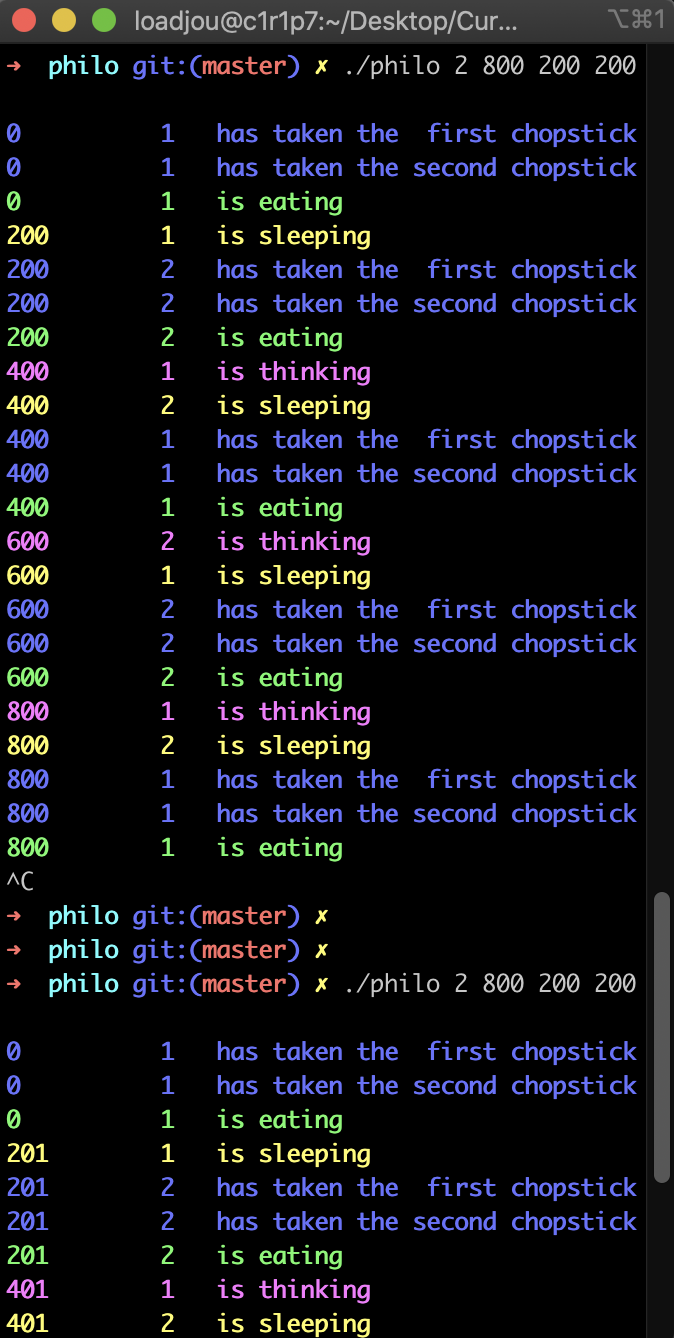
This project is an implementation of the classic "Dining Philosophers" problem, where a group of philosophers are sitting around a table and are each trying to eat a bowl of rice using chopsticks. The goal of the project is to ensure that no philosopher starves and that there is no deadlock.
The project consists of two parts: the mandatory part and the bonus part. The mandatory part focuses on the basic implementation of threading and mutexes, while the bonus part includes additional features and optimization.

-
Thread creation and management
-
Mutex usage for synchronization
-
Concurrent programming
-
Problem-solving
- C programming language
- pthread library
- Dining Philosophers problem
- Deadlock and starvation avoidance
- Thread synchronization
In this project, you will learn the basics of threading a process.
You will see how to create threads and you will discover mutexes. Version: 10.
Here are the things you need to know if you want to succeed this assignment:
- One or more philosophers sit at a round table. There is a large bowl of spaghetti in the middle of the table.
- The philosophers alternatively eat, think, or sleep. While they are eating, they are not thinking nor sleeping; while thinking, they are not eating nor sleeping; and, of course, while sleeping, they are not eating nor thinking.
- There are also forks on the table. There are as many forks as philosophers.
- Because serving and eating spaghetti with only one fork is very inconvenient, a philosopher takes their right and their left forks to eat, one in each hand.
- When a philosopher has finished eating, they put their forks back on the table and start sleeping. Once awake, they start thinking again. The simulation stops when a philosopher dies of starvation.
- Every philosopher needs to eat and should never starve.
- Philosophers don’t speak with each other.
- Philosophers don’t know if another philosopher is about to die.
- No need to say that philosophers should avoid dying!
- You have to write a program for the mandatory part and another one for the bonus part (if you decide to do the bonus part). They both have to comply with the following rules:
• Global variables are forbidden! • Your(s) program(s) should take the following arguments: number_of_philosophers - time_to_die - time_to_eat - time_to_sleep [number_of_times_each_philosopher_must_eat] * number_of_philosophers: The number of philosophers and also the number of forks. * The vertical position corresponds to its ordinate. * The value corresponds to its altitude. • Each philosopher has a number ranging from 1 to number_of_philosophers. • Philosopher number 1 sits next to philosopher number number_of_philosophers. Any other philosopher number N sits between philosopher number N - 1 and philosopher number N + 1.
• Any state change of a philosopher must be formatted as follows: * timestamp_in_ms X has taken a fork * timestamp_in_ms X is eating * timestamp_in_ms X is sleeping * timestamp_in_ms X is thinking * timestamp_in_ms X died Replace timestamp_in_ms with the current timestamp in milliseconds and X with the philosopher number. • A displayed state message should not be mixed up with another message. • A message announcing a philosopher died should be displayed no more than 10 ms after the actual death of the philosopher. • Again, philosophers should avoid dying!
| Program name | philo |
|---|---|
| Turn in files | Makefile, *.h, *.c, in directory philo/ |
| Makefile | NAME, all, clean, fclean, re |
| Arguments | number_of_philosophers time_to_die time_to_eat time_to_sleep [number_of_times_each_philosopher_must_eat] |
| External functs. | • memset, printf, malloc, free, write • usleep, gettimeofday, pthread_create • pthread_detach, pthread_join, pthread_mutex_init • pthread_mutex_destroy, pthread_mutex_lock, • pthread_mutex_unlock |
| Libft authorized | No |
| Description | Philosophers with threads and mutexes |
The specific rules for the mandatory part are:
- Each philosopher should be a thread.
- There is one fork between each pair of philosophers. Therefore, if there are several philosophers, each philosopher has a fork on their left side and a fork on their right side. If there is only one philosopher, there should be only one fork on the table.
- To prevent philosophers from duplicating forks, you should protect the forks state with a mutex for each of them.
The specific rules for the mandatory part are:
- All the forks are put in the middle of the table.
- They have no states in memory but the number of available forks is represented by a semaphore.
- Each philosopher should be a process. But the main process should not be a philosopher.