The main contributors to the project are Chen Yunqing(myself) and Chen Cheng.
This repository is a general Medical image Segmentation Framework and highly based on https://github.com/MontaEllis/Pytorch-Medical-Segmentation
中文说明: ZH_README
If the following model has been helpful to you, we hope you can cite the corresponding reference.
| Publication Date | Model Name | The First and Last Authors | Title | Reference |
|---|---|---|---|---|
| 2016-10 | 3D U-Net | Özgün Çiçek and Ronneberger, Olaf | 3D U-Net: Learning Dense Volumetric Segmentation from Sparse Annotation | MICCAI2016 |
| 2016-10 | 3D V-Net | Fausto Milletari and Seyed-Ahmad Ahmadi | V-Net: Fully Convolutional Neural Networks for Volumetric Medical Image Segmentation | 3DV2016 |
| 2017-09 | 3D DenseVoxelNet | Lequan Yu and Jing Qin & Pheng-Ann Heng | Automatic 3D Cardiovascular MR Segmentation with Densely-Connected Volumetric ConvNets | MICCAI2017 |
| 2017-09 | 3D DenseNet | Toan Duc Bui and Taesup Moon | 3D Densely Convolutional Networks for Volumetric Segmentation | arxiv |
| 2017-05 | 3D HighResNet | Wenqi Li and M. Jorge Cardoso & Tom Vercauteren | On the Compactness, Efficiency, and Representation of 3D Convolutional Networks: Brain Parcellation as a Pretext Task | IPMI2017 |
| 2017-05 | 3D Residual U-Net | Kisuk Lee and H. Sebastian Seung | Superhuman Accuracy on the SNEMI3D Connectomics Challenge | arxiv |
| 2021-10 | CSR-Net | Cheng Chen and Ruoxiu Xiao | CSR-Net: Cross-Scale Residual Network for multi-objective scaphoid fracture segmentation | CIBM2021 |
| 2022 | UNETR | Ali Hatamizadeh and Daguang Xu | UNETR: Transformers for 3D Medical Image Segmentation | CVPR2022 |
| 2023 | IS | Cheng Chen and Ruoxiu Xiao | Integration- and separation-aware adversarial model for cerebrovascular segmentation from TOF-MRA | CMPB |
| 2025 | DUNet | Can Zhang and Cheng Chen | DU-Net:A Collaborative Optimization Model for Small-Sample Cerebrovascular Segmentation | Chinese Journal of Engineering |
The recommend python and package version:
- python 3.10.0
- pytorch 1.13.1 (do not use torch2.0, it will cause program failed to start)
here we use an example(Traning 3D Unet) to teach you how use this repository
python train.py config=unetTo specify the folder name for the current save, you can modify the corresponding parameter using config.XXX=XXX.
python train.py config=unet config.name=unet-1All files during the model training process will be saved in ./logs/unet-1
all parameter can be setted in conf/unet.yaml
Considering that many settings are common to all configuration files, such as data_path, num_epochs, etc., to avoid repetitive work, we have placed these common parameters in conf/config.yaml. All configuration files will have these properties from config.yaml.
Taking num_workers (defaulted to 18 in config.yaml) as an example, the priority of parameter overriding is as follows:
Command line argument config.num_workers=20 > num_workers=18 in data_3d.yaml > Default value num_workers=18 in config.yaml.
Traning logs will be saved like this:
./logs/ying_tof (Corresponding saved folder: ./logs/config.name)
└── 2023-11-24 (Date: year-month-day)
    └── 17-05-02 (Time: hour-minute-second)
        ├── .hydra (Configuration save files)
        │   ├── config.yaml (Configuration for this running)
        │   ├── hydra.yaml
        │   └── overrides.yaml
        ├── train_3d.log (Log during training)
        └── train_tensorboard (Tensorboard folder)
            └── events.out.tfevents.1700816703.medai.115245.0 (file for Tensorboard)
run the code
python predict.py config=unet config.ckpt=XXXWARNING: ckpt must be the absolute path of the model, not the relative path
./results/ (Root folder for results)
└── unet (Model name: unet)
    └── 2023-12-04 (Date: year-month-day)
        └── 17-39-30 (Time: hour-minute-second)
            ├── metrics.csv (CSV file containing metrics)
            ├── pred_file (Folder for prediction files)
            │   ├── pred-0000.mhd (Prediction file 0 in MHD format)
            │   ├── pred-0000.zraw (Prediction file 0 in ZRAW format)
            │   ├── pred-0001.mhd (Prediction file 1 in MHD format)
            │   ├── pred-0001.zraw (Prediction file 1 in ZRAW format)
            │   ├── pred-0002.mhd (Prediction file 2 in MHD format)
            │   └── ... (Additional prediction files)
            └── predict.log (Log file for prediction)
create new file in path /conf/config, file name ends with .yaml.
For example, if you wanna use 3D Vnet, you can create vnet.yaml, and then set all parameters you wanna set.
config.PARAM: replace PARAM with the parameters you wanna use
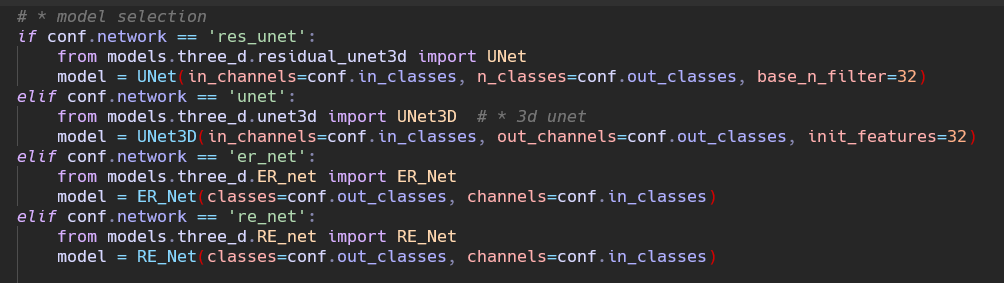
in train.py, add these codes after the last model
elif config.network == 'NETWORK':
    from models.three_d.NETWORK import NETWORK
model = NETWORK()NETWORK: means the network you wanna use
if this code is helpful for you, you can cite these for us. Thanks!
 C Chen and R Xiao. Generative consistency for semi-supervised cerebrovascular segmentation from TOF-MRA, 2022, IEEE Transactions on Medical Imaging 42 (2), 346-353
 C Chen and R Xiao. All answers are in the images: A review of deep learning for cerebrovascular segmentation, 2023, Computerized Medical Imaging and Graphics, 102229
 C Chen and J Zhao. Understanding the brain with attention: A survey of transformers in brain sciences, 2023, Brain-X, 1 (3): e29.