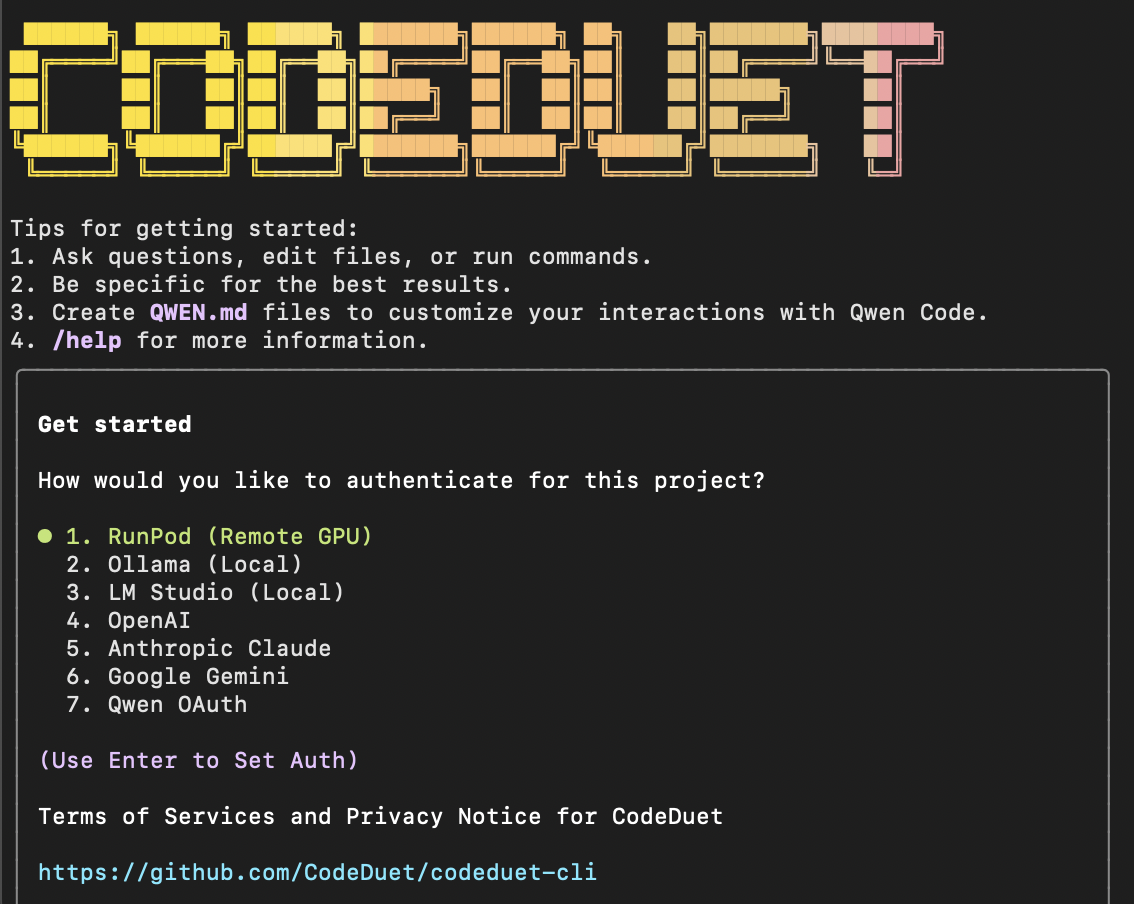




AI-powered command-line workflow tool for developers
Installation • Quick Start • Features • Provider Setup • What's New • Documentation • Contributing
CodeDuet is a powerful command-line AI workflow tool forked from Qwen Code, which was adapted from Gemini CLI. It enhances your development workflow with advanced code understanding, automated tasks, and intelligent assistance, supporting multiple AI providers and models.
Get started with CodeDuet at no cost using any of these free options:
- 🚀 RunPod: Scalable remote GPU inference for high-performance models
- 🏠 Ollama: Run models locally (completely free and private)
- 🏠 LM Studio: Local model inference with intuitive GUI
- 🤖 OpenAI: GPT models with your OpenAI API key
- 🧠 Anthropic Claude: Advanced reasoning with Claude models
- ⚡ xAI Grok: X.ai's powerful reasoning models with real-time knowledge
- 🔍 Google Gemini: Google's latest AI models
- 🔧 Qwen OAuth: Legacy Qwen model access
- Simply run
codeduetorcd-cliand choose your preferred provider from the menu
- OpenRouter: Provides free tier access to multiple models
- Together AI: Offers free credits for new users
- Local Models: Run models locally with Ollama, LM Studio, etc.
- Anthropic/OpenAI: Use free credits if available
For detailed setup instructions, see Authorization.
Warning
Token Usage Notice: CodeDuet may issue multiple API calls per cycle, resulting in higher token usage (similar to other AI coding tools). We're actively optimizing API efficiency.
- Multi-Provider Support - Works with OpenAI, Anthropic, Ollama, LM Studio, RunPod, and many other providers
- Local Model Support - Run models privately on your machine with Ollama or LM Studio
- Remote GPU Access - Scale with cloud GPU providers like RunPod
- Provider-Specific Memory Files - CLAUDE.md, GEMINI.md, CHATGPT.md, GROK.md, QWEN.md for customized AI interactions
- Code Understanding & Editing - Query and edit large codebases beyond traditional context window limits
- Workflow Automation - Automate operational tasks like handling pull requests and complex rebases
- YOLO Mode - Skip permission prompts for rapid development (use with caution)
Ensure you have Node.js version 20 or higher installed.
curl -qL https://www.npmjs.com/install.sh | shnpm install -g @codeduet-cli/codeduet-cli@latest
codeduet --versionmacOS Permission Fix (if needed):
# If you get permission errors, use sudo:
sudo npm install -g @codeduet-cli/codeduet-cli@latest

# Or configure npm for user-level installs:
mkdir ~/.npm-global
npm config set prefix '~/.npm-global'
echo 'export PATH=~/.npm-global/bin:$PATH' >> ~/.zshrc
source ~/.zshrc
npm install -g @codeduet-cli/codeduet-cli@latestgit clone https://github.com/CodeDuet/codeduet-cli.git
cd codeduet-cli
npm install
# Install globally (may require sudo on macOS)
npm install -g .
# or with sudo if needed:
sudo npm install -g .After installation, test that all commands work:
codeduet --version
cd-cli --version
codeduet-code --version# Start CodeDuet (multiple ways to launch)
codeduet
# or
cd-cli
# or
codeduet-code
# Example commands
> Explain this codebase structure
> Help me refactor this function
> Generate unit tests for this moduleControl your token usage with configurable session limits to optimize costs and performance.
Create or edit .qwen/settings.json in your home directory:
{
  "sessionTokenLimit": 32000
}Note: The
.qwendirectory name is maintained for backwards compatibility.
CodeDuet supports provider-specific memory files to customize AI interactions:
Supported Memory Files:
- CLAUDE.md - Custom instructions for Anthropic Claude interactions
- GEMINI.md - Custom instructions for Google Gemini interactions
- CHATGPT.md - Custom instructions for OpenAI ChatGPT interactions
- GROK.md - Custom instructions for xAI Grok interactions
- QWEN.md - Custom instructions for Qwen models
File Locations:
# Project-specific (highest priority)
./CLAUDE.md
./GEMINI.md
./CHATGPT.md
./GROK.md
./QWEN.md

# Global (shared across projects)
~/.qwen/CLAUDE.md
~/.qwen/GEMINI.md
~/.qwen/CHATGPT.md
~/.qwen/GROK.md
~/.qwen/QWEN.md
Example Memory File Content:
# My Coding Preferences

## Code Style
- Use TypeScript for all new JavaScript projects
- Prefer functional programming patterns
- Use const/let instead of var
- Always include error handling

## Project Context
- This is a React application using Next.js
- We use Tailwind CSS for styling
- Database: PostgreSQL with Prisma ORM

## Personal Preferences
- Explain complex code with comments
- Write comprehensive unit tests
- Follow clean architecture principles
Usage:
- Create memory files using the
/memorycommand or save_memory tool - Files are automatically discovered and loaded during conversations
- Project-level files take priority over global files
- Multiple memory files can be active simultaneously
/compress- Compress conversation history to continue within token limits/clear- Clear all conversation history and start fresh/stats- Check current token usage and limits
📝 Note: Session token limit applies to a single conversation, not cumulative API calls.
CodeDuet supports multiple AI providers. Choose your preferred method:
Use your OpenAI API key for access to GPT models:
# Just run this command and configure when prompted
codeduet
Setup:
- Get your API key from OpenAI Platform
- Run
codeduetand follow the setup prompts - Or set environment variables (see below)
Use your Anthropic API key for Claude models:
export ANTHROPIC_API_KEY="your_api_key_here"
export ANTHROPIC_MODEL="claude-3-sonnet-20240229"  # optional, this is the default
codeduetRun models locally with Ollama:
# Install Ollama (visit https://ollama.ai for installation)
ollama pull llama2  # or any other model

# Set environment variables (optional, defaults provided)
export OLLAMA_BASE_URL="http://localhost:11434"  # default
export OLLAMA_MODEL="llama2"  # or your preferred model

codeduetUse LM Studio for local inference:
# Start LM Studio and load a model
# Enable the local server in LM Studio settings

# Set environment variables (optional, defaults provided)
export LM_STUDIO_BASE_URL="http://localhost:1234"  # default
export LM_STUDIO_MODEL="local-model"  # your loaded model

codeduetUse RunPod for scalable GPU inference:
# Get your RunPod API key and endpoint URL
export RUNPOD_API_KEY="your_runpod_api_key"
export RUNPOD_BASE_URL="https://api-xxxxxxxxx.runpod.io/v1"  # your endpoint
export RUNPOD_MODEL="your_model_name"

codeduetUse your xAI API key for Grok models:
export GROK_API_KEY="your_xai_api_key_here"  # or use XAI_API_KEY
export GROK_MODEL="grok-beta"  # optional, this is the default
export GROK_BASE_URL="https://api.x.ai/v1"  # optional, this is the default
codeduet
Get your API key from xAI Console.
Use your Google Gemini API key:
export GEMINI_API_KEY="your_api_key_here"
codeduetUse API keys for OpenAI or other compatible providers:
Configuration Methods:
-
Environment Variables
export OPENAI_API_KEY="your_api_key_here"
export OPENAI_BASE_URL="your_api_endpoint"
export OPENAI_MODEL="your_model_choice"
-
Project
.envFile Create a.envfile in your project root:OPENAI_API_KEY=your_api_key_here OPENAI_BASE_URL=your_api_endpoint OPENAI_MODEL=your_model_choice
API Provider Options
⚠️ Regional Notice:
- Mainland China: Use Alibaba Cloud Bailian or ModelScope
- International: Use Alibaba Cloud ModelStudio or OpenRouter
🇨🇳 For Users in Mainland China
Option 1: Alibaba Cloud Bailian (Apply for API Key)
export OPENAI_API_KEY="your_api_key_here"
export OPENAI_BASE_URL="https://dashscope.aliyuncs.com/compatible-mode/v1"
export OPENAI_MODEL="gpt-4"
Option 2: ModelScope (Free Tier) (Apply for API Key)
- ✅ 2,000 free API calls per day
⚠️ Connect your Aliyun account to avoid authentication errors
export OPENAI_API_KEY="your_api_key_here"
export OPENAI_BASE_URL="https://api-inference.modelscope.cn/v1"
export OPENAI_MODEL="Qwen/Qwen3-Coder-480B-A35B-Instruct"
🌍 For International Users
Option 1: Alibaba Cloud ModelStudio (Apply for API Key)
export OPENAI_API_KEY="your_api_key_here"
export OPENAI_BASE_URL="https://dashscope-intl.aliyuncs.com/compatible-mode/v1"
export OPENAI_MODEL="gpt-4"
Option 2: OpenRouter (Free Tier Available) (Apply for API Key)
export OPENAI_API_KEY="your_api_key_here"
export OPENAI_BASE_URL="https://openrouter.ai/api/v1"
export OPENAI_MODEL="openai/gpt-3.5-turbo"cd your-project/
codeduet
# Architecture analysis
> Describe the main pieces of this system's architecture
> What are the key dependencies and how do they interact?
> Find all API endpoints and their authentication methods# Refactoring
> Refactor this function to improve readability and performance
> Convert this class to use dependency injection
> Split this large module into smaller, focused components
# Code generation
> Create a REST API endpoint for user management
> Generate unit tests for the authentication module
> Add error handling to all database operations# Git automation
> Analyze git commits from the last 7 days, grouped by feature
> Create a changelog from recent commits
> Find all TODO comments and create GitHub issues
# File operations
> Convert all images in this directory to PNG format
> Rename all test files to follow the *.test.ts pattern
> Find and remove all console.log statements# Performance analysis
> Identify performance bottlenecks in this React component
> Find all N+1 query problems in the codebase
# Security audit
> Check for potential SQL injection vulnerabilities
> Find all hardcoded credentials or API keys> What are the core business logic components?
> What security mechanisms are in place?
> How does the data flow through the system?
> What are the main design patterns used?
> Generate a dependency graph for this module
> What parts of this module can be optimized?
> Help me refactor this class to follow SOLID principles
> Add proper error handling and logging
> Convert callbacks to async/await pattern
> Implement caching for expensive operations
> Generate comprehensive JSDoc comments for all public APIs
> Write unit tests with edge cases for this component
> Create API documentation in OpenAPI format
> Add inline comments explaining complex algorithms
> Generate a README for this module
> Remember that I prefer TypeScript for new projects
> Save this: I use Tailwind CSS for styling
> Create a CLAUDE.md file with my coding preferences
> Update my memory with the new API endpoint structure
> Remember that this project uses PostgreSQL with Prisma
> Set up a new Express server with authentication
> Create a React component with TypeScript and tests
> Implement a rate limiter middleware
> Add database migrations for new schema
> Configure CI/CD pipeline for this project
/help- Display available commands/clear- Clear conversation history/compress- Compress history to save tokens/stats- Show current session information/exitor/quit- Exit CodeDuet
Ctrl+C- Cancel current operationCtrl+D- Exit (on empty line)Up/Down- Navigate command history
| Agent | Model | Accuracy |
|---|---|---|
| CodeDuet | GPT-4 | TBD |
| CodeDuet | Claude-3.5-Sonnet | TBD |
See CONTRIBUTING.md to learn how to contribute to the project.
For detailed authentication setup, see the authentication guide.
Permission Errors (macOS/Linux)
# Error: EACCES permission denied
# Solution 1: Use sudo
sudo npm install -g @codeduet-cli/codeduet-cli@latest

# Solution 2: Configure npm for user installs (recommended)
mkdir ~/.npm-global
npm config set prefix '~/.npm-global'
echo 'export PATH=~/.npm-global/bin:$PATH' >> ~/.zshrc
source ~/.zshrc
npm install -g @codeduet-cli/codeduet-cli@latest
Command Not Found
# Verify installation
which codeduet
npm list -g @codeduet-cli/codeduet-cli

# If missing, check PATH or reinstall
echo $PATH
npm install -g @codeduet-cli/codeduet-cli@latest
Node Version Warnings
# EBADENGINE warnings are usually safe to ignore
# But you can upgrade Node.js if desired:
# Visit https://nodejs.org for latest LTS version
Build Errors
# Clean and reinstall
npm run clean
rm -rf node_modules package-lock.json
npm install
npm run build
For more detailed troubleshooting, check the troubleshooting guide.
This project is forked from Qwen Code, which is based on Google Gemini CLI. We acknowledge and appreciate the excellent work of both the Qwen Code and Gemini CLI teams. CodeDuet focuses on multi-provider support and enhanced developer workflow features.