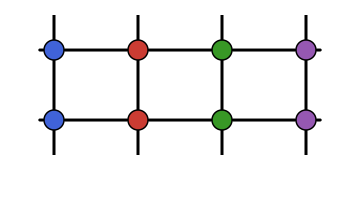





Tensor Train Numerics is a Julia package designed to provide efficient numerical methods for working with tensor trains (TT) and quantized tensor trains (QTT).
To get started with Tensor Train Numerics, you can install the package using Julia's package manager:
using Pkg
Pkg.add("TensorTrainNumerics")using LinearAlgebra
using TensorTrainNumerics
tensor = reshape(collect(1.0:16.0), 2, 2, 2, 2)
tt = ttv_decomp(tensor; tol = 1.0e-12)
tensor_reconstructed = ttv_to_tensor(tt)
relerr = norm(tensor - tensor_reconstructed) / norm(tensor)
println("Relative error: ", relerr)which returns
Relative error: 4.447195710046155e-16using LinearAlgebra
using TensorTrainNumerics
f(X) = vec(exp.(-sum(X .^ 2, dims = 2)))
domain = [collect(range(-1.0, 1.0, length = 8)) for _ in 1:4]
tt = tt_cross(f, domain, MaxVol(verbose = false, tol = 1.0e-8); ranks = 2)
approx = ttv_to_tensor(tt)
exact = similar(approx)
for I in CartesianIndices(exact)
x = reshape([domain[k][I[k]] for k in 1:4], 1, :)
exact[I] = f(x)[1]
end
relerr = norm(approx - exact) / norm(exact)
println(tt)
println("Relative error: ", relerr)which returns
Relative error: 2.661496213238571e-16using LinearAlgebra
using TensorTrainNumerics
d = 6
A = id_tto(d)
b = qtt_sin(d, λ = π)
x0 = rand_tt(b.ttv_dims, b.ttv_rks)
x = als_linsolve(A, b, x0; sweep_count = 4)
rhs = qtt_to_function(b)
sol = qtt_to_function(x)
relerr = norm(sol - rhs) / norm(rhs)
println("Relative error: ", relerr)which returns
Relative error: 4.560872651853784e-16- Tensor Train Decomposition: Algorithms for decomposing high-dimensional tensors into tensor train format
- Tensor Operations: Support for basic tensor operations such as addition, multiplication, the hadamard product in tensor train format
- Discrete Operators: Implementation of discrete Laplacians, gradient operators, and shift matrices in tensor train format for solving partial differential equations
- TT-cross algorithm for approximating tensors from function calls
- Quantized Tensor Trains: Tools for constructing and manipulating quantized tensor trains, which provide further compression and efficiency for large-scale problems.
- Iterative Solvers: Integration with iterative solvers for solving linear systems and eigenvalue problems in tensor train format
- The Fourier transform in QTT format and interpolation in QTT format
- Visualization: Basic visualization tools.
Many of the features are inspired by the work of Mi-Song Dupuy