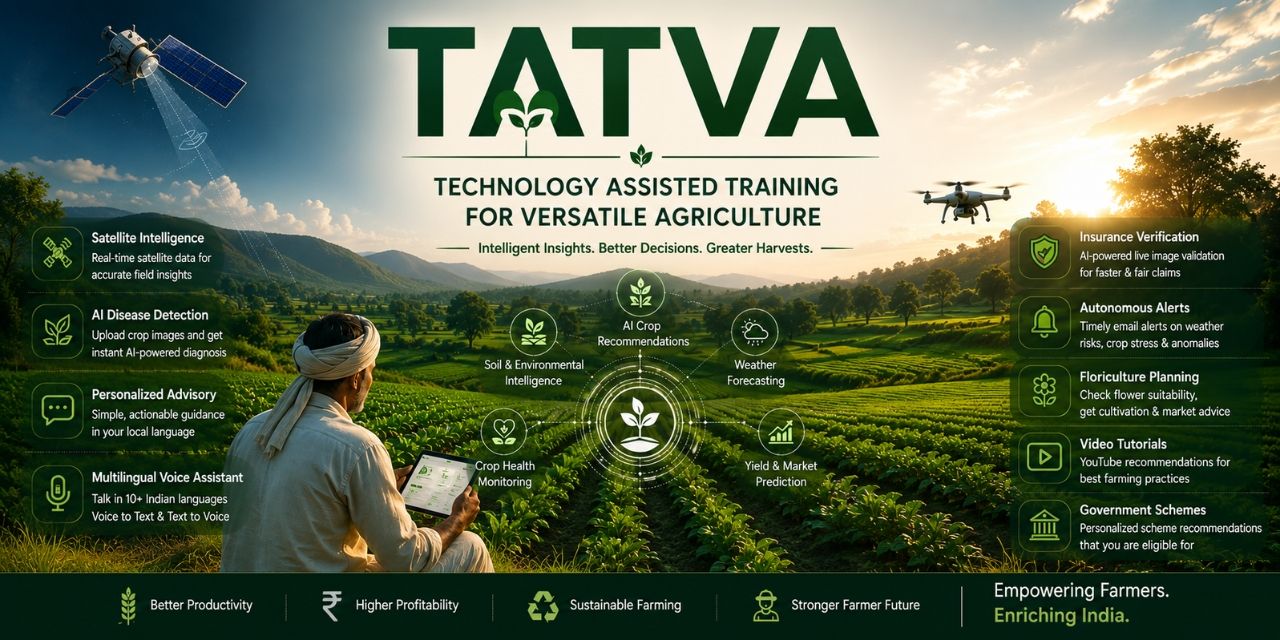
Making crop insurance, farm monitoring, government schemes, and AI-driven agriculture accessible from one unified platform.
TATVA is an AI driven precision agriculture ecosystem designed to empower Indian farmers through intelligent, data driven decision making across the complete agricultural lifecycle. The platform bridges the gap between advanced agricultural technology and practical farming by combining satellite intelligence, environmental analysis, soil intelligence, computer vision, predictive analytics and multimodal artificial intelligence into a single farmer friendly ecosystem. Rather than exposing complex scientific reports or technical metrics, TATVA transforms sophisticated AI outputs into simple, actionable recommendations that can be understood and implemented by farmers regardless of their educational background or digital literacy. The platform focuses on improving agricultural productivity, profitability, sustainability and financial security while reducing crop losses, optimizing resource utilization and promoting climate resilient farming practices across India.
Agriculture is among the most complex industries in the world because it depends upon a large number of dynamic and interconnected variables. Weather conditions, soil fertility, water availability, pest outbreaks, market fluctuations, and climate change continuously influence agricultural productivity. Even experienced farmers often struggle to predict these variables accurately, leading to reduced yields, financial losses, and inefficient resource utilization.
In many regions, particularly in developing countries such as India, farmers continue to rely heavily on inherited experience and conventional cultivation techniques. While traditional knowledge remains valuable, modern agricultural challenges require far more precise and data-driven approaches.
Technological innovations such as satellite imagery, environmental monitoring systems, machine learning algorithms, computer vision, cloud computing, and artificial intelligence have created unprecedented opportunities to revolutionize agriculture. However, these technologies often remain inaccessible to farmers due to technical complexity, fragmented solutions, high implementation costs, and poor usability.
TATVA addresses this challenge by providing a comprehensive agricultural intelligence platform capable of integrating multiple advanced technologies into one seamless ecosystem. Instead of expecting farmers to understand satellite indices, neural network predictions, or environmental datasets, TATVA performs all analytical processing internally and presents only meaningful recommendations tailored to each individual farmer's land and cultivation objectives.
The platform has been designed with the philosophy that technology should simplify farming rather than complicate it. Every recommendation generated by the system is intended to be practical, contextual, explainable, and immediately actionable.
The global agricultural sector is currently undergoing one of the most significant transformations in history. Rapid population growth has increased food demand while climate change has introduced unprecedented uncertainty into farming operations. Simultaneously, declining soil quality, water scarcity, and rising production costs have significantly increased the risks associated with agriculture.
Small and marginal farmers experience these challenges most severely because they often lack access to scientific advisory systems, environmental intelligence, financial planning tools, and modern agricultural technologies. Decisions regarding crop selection, irrigation scheduling, fertilizer application, disease management, harvesting, and market timing are frequently made based on incomplete information.
Existing agricultural applications typically address isolated problems. Some platforms provide weather forecasts, others focus exclusively on crop disease detection, while separate applications offer market prices or government schemes. Farmers must constantly switch between multiple systems, making agricultural decision-making fragmented and inefficient.
TATVA was conceptualized to overcome this fragmentation by creating a unified digital ecosystem where every agricultural decision is supported by interconnected intelligence generated from multiple reliable sources.
The motivation behind TATVA extends beyond technological innovation. The project seeks to improve farmers' quality of life by minimizing uncertainty, reducing financial risks, increasing agricultural productivity, and promoting environmentally sustainable cultivation practices.
Agriculture today faces a combination of environmental, economic, and technological challenges that significantly affect productivity and profitability.
Some of the most pressing problems include:
Unpredictable climate conditions
- Increasing frequency of droughts and floods
- Soil degradation
- Declining groundwater levels
- Pest infestations
- Delayed disease detection
- Excessive fertilizer usage
- Poor irrigation planning
- Inefficient crop selection
- Limited market intelligence
- Delayed crop insurance settlements
- Agricultural fraud
- Digital illiteracy among farmers
- Fragmented agricultural services
Most existing agricultural technologies operate independently and fail to provide holistic support across the entire cultivation lifecycle. Consequently, farmers continue making critical decisions without comprehensive environmental analysis or predictive intelligence.
These limitations result in:
- Lower agricultural productivity
- Increased cultivation costs
- Reduced profitability
- Higher crop losses
- Financial instability
- Food security concerns
- Unsustainable farming practices
TATVA has been designed specifically to eliminate these limitations by integrating environmental intelligence, predictive analytics, computer vision, multimodal artificial intelligence, and farmer-centric advisory services into one intelligent ecosystem.
The vision of TATVA is to become the most trusted AI-powered agricultural intelligence platform capable of transforming conventional farming into precision agriculture through intelligent decision support.
The platform seeks to establish an ecosystem where every agricultural decision—from selecting a crop to selling harvested produce—is guided by reliable data rather than assumptions.
TATVA envisions a future where advanced technologies such as artificial intelligence, satellite monitoring, geospatial analytics, and predictive modeling become accessible to every farmer regardless of technical expertise or educational background.
Beyond improving agricultural productivity, the platform aims to contribute toward sustainable farming practices, climate resilience, improved food security, and rural economic development.
The mission of TATVA is to democratize access to advanced agricultural intelligence by developing a simple, intelligent, and accessible digital platform capable of assisting farmers throughout the complete agricultural lifecycle.
The platform strives to simplify scientific information into practical recommendations while ensuring transparency, explainability, affordability, and usability.
Through continuous innovation and responsible artificial intelligence, TATVA seeks to empower farmers with accurate information at the right time, enabling them to make better decisions and achieve long-term agricultural sustainability.
The primary objectives of TATVA include:
Modernizing traditional farming practices using artificial intelligence. Supporting farmers through every stage of cultivation. Improving crop productivity using predictive analytics. Detecting diseases during early growth stages. Reducing crop losses through timely interventions. Maximizing profitability using market forecasting. Optimizing irrigation and fertilizer utilization. Simplifying agricultural decision-making. Providing multilingual support for improved accessibility. Accelerating insurance claim verification. Preventing fraudulent insurance activities. Creating an integrated digital agricultural ecosystem. Supporting government agencies through centralized monitoring. Promoting environmentally sustainable farming.
The development of TATVA is guided by several foundational principles that influence every aspect of the platform's architecture and user experience.
Farmer-Centric Design: Every feature is designed from the perspective of practical agricultural needs rather than technological novelty. Simplicity, usability, and relevance remain the highest priorities.
Artificial Intelligence as an Assistant: AI functions as a decision-support system rather than a decision-maker. Farmers retain complete control while benefiting from intelligent recommendations.
Integrated Intelligence: Instead of isolated modules, every component contributes to a unified agricultural knowledge ecosystem where information flows seamlessly across different services.
Explainability: Recommendations are accompanied by clear explanations, enabling farmers to understand the reasoning behind every suggestion.
Accessibility: Support for multiple Indian languages and intuitive interfaces ensures that advanced technology remains accessible to diverse farming communities.
Scalability: The platform is designed to accommodate future technological advancements, including IoT sensors, autonomous drones, blockchain integration, and real-time environmental monitoring.
TATVA provides an end to end AI powered precision agriculture platform that assists farmers from land registration until harvest and market sale. The platform integrates environmental intelligence, crop planning, disease diagnostics, yield prediction, market forecasting, insurance verification, autonomous alerting, multilingual assistance and floriculture planning into one unified ecosystem. Every recommendation generated by the system is translated into practical guidance using simple language instead of technical reports, enabling farmers to make informed decisions with confidence.
The platform follows a modern cloud native architecture developed using Next.js, React, TypeScript and Node.js. MongoDB serves as the primary database for storing farmer profiles, land registrations, agricultural records and analytical outputs. Authentication is managed through NextAuth.js while the frontend is designed using Tailwind CSS and Shadcn UI to provide a responsive and accessible experience across desktop and mobile devices. The architecture follows modular development principles allowing every AI service to operate independently while remaining tightly integrated within the ecosystem.
Artificial Intelligence acts as the foundation of TATVA. Google Gemini 3.5 serves as the primary reasoning engine responsible for contextual understanding, agricultural advisory generation, recommendation synthesis, multilingual content generation and natural language explanations. Instead of producing generic responses, Gemini combines environmental observations, satellite information, soil characteristics, weather intelligence and predictive analytics to generate highly contextual recommendations for farmers.
The AI engine supports natural language understanding, structured reasoning, multimodal image interpretation, contextual recommendation generation, multilingual response generation, agricultural advisory synthesis, document understanding, conversational assistance and explainable artificial intelligence. Every response generated by the platform prioritizes simplicity, clarity and practical implementation instead of scientific complexity.
The crop recommendation engine evaluates registered farmland using environmental intelligence, soil characteristics, climatic conditions and localized weather forecasts to identify the most suitable crops for cultivation. Instead of recommending crops solely based on historical practices, the system generates scientifically optimized recommendations that maximize productivity while reducing cultivation risks. Every recommendation is accompanied by a simple explanation that enables farmers to understand why a particular crop has been recommended.
Maintaining crop health throughout the cultivation cycle is essential for achieving high productivity and minimizing economic losses. Traditional crop monitoring depends heavily upon manual observation, requiring farmers to inspect individual plants for visible signs of disease, nutrient deficiency, pest infestation, or environmental stress. Such inspections are time-consuming and often identify problems only after significant damage has already occurred.
TATVA addresses this limitation through an intelligent crop health analysis module capable of continuously evaluating crop conditions using computer vision, satellite observations, drone imagery, environmental monitoring, and artificial intelligence.
Rather than assessing individual symptoms in isolation, the platform evaluates crop health as a multidimensional biological system influenced by environmental, nutritional, climatic, and physiological factors. Every observation contributes to a comprehensive understanding of the crop's overall condition.
Visual information obtained from uploaded photographs undergoes sophisticated image preprocessing before analysis. The platform enhances image quality, removes irrelevant background information, standardizes illumination variations, and identifies plant structures suitable for detailed examination. These preprocessing stages improve analytical accuracy while minimizing the influence of inconsistent imaging conditions.
Following image enhancement, computer vision algorithms evaluate numerous visual characteristics including leaf coloration, texture, morphological abnormalities, lesion distribution, chlorosis, necrosis, wilting patterns, canopy uniformity, and growth consistency.
Simultaneously, environmental observations obtained from weather forecasts, soil intelligence, and satellite imagery are incorporated into the analysis. This contextual reasoning enables the platform to distinguish between visually similar conditions resulting from entirely different underlying causes.
For example, leaf yellowing may originate from nitrogen deficiency, excessive irrigation, drought stress, fungal infection, or natural physiological aging. Rather than relying solely on visual appearance, TATVA integrates environmental intelligence to determine the most probable explanation before generating recommendations.
The resulting health assessment provides farmers with a clear understanding of crop condition, identifies emerging risks, estimates severity, recommends corrective actions, and prioritizes interventions according to urgency.
Longitudinal monitoring enables the platform to observe crop development across the entire cultivation season. Instead of producing isolated assessments, TATVA constructs continuous health profiles that reveal evolving trends, allowing preventive interventions before significant productivity losses occur.
Plant diseases represent one of agriculture's most persistent challenges, reducing yields, increasing production costs, and threatening food security across diverse climatic regions. Delayed disease identification frequently results in widespread crop damage that could have been prevented through early intervention.
The AI Disease Detection module combines advanced computer vision with agricultural intelligence to identify plant diseases rapidly, accurately, and consistently.
When farmers upload images of affected crops, the system first performs comprehensive preprocessing operations designed to improve image quality and standardize analytical conditions. Background distractions are minimized, lighting inconsistencies are corrected, image noise is reduced, and regions of interest are isolated for detailed examination.
Following preprocessing, deep learning models analyze visual characteristics associated with numerous plant diseases. Rather than simply matching patterns against static image databases, the system evaluates morphological relationships, lesion structures, discoloration patterns, growth abnormalities, and physiological indicators that collectively distinguish one disease from another.
Disease detection extends beyond visual classification. Environmental intelligence substantially enhances diagnostic accuracy by incorporating weather conditions, humidity levels, seasonal disease prevalence, regional outbreaks, crop growth stage, and historical cultivation records.
For instance, identical visual symptoms may correspond to different diseases depending upon prevailing climatic conditions. By integrating environmental reasoning, TATVA significantly reduces diagnostic ambiguity while improving recommendation reliability.
Upon completing analysis, the platform presents farmers with a comprehensive diagnostic report explaining the identified disease, probable causes, expected progression, potential impact on productivity, recommended treatments, preventive measures, and long-term management strategies.
Rather than encouraging indiscriminate pesticide application, TATVA promotes targeted interventions that minimize environmental impact while maximizing treatment effectiveness.
Future developments will incorporate hyperspectral imaging, molecular diagnostics, federated learning across agricultural institutions, and continuously expanding disease knowledge bases, enabling increasingly accurate identification of emerging plant pathogens.
Predicting agricultural yield before harvest represents one of the most valuable capabilities offered by modern precision agriculture. Accurate yield estimation enables farmers to optimize harvesting schedules, storage planning, transportation logistics, financial management, market participation, and resource allocation.
The TATVA Yield Prediction System employs predictive machine learning models capable of estimating expected crop production using diverse environmental, geographical, biological, and historical information sources.
Rather than relying upon simple statistical averages, yield prediction integrates multiple dimensions of agricultural intelligence.
The prediction process evaluates crop selection, soil fertility, weather forecasts, historical productivity, vegetation health, irrigation availability, nutrient management, disease occurrence, satellite observations, and seasonal environmental conditions.
Each contributing factor influences the final prediction according to its estimated impact on crop productivity.
Historical cultivation records significantly improve predictive performance by enabling machine learning algorithms to identify recurring productivity patterns across multiple growing seasons. The platform learns from previous agricultural outcomes, gradually refining prediction accuracy as additional data becomes available.
Unlike conventional yield estimation methods that provide single numerical outputs without context, TATVA accompanies every prediction with explanatory information describing the major environmental factors influencing productivity.
The system also communicates uncertainty appropriately, recognizing that agricultural forecasting inherently involves environmental variability.
Yield prediction supports numerous downstream decision-making processes throughout the platform.
Market forecasting utilizes production estimates when predicting supply-demand dynamics.
Profit estimation combines expected yield with projected market prices.
Harvest scheduling benefits from anticipated production volumes.
Insurance assessments compare predicted productivity with reported losses.
Government agencies may utilize aggregated predictions for regional agricultural planning and food security assessment.
As climate conditions become increasingly unpredictable, predictive yield estimation will become an indispensable component of resilient agricultural management.
Analytical intelligence forms the quantitative backbone of TATVA, translating raw environmental, biological, and economic data into forward-looking predictions that farmers can act on well before a single stalk is harvested. Rather than presenting a single static number, the platform builds a continuously updating analytical model for every registered plot, refining its projections as new data becomes available throughout the growing season.
Yield Prediction Methodology. The yield prediction engine ingests data from multiple independent sources: satellite-derived vegetation indices that track canopy density and photosynthetic activity, soil analysis reports covering nutrient composition and water-holding capacity, real-time and forecasted weather data including rainfall, temperature, and humidity trends, and the farmer's own crop health assessments logged through the platform. These inputs are fused together using regression models, ensemble tree-based methods, and neural architectures trained on historical yield records collected across comparable agro-climatic zones. Because the model is re-evaluated at regular intervals rather than generated once, the predicted yield curve tightens in confidence as the crop progresses from sowing to maturity, giving farmers an increasingly precise picture of what to expect at harvest.
Market Forecasting Methodology. Running in parallel, the market forecasting module analyzes historical commodity price movements, seasonal demand cycles, regional mandi price variations, and macro-level supply-demand indicators to project where prices are likely to head over the coming weeks and months. The model does not merely extrapolate past trends; it accounts for cyclical patterns specific to each crop, the lag between harvest announcements and price reactions, and the effect of regional oversupply or scarcity. The result is a forward-looking price curve that farmers can weigh against their yield projections.
Combined Decision Support. The real analytical value emerges when yield prediction and market forecasting are considered together. TATVA overlays the two curves to identify windows where expected harvest quantity and expected market price intersect most favorably, then translates this intersection into a plain-language recommendation such as suggesting an optimal harvest week or advising a farmer to hold produce briefly if a price rise is anticipated. Farmers can also run "what-if" scenarios directly within the platform, adjusting variables like harvest timing or storage duration to see how the analytical model's recommendation shifts in response. This transforms what has traditionally been a guessing game, dependent on intermediaries or incomplete local information, into a data-backed decision process.
TATVA includes a dedicated floriculture planning ecosystem specifically designed for flower cultivation. Farmers can select an existing registered plot together with their preferred flower variety. The AI evaluates environmental suitability, climatic compatibility, soil conditions and expected market opportunities before generating a Flower Suitability Gauge ranging from zero to one hundred. The recommendation is categorized as Highly Recommended, Can Be Cultivated with Proper Care or Not Recommended. The accompanying advisory explains cultivation strategies, expected flowering period, market opportunities and practical precautions using simple farmer friendly language.
The insurance verification module introduces secure live image validation to eliminate fraudulent crop insurance claims. Farmers capture live evidence directly through the platform while artificial intelligence verifies image authenticity before forwarding claims for further processing. This significantly improves transparency while reducing verification delays for genuine farmers.
The autonomous alerting engine is one of the platform's most quietly powerful features, because it requires no action from the farmer at all to function. Once a plot is registered, the engine begins continuously monitoring a wide array of data streams tied to that specific location: short and medium range weather forecasts, satellite-derived environmental readings, soil moisture trends, pest and disease risk indicators drawn from regional outbreak patterns, and the farmer's own logged crop health history. This monitoring runs in the background at all times, independent of whether the farmer opens the app that day, that week, or at all.
How Detection Works. The engine does not simply react to raw threshold breaches. It applies pattern recognition across multiple correlated signals before deciding that a genuine risk exists, which reduces false alarms and ensures that farmers are not overwhelmed with noise. For example, a single day of low rainfall in the forecast is not treated as an emergency, but a compounding pattern of reduced rainfall, rising temperature, and declining soil moisture over several consecutive days is recognized as an emerging drought stress condition worth flagging. Similarly, disease and pest risk is assessed by cross-referencing current weather conditions against known outbreak patterns for the specific crop variety registered on that plot, since many fungal and pest threats are strongly correlated with particular humidity and temperature windows.
Categories of Alerts. The alerting engine is designed to cover several distinct categories of risk rather than a single generic warning type:
- Weather-based alerts, covering impending heavy rainfall, hailstorms, heatwaves, unseasonal frost, or extended dry spells that could affect crop development.
- Irrigation and water stress alerts, triggered when soil moisture readings combined with forecasted conditions suggest a plot is trending toward water deficit before visible wilting would otherwise alert the farmer.
- Pest and disease risk alerts, issued when environmental conditions align with known risk windows for infestations or fungal and bacterial outbreaks relevant to the specific crop under cultivation.
- Crop health escalation alerts, generated when a farmer's own uploaded crop health images indicate a worsening condition that requires more urgent intervention than the original diagnostic report suggested.
Email Alert Delivery and Personalization. When a risk condition is confirmed, the platform automatically composes and dispatches a personalized email alert to the farmer's registered address. Each email is written in plain, non-technical language and includes a clear description of the detected risk, an assessment of how severe the potential impact could be if no action is taken, and a concrete set of recommended actions appropriate to the situation, such as adjusting irrigation schedules, applying preventive treatment, or harvesting earlier than originally planned. Alerts are deliberately kept concise and actionable rather than data-heavy, since the goal is to prompt timely action rather than require further interpretation. Because the system is tied to each individual plot's registered location and crop type, no two farmers receive identical alerts; the content, urgency, and recommended response are all shaped by that specific farm's conditions. This personalized, always-on email channel effectively gives every farmer on the platform an automated agronomist watching over their fields around the clock, surfacing problems while they are still preventable rather than after they have already caused damage.
Fraudulent insurance claims represent a substantial challenge within agricultural insurance ecosystems. False damage reports, manipulated photographs, duplicate submissions, fabricated evidence, and location inconsistencies not only impose financial losses upon insurers but also delay assistance for legitimate claimants.
TATVA incorporates a dedicated Fraud Detection Engine designed to identify suspicious activities through a combination of computer vision, metadata analysis, environmental intelligence, and behavioral pattern recognition.
The platform performs authenticity verification across multiple dimensions simultaneously. Uploaded images are examined for indications of digital manipulation, compression inconsistencies, duplicated content, artificial editing artifacts, and abnormal visual characteristics commonly associated with fabricated evidence.
Metadata analysis evaluates timestamps, geographical coordinates, device information, image generation history, and environmental consistency. Photographs captured outside registered farmland, reused from previous claims, or exhibiting suspicious metadata inconsistencies receive elevated fraud risk assessments.
Environmental intelligence further strengthens verification reliability. Satellite observations, weather records, seasonal agricultural conditions, and historical cultivation data collectively determine whether reported damage corresponds to observable environmental events. For example, drought-related claims submitted during periods of above-average rainfall may trigger additional verification procedures.
Behavioral analytics introduces another protective layer by identifying unusual claim submission patterns, repeated high-risk activities, or abnormal interaction behaviors that may indicate coordinated fraudulent activity.
Importantly, fraud detection remains supportive rather than punitive. Instead of automatically rejecting suspicious claims, the system prioritizes additional verification while maintaining transparency throughout the evaluation process. This balanced approach protects both insurance providers and genuine farmers while preserving trust in the verification process.
Future developments will incorporate deepfake detection, blockchain-supported evidence authentication, federated fraud intelligence across insurance organizations, and continuously evolving anomaly detection algorithms capable of adapting to emerging fraud techniques.
Accessibility is treated as a first-class engineering requirement within TATVA rather than an afterthought, and the multilingual support system is central to that commitment. The platform supports voice-driven interaction across more than ten Indian languages, built on speech-to-text and text-to-speech technologies that allow farmers to speak naturally to the platform and hear responses spoken back to them, rather than being required to read and type in a language they may not be comfortable with.
Why Voice Matters for This Audience. A significant proportion of India's farming population has limited formal education or limited comfort with typing on a smartphone keyboard, particularly in a non-native script. By supporting spoken interaction, TATVA removes literacy and typing fluency as a barrier to accessing advanced agricultural intelligence. A farmer can ask a question about a crop disease symptom out loud in their own language and receive both a spoken and written response, without ever needing to type a single word.
Depth of Multilingual Coverage. The multilingual system is not limited to translating a fixed set of pre-written messages. Because the underlying Gemini-powered reasoning engine generates every recommendation dynamically, multilingual output is generated natively for each response rather than passed through a separate translation layer afterward, which helps preserve the accuracy and nuance of agricultural terminology across languages. This means crop recommendations, disease diagnostic reports, treatment plans, market forecasts, and autonomous alerts can all be delivered in the farmer's preferred language, not just the platform's static interface text.
Voice Throughout the Platform, Not Just at Entry. Voice interaction is integrated across the full breadth of TATVA's features rather than being confined to a single chatbot-style entry point. Farmers can register land details, request crop recommendations, upload and discuss crop health images, and review market forecasts, all through spoken interaction. The speech processing pipeline is specifically tuned to perform reliably in the noisy, variable acoustic environments typical of open fields and rural settings, rather than assuming the clean, quiet conditions of an office or studio recording.
Outcome. The combined effect of broad language coverage and full-platform voice integration is that TATVA's intelligence becomes accessible to a substantially larger segment of the rural population than a text-only, English-first application could ever reach, directly addressing one of the core barriers identified in the platform's original problem statement.
Understanding a recommendation is not always the same as knowing how to carry it out correctly, particularly for farming practices that are new to a farmer or that require precise physical technique, such as pruning, grafting, applying a treatment at the correct concentration, or setting up a particular irrigation method. TATVA addresses this gap between advice and execution through its educational assistance system, which pairs nearly every major AI-generated recommendation with a curated set of relevant YouTube tutorial videos.
How Video Matching Works. Whenever the platform generates a significant recommendation, whether it is a crop selection, a disease treatment plan, a floriculture cultivation strategy, or a market timing suggestion, the educational assistance system runs a content recommendation process that searches for and ranks tutorial videos aligned with the specific practice being recommended. The matching considers the crop variety involved, the specific technique or intervention being described, and where possible, the regional or linguistic context of the farmer, so that the videos surfaced are as directly applicable as possible rather than being generic agricultural content.
Why Visual Learning Matters Here. Written instructions, even when translated and simplified, can struggle to convey certain physical techniques with full clarity, for instance the correct depth for transplanting a seedling, the visual signs that distinguish two similar-looking diseases, or the precise motion required for a particular pruning cut. Video content closes this gap by allowing farmers to see the practice being demonstrated in real conditions, at real speed, which significantly improves the accuracy with which recommendations are implemented in the field compared to text alone.
Integration Into the Advisory Flow. Video recommendations are not delivered as a separate, disconnected library that farmers must search through independently. They are attached directly to the specific advisory output that prompted them, so a farmer reviewing a disease treatment plan sees the relevant demonstration video presented alongside that exact treatment step, and a farmer exploring floriculture guidance sees cultivation videos matched to the specific flower variety under consideration. The presentation is kept simple and uncluttered, with clear titles and straightforward navigation, consistent with the platform's broader design philosophy of prioritizing usability over information density.
Outcome. By combining AI-generated advisory text with matched visual demonstrations, TATVA improves not just farmers' understanding of what to do, but their ability to execute it correctly, closing the gap between receiving good advice and successfully applying it in the field.
Agricultural information represents valuable digital assets that require comprehensive protection against unauthorized access, manipulation, and misuse.
TATVA adopts a security-first design philosophy in which data protection is integrated throughout every layer of the platform architecture.
Authentication mechanisms ensure that only authorized users access sensitive agricultural records. Secure session management, encrypted communication protocols, and token-based authentication collectively safeguard user identities and personal information.
Sensitive agricultural datasets—including land records, insurance documentation, cultivation histories, financial projections, and AI-generated analyses—are securely stored using modern encryption standards.
Role-based access control ensures that farmers, administrators, insurance providers, researchers, and institutional partners access only information relevant to their responsibilities.
Privacy remains equally important.
TATVA does not expose confidential farmer information without explicit authorization. Aggregated agricultural analytics may support institutional decision-making while preserving individual anonymity.
Future developments will incorporate blockchain-supported audit trails, decentralized identity management, confidential computing technologies, and privacy-preserving federated machine learning frameworks.
TATVA is an AI powered precision agriculture ecosystem built specifically for Indian farmers. By combining satellite intelligence, environmental analytics, artificial intelligence, multilingual communication and predictive decision support into a unified platform, TATVA enables farmers to make smarter farming decisions throughout the complete agricultural lifecycle. The platform simplifies advanced agricultural intelligence into practical guidance that improves productivity, profitability and long term sustainability.
India possesses one of the world's largest agricultural communities with millions of small and marginal farmers facing increasing environmental uncertainty and market volatility. Rapid digital adoption, expanding rural internet connectivity and government initiatives promoting digital agriculture create an ideal environment for intelligent agricultural ecosystems. TATVA addresses this opportunity by delivering accessible, localized and scalable agricultural intelligence specifically designed for Indian farming conditions.
Unlike traditional agricultural applications that focus on individual services, TATVA delivers an integrated ecosystem where every stage of cultivation is supported by artificial intelligence. Farmers receive assistance from crop selection through disease management, yield estimation, market forecasting, insurance verification, floriculture planning and educational support within a single platform, eliminating fragmentation while simplifying agricultural decision making.
Ensuring the long-term sustainability of TATVA requires a carefully balanced commercial strategy that supports continuous technological innovation while maintaining affordability for farmers.
The platform follows a diversified revenue model designed to minimize dependence upon any single income source.
The primary revenue stream originates from subscription-based services offering advanced agricultural intelligence, premium analytical reports, personalized advisory systems, and enhanced decision-support capabilities.
A freemium strategy allows all farmers to access essential agricultural services without financial barriers while reserving specialized enterprise features for premium subscribers.
Additional revenue is generated through institutional collaborations involving insurance companies, agricultural cooperatives, financial institutions, research organizations, government agencies, and agribusiness enterprises.
The insurance verification framework provides opportunities for service-based partnerships with insurance providers seeking efficient claims processing solutions.
Market intelligence services may also support commodity buyers, exporters, distributors, and agricultural marketplaces requiring predictive supply chain information.
Future revenue opportunities include:
- Precision agriculture consulting
- AI-powered farm management subscriptions
- Enterprise agricultural analytics
- API licensing
- Agricultural data intelligence services
- Digital marketplace commissions
This diversified strategy ensures long-term financial sustainability while preserving affordability for small and marginal farmers.
Farmer retention is achieved through continuous value generation rather than periodic engagement. Personalized recommendations, autonomous agricultural alerts, multilingual communication, educational assistance, seasonal advisory updates, continuous AI improvements and contextual notifications encourage farmers to actively use the platform throughout every cultivation cycle. Trust, simplicity and measurable agricultural improvements remain the primary retention drivers.
TATVA focuses on community driven adoption through agricultural cooperatives, Farmer Producer Organizations, agricultural universities, Krishi Vigyan Kendras, rural entrepreneurship initiatives, digital awareness campaigns, demonstration programs and institutional collaborations. Educational content, real world success stories and farmer centric awareness campaigns establish credibility while encouraging widespread adoption throughout rural India.
Scalability and Future Readiness
Agriculture continues evolving through advances in artificial intelligence, remote sensing, robotics, biotechnology, climate science, and digital infrastructure. TATVA has therefore been architected with scalability as a fundamental design objective rather than an afterthought.
The modular architecture enables independent evolution of every platform component.
New AI models can be incorporated without disrupting existing services.
Additional languages may be introduced without redesigning user interfaces.
Emerging environmental data sources can integrate seamlessly into existing analytical pipelines.
Future scalability extends beyond software architecture.
Planned technological expansions include:
- Internet of Things (IoT) sensor integration
- Smart irrigation controllers
- Autonomous agricultural drones
- Real-time soil monitoring
- Wearable farming devices
- Climate adaptation models
- Blockchain-enabled traceability
- Robotic field monitoring
- Precision fertilizer recommendation systems
- Carbon footprint estimation
- Sustainable farming certification
- Smart greenhouse management
- Autonomous farm equipment integration
These future developments position TATVA as a continuously evolving agricultural intelligence ecosystem rather than a static software application.
Future development will focus on Internet of Things integration, real time environmental sensors, smart irrigation automation, drone based crop monitoring, blockchain enabled agricultural traceability, carbon credit estimation, advanced environmental intelligence, expanded floriculture analytics, AI driven government scheme recommendations, predictive financial advisory services, collaborative farmer communities, advanced market intelligence and deeper institutional integrations while preserving the platform's commitment to simplicity, accessibility and farmer first innovation.
Agriculture has traditionally evolved through shared knowledge, collective experience, and community collaboration. Farmers often learn successful cultivation techniques, disease management strategies, irrigation practices, and market opportunities through discussions with neighboring farming communities. TATVA extends this collaborative tradition into the digital age through its integrated Community Platform.
The Community Platform serves as a digital ecosystem where farmers, agricultural experts, researchers, cooperatives, government organizations, and extension officers can exchange knowledge, experiences, and practical insights.
Rather than functioning as a conventional social network, the platform emphasizes meaningful agricultural collaboration. Farmers can discuss cultivation practices, seek advice regarding emerging challenges, share successful farming techniques, report local pest outbreaks, exchange market observations, and collectively solve agricultural problems.
Regional communities enable farmers experiencing similar environmental conditions to benefit from localized knowledge sharing. Discussions remain highly contextual because participants often cultivate comparable crops under similar climatic conditions.
The community ecosystem also contributes valuable data to the broader TATVA intelligence platform. Emerging disease reports, environmental observations, and regional cultivation experiences collectively improve predictive analytics while strengthening recommendation accuracy.
Expert participation further enhances platform credibility. Agricultural scientists, extension officers, experienced farmers, and institutional partners may contribute verified recommendations that complement AI-generated insights.
Future community features may include cooperative marketplaces, collaborative purchasing systems, digital mentorship programs, farmer recognition initiatives, expert consultation services, and regional agricultural innovation forums.
TATVA represents a vision of agriculture where technology empowers farmers rather than replacing them. By combining artificial intelligence, computer vision, satellite intelligence, predictive analytics, environmental monitoring, financial intelligence, and multilingual accessibility into a unified platform, TATVA transforms fragmented agricultural decision-making into an integrated, intelligent, and data-driven experience.
The platform recognizes that successful agriculture requires more than isolated technological innovations. It demands continuous environmental awareness, explainable artificial intelligence, personalized advisory services, financial planning, educational support, collaborative knowledge sharing, and trustworthy digital infrastructure.
Every component of TATVA has therefore been designed around a single principle: enabling farmers to make better decisions through reliable, understandable, and actionable intelligence.
As agriculture enters an era increasingly shaped by climate uncertainty, resource limitations, and growing global food demand, intelligent digital ecosystems such as TATVA will become indispensable.
TATVA is not merely an agricultural application; it is a step toward a future where every farming decision is informed by science, strengthened by artificial intelligence, and guided by the experience of the farming community itself.