AI-powered research platform for rare diseases
Multi-agent architecture • Biomedical APIs • Comprehensive reports




Quick Start • Architecture • Devpost Submission
Note
OrphaFold is a Research Prototype and Proof of Concept (PoC). It is intended for professional researchers and geneticists as a decision-support tool, not as a clinical system.
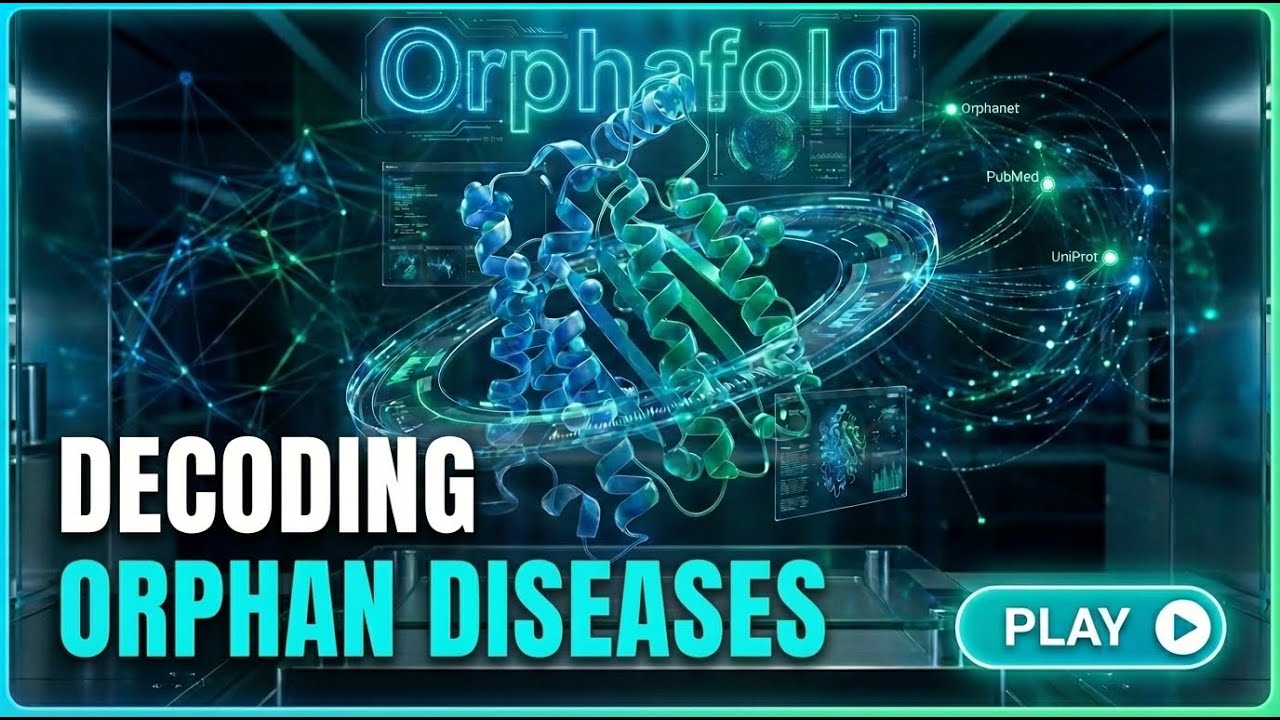
OrphaFold is an AI-powered platform designed to accelerate research into orphan diseases by combining real-time API enrichment with advanced Multi-Agent orchestration and structural biology.
Today, 300 million people live with a rare disease. Yet, 95% of these 7,000+ conditions have no approved treatment. This is largely driven by a chronic lack of funding, economic barriers, and fragmented knowledge trapped in silos.
- Structural Intelligence: Using protein structures (AlphaFold) as a key baseline for discovery.
- Binding Pocket Analysis: Performing comparative analysis of protein binding pockets and 3D folds.
- Democratizing Repurposing: Identifying hidden connections between existing drugs and rare proteins through structural homology.
| 🏠 Search & Home | 🧪 Biological Insights |
|---|---|
 |
 |
| 💊 Hypothesis Lab | 🔬 Research Tracking |
 |
 |
| 👁️ Project Vision | 🧬 Structural Analysis |
 |
 |
| 🧪 Cross-Disease Insights | � Structural Proteomics (AlphaFold) |
 |
 |
| 📚 Bibliography Management | |
 |
OrphaFold orchestrates a 4-agent pipeline to analyze orphan pathologies from multiple biological perspectives:
- Purpose: Establishes the clinical baseline using direct REST APIs.
- APIs & Tools: Orphanet (orphadata.com), OMIM (NCBI E-utilities), Google Search Grounding.
- Output: Prevalence, inheritance patterns, and disease classifications.
- Purpose: Uncovers the molecular pathophysiology and structural machinery.
- APIs & Tools: UniProt, NCBI Gene, ClinVar, AlphaFold DB.
- Output: Target proteins, functional domains, pLDDT confidence, and druggability assessments.
- Purpose: Connects the disease to the broader research and clinical landscape.
- APIs & Tools: PubMed (NCBI), ClinicalTrials.gov, structural homology search.
- Output: Active trials, synthesized bibliography, and cross-disease insights.
- Purpose: Proposes therapeutic candidates by bridging mechanism overlap via Structural Homology (On-Demand).
- APIs & Tools: DrugBank, ChEMBL, Reasoning Engine (thinking budget), 3D Binding Pocket analysis.
- Output: In-silico repurposing hypotheses with feasibility scores based on 3D fold similarity and catalytic site mapping.
- Input: The user enters a rare disease name or description (e.g., "Cystic Fibrosis").
- API Enrichment: The system acts as a "Pre-Flight" layer, simultaneously querying:
- Orphanet, OMIM, UniProt, NCBI Gene, ClinVar, PubMed.
- Agent Orchestration: The gathered context is fed into the Multi-Agent System powered by Gemini 1.5 Pro.
- Synthesis & Homology: The agents reason over the data, perform structural homology analysis to identify shared binding motifs, and generate a structured report.
- Visualization: The frontend renders interactive molecular structures (pdb), clinical data cards, and research timelines directly from the AlphaFold DB.
Prerequisites: Node.js (v18+)
-
Clone the repository:
git clone https://github.com/Paulhb7/orphafold.git cd orphafold -
Install dependencies:
make install # OR npm install -
Configure Environment:
- Create a
.env.localfile in the root directory. - Add your Gemini API Key:
GEMINI_API_KEY=your_api_key_here
- Create a
-
Run Locally:
make dev
# OR
npm run dev
This project is optimized for deployment on Google AI Studio.
Our journey from discovery to impact continues with the following roadmap:
- Direct Docking Simulations: Integrate in-silico simulations directly within the agentic loop to transform hypotheses into predictive scores.
- Agent Development Kit (ADK): Transition to the ADK framework to leverage more comprehensive orchestration and modularity.
- Pilot Beta Tests: Collaborate with geneticists and rare disease researchers to validate the platform's utility in real-world research scenarios.
- Scale Data Sources: Expand the agent pipeline to include more specialized biomedical repositories and real-world evidence (RWE) data.