You signed in with another tab or window. Reload to refresh your session.You signed out in another tab or window. Reload to refresh your session.You switched accounts on another tab or window. Reload to refresh your session.Dismiss alert
Python project to build the Delaunay triangulation of 2D points and solve the Poisson and convection-diffusion equations in different study cases (Cavity and Oven).
Oven study case is inspired from a study case proposed during a class, which was initially solved using the open-source PDE solver FreeFem++.
The utlimate goal was to implement from scratch both a mesher and a PDE solver that could be used for this case. Along the way, additional features were developped such as time-dependant calculations and adaptive meshing.
Study case: Oven heating
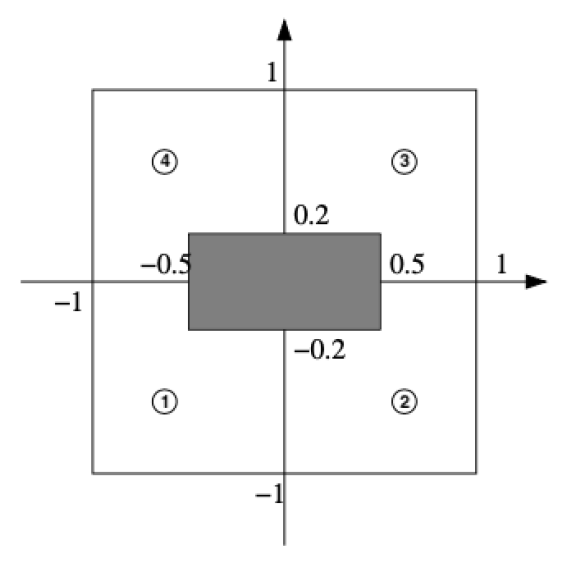
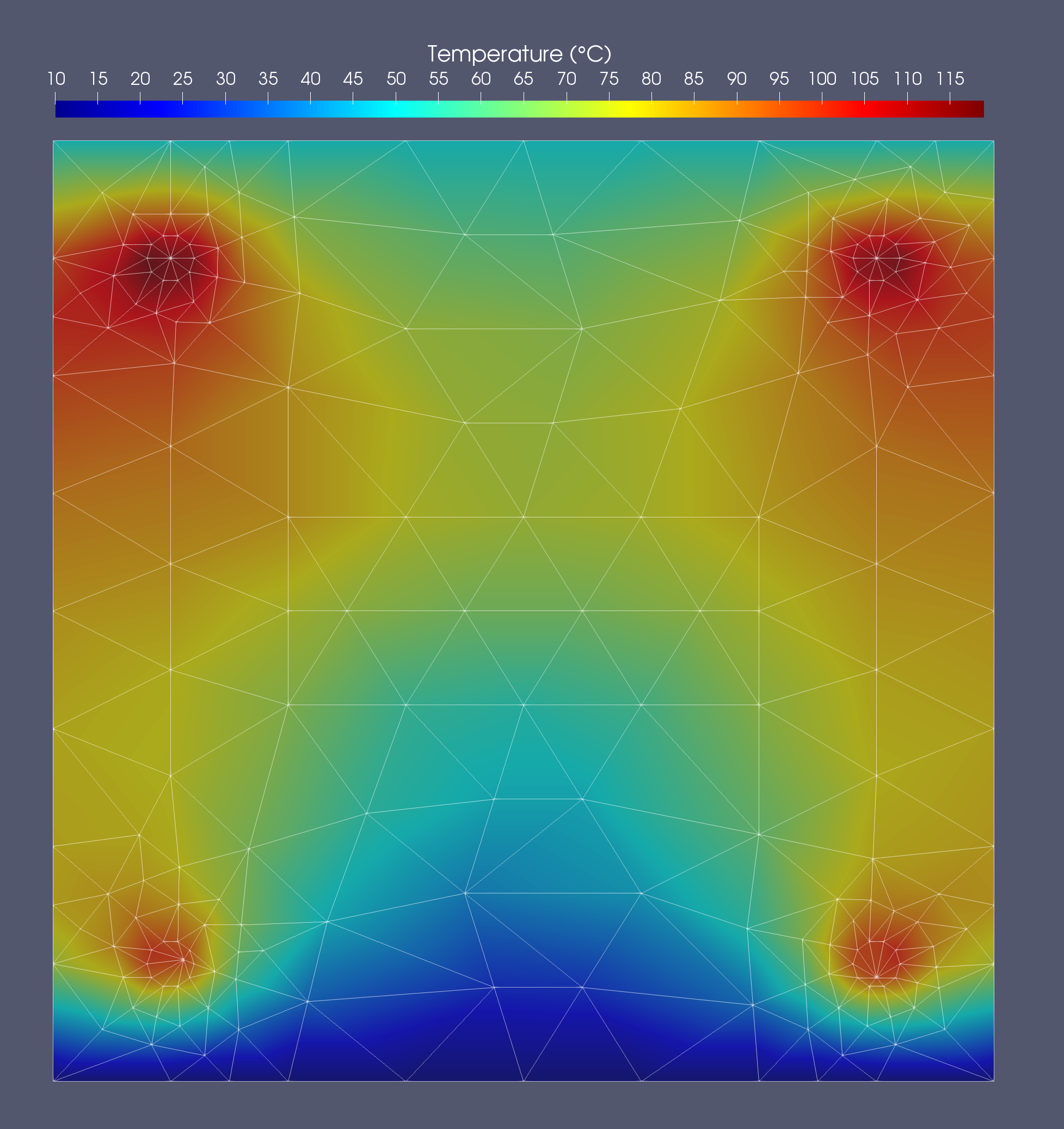
We will note $\Omega$ the opening representing the oven. The oven is a square of 1 m side, and the room is a rectangle of 1 m by 0.4 m, in the center of the oven (to simplify, we will take the origin in the center of the square). We will note $C_i$ the resistors (modeled here as circles of radius 0.05), and placed at the points (±0.75, ±0.75) (initially, $N_r$ = 4).
The upper edge of the furnace $\Gamma_u$ is assumed to be maintained at $T_u = 50 \degree C$, the lower edge $\Gamma_d$ at $T_d = 10 \degree C$, and the two lateral edges $\Gamma_l$ are isolated (zero heat flux). The temperature is thus a solution of the equation
In this equation, $k$ is the thermal diffusion coefficient, which is variable in the oven: it is 1 in the room, and 10 in the rest of the oven. $f$ is the heat source, and will be of the form $f = \sum\limits_{i=1}^{N_r}\alpha_i{1}_{c_i}$, where the $\alpha_i$ coefficients are either chosen (in the straightforward problem), or to be determined (in the inverse problem).
Mesh
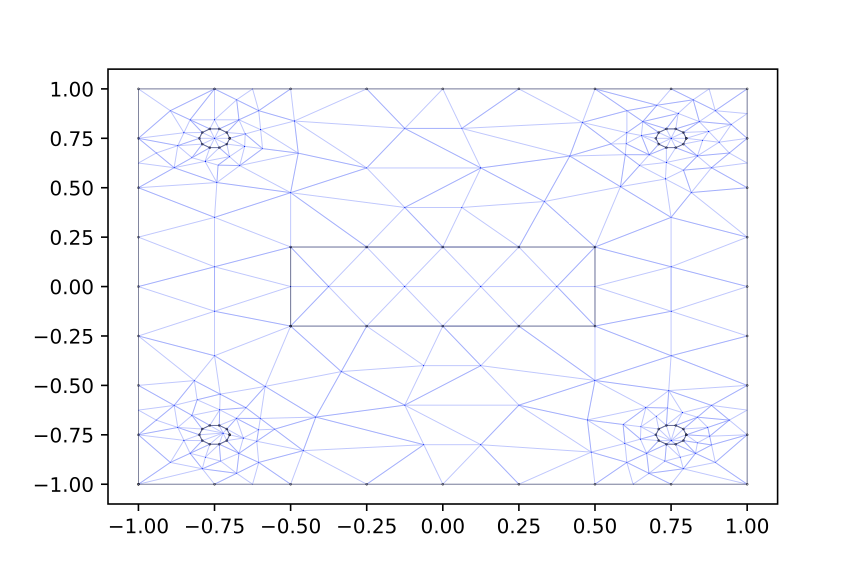
Delaunay triangulation
Unstructured
Constrained
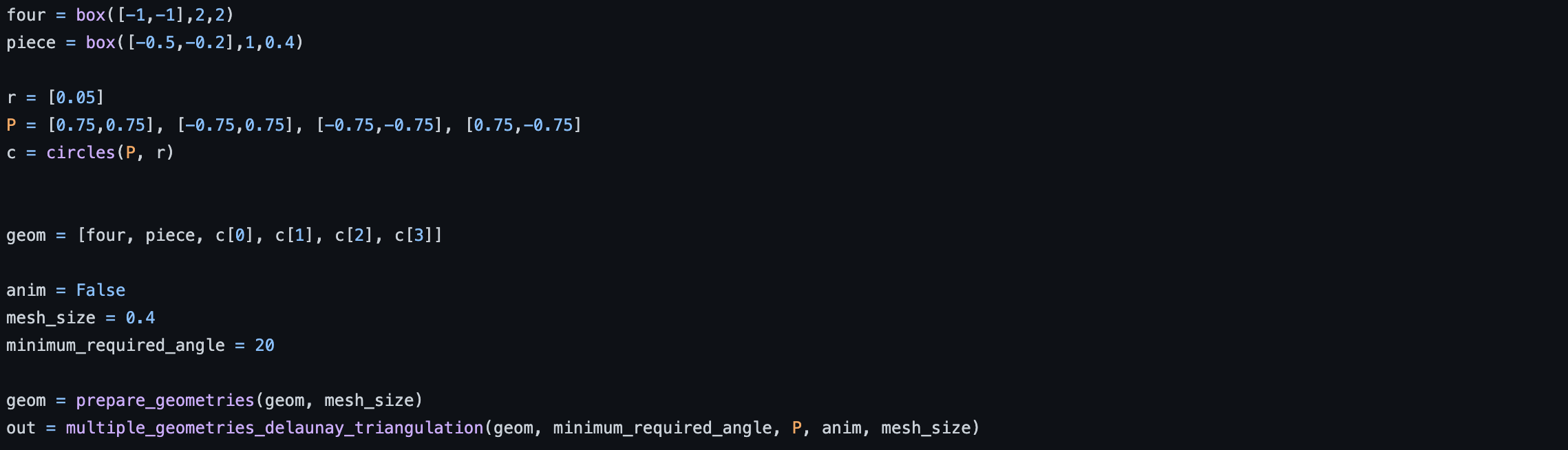
Maximum mesh size
Minimum angle of 20°
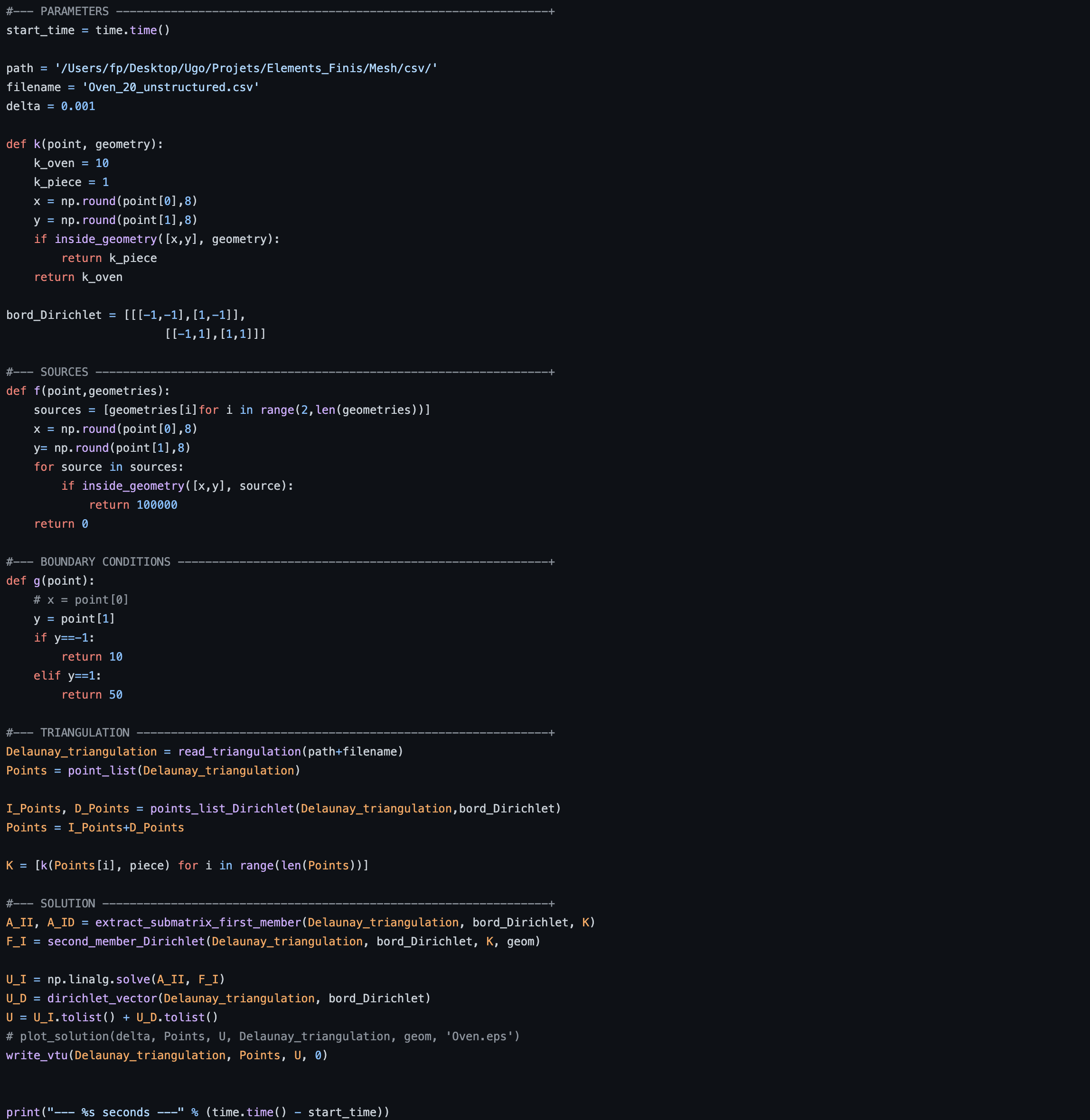
PDE Solver
The variational formulation of the problem is as follows