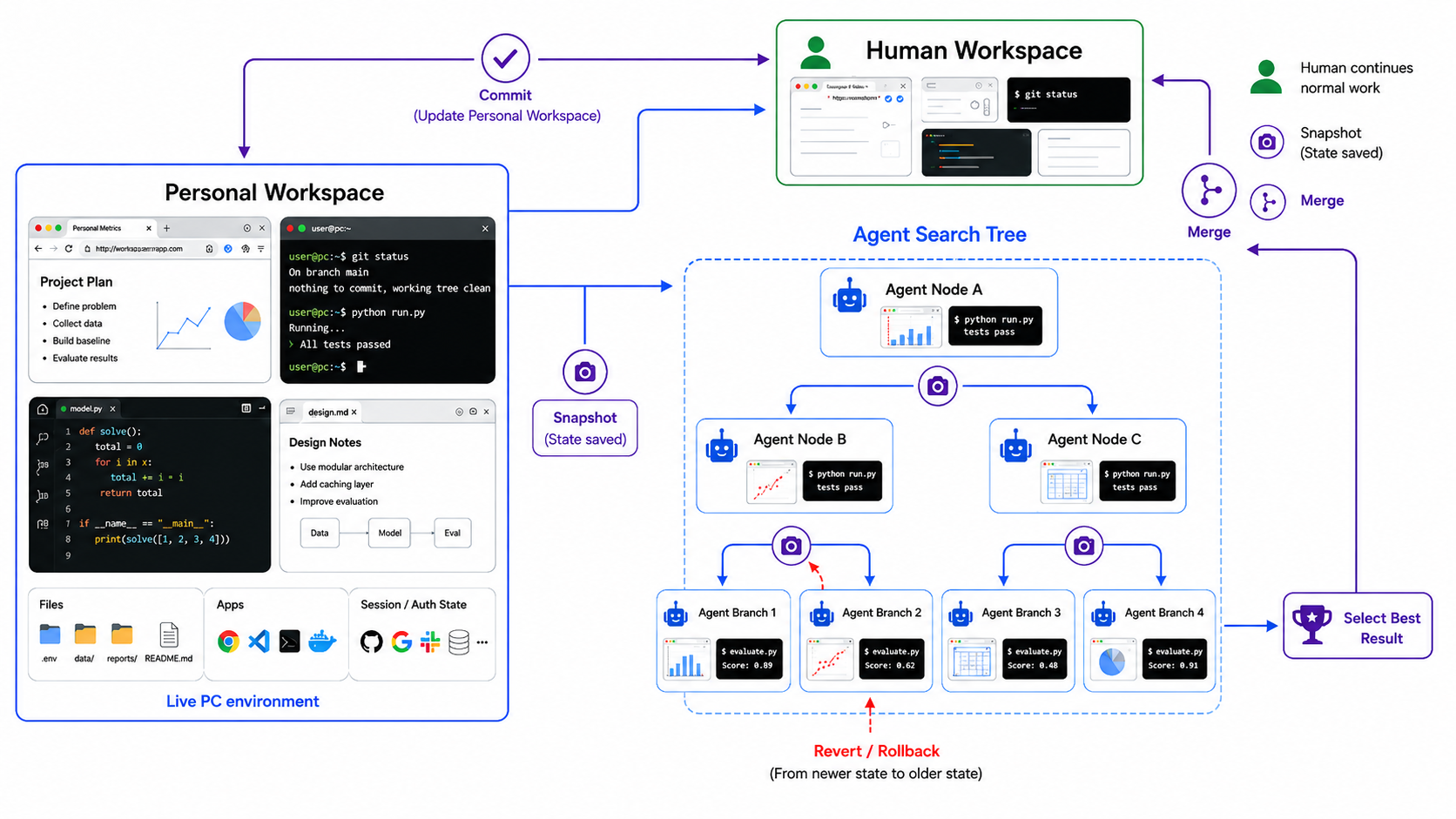
Tclone is a workspace-versioning substrate built for computer-use agents. Tclone provides a versioned personal workspace that can be quickly forked, snapshotted, and rolledback. It forks a live, running container in milliseconds: clones share memory and file-cache pages copy-on-write, so a branch is runnable instantly while its durable checkpoint streams to disk in the background — letting computer-use agents explore many action paths in parallel.
Please find more details in our paper and blog post.
| Directory | Role |
|---|---|
criu/ |
criu tfork + vma_cherrypick / capbypass kernel modules + libcriu |
crun/ |
crun tfork OCI runtime verb |
conmon/ |
--tfork flag |
podman/ |
container clone --live |
linux-pagecache-cow/ |
Linux kernel with a CoW page-cache (filecow) layer |
ubuntu-img/ |
sample webtop image (optional) |
agents/ |
OSWorld evaluation harness |
- Ubuntu x86_64, root access.
- btrfs filesystem at podman's graphroot
(
findmnt -no FSTYPE /var/lib/containers/storage→btrfs).
sudo sysctl -w kernel.io_uring_disabled=2
sudo sysctl -w fs.nr_open=1048576
sudo sysctl -w fs.inotify.max_user_instances=524288
sudo sysctl -w kernel.apparmor_restrict_unprivileged_unconfined=0
Persist by appending to /etc/sysctl.d/90-tfork.conf.
git submodule update --init --recursivesudo apt install podman # podman has some other components we won't modify
# this makes installing components much simpler
sudo ./criu/build.sh # libcriu + kernel modules
sudo ./crun/build.sh # links against in-tree libcriu
sudo ./conmon/build.sh # --tfork flag
sudo ./podman/build.sh # container clone --livelinux-pagecache-cow/ is a modified Linux that
adds a copy-on-write page-cache (filecow) layer shared across
address_spaces when one btrfs subvol is a snapshot of another. With this
kernel running, the default btrfs subvolume snapshot rootfs path of
--live clones shares its file pages with the source through the kernel
CoW path.
# install your distro's kernel build dependencies (gcc, make, bison, flex,
# libelf-dev, libssl-dev, bc, etc.)
cd linux-pagecache-cow
cp config .config
./build_kernel.sh build
sudo ./build_kernel.sh install   # then reboot into the pgcachecow kernel
Verify after reboot:
uname -r
cat /proc/filecow_stats   # ra_unbounded_calls / ra_order_calls grow on fan-out
Run podman through ./podman-tfork.sh — a wrapper that
points the in-tree podman at the in-tree conmon, crun, and libcriu without
touching any system files. It writes a CONTAINERS_CONF (in-tree conmon +
crun, cgroup_manager = "cgroupfs", log_driver = "k8s-file"), sets
LD_LIBRARY_PATH for libcriu, and exports OS4AGENT_CRUN / OS4AGENT_CONMON.
All other arguments pass through to podman.
Wiring:
sudo ./podman-tfork.sh info | grep -A2 -E "conmon:|ociRuntime:|cgroupManager:|graphStatus:|graphRoot:|kernel:|logDriver:"conmon and ociRuntime should point at the in-tree binaries (the
ociRuntime version reads criu_tfork_*); cgroupManager = cgroupfs,
logDriver = k8s-file, graphRoot on a btrfs mount, kernel the
page-cache-CoW build.
The tfork pieces are live:
# all 4 criu kernel modules loaded (criu/build.sh insmods these):
lsmod | grep -E 'vma_cherrypick|criu_capbypass|pkey_state|reparent_task'

# tfork verbs/flags present in the in-tree binaries:
LD_LIBRARY_PATH=$(pwd)/criu/lib/c ./crun/crun --help | grep tfork   # crun tfork verb
./conmon/bin/conmon --help 2>&1 | grep -- --tfork                  # conmon --tfork
sudo ./podman-tfork.sh container clone --help | grep -- --live     # podman --live

# page-cache-CoW kernel running:
cat /proc/filecow_statssudo ./podman-tfork.sh run -d \
--name webtop-src \
--log-driver=k8s-file \
--security-opt seccomp=unconfined \
--security-opt apparmor=unconfined \
--shm-size=2g \
--tmpfs /config:size=512m \
--tmpfs /tmp:size=1g \
--tmpfs /run:size=256m \
-e PUID=1000 -e PGID=1000 -e TZ=Etc/UTC \
-e CUSTOM_USER=admin -e PASSWORD=changeme \
-p 3101:3001 \
ghcr.io/wuklab/webtop:ubuntu-kdesudo ./podman-tfork.sh container clone --live --copies=4 \
--persistent=async \
--tfork-tcp-close --tfork-ghost-limit=$((64 << 20)) \
--name webtop-fan webtop-srcFlags below attach to podman container clone --live. Run
./podman-tfork.sh --tfork-help for the same reference at the shell.
| Flag | Default | Effect |
|---|---|---|
--live |
off | engage the tfork path; required to clone live. |
--copies N |
1 | fan out to N parallel clones from one source freeze. |
--persistent[=async|sync] |
off | persist source memory to clone's image-dir (pages-*.img). Bare --persistent → async; =sync flushes before clone returns. |
--tfork-ghost-limit BYTES |
256 MiB | raise CRIU's per-dump ghost-file cap above its 1 MiB default. GUI apps (chromium, firefox, KDE) keep multi-MiB unlinked tmp files mmap'd. 0 falls back to CRIU's default. |
--tfork-tcp-close[=BOOL] |
true | dump ESTABLISHED TCP sockets as closed (clones with fresh netns reconnect cleanly). =false reverts to CRIU's refuse-on-established. |
If podman container clone --live hangs in Phase A (CRIU's cgroup walk)
and eventually fails with timeout waiting for N tfork.pid* files, the
cgroup tree has likely accumulated empty zombie cgroups from prior crashed
clones. CRIU enumerates every cgroup the source process belongs to, and a
few hundred thousand empty entries push past the 60s podman timeout.
sudo ./tfork-cgroup-cleanup.shcheck agent-s README
- btrfs only
- rootful only
- amd64 only
- Filecow layers are reclaimed with their cached inode/mapping owners rather than eagerly when a child is deleted. Repeated unchanged forks reuse the current layer, so retained layers are bounded by changed generations instead of the total fork count.
This repository contains multiple components under their respective
licenses (GPL-2.0, LGPL-2.1, Apache-2.0, GPL-3.0). The license of a given
file is the one of the directory it lives in; see the LICENSE/COPYING
file there.