



mm-evalkit is the evaluation benchmark for MuscleMimic policies. It compares
rollout NPZ files with recorded human data at three physiological levels:
- kinematics: joint-angle RMSE and waveform correlation;
- kinetics: joint-moment and vertical-GRF RMSE and waveform correlation; and
- neuromuscular behavior: muscle-activation correlation and muscle RSA against human EMG.
The benchmark produces population and subject-matched metrics, human reference baselines, statistical reports, figures, and exclusion audits.
MM-EvalKit does not redistribute human recordings. Download each dataset from its original archive and cite its accompanying paper using the entries in Citation and dataset credit.
| Dataset | Official resources | Evaluation | Analysis unit |
|---|---|---|---|
| Gait120 | Data · Paper | Joint angles, joint moments, vertical GRF, muscle activation, and EMG | Subject and gait cycle |
| Wang | Data · Paper | Joint angles, muscle activation, and EMG | Population gait profile |
| ULTRA-MoCap | Data · Paper | Arm kinematics, muscle activation, and EMG | Subject, movement, and trial |
Gait120 provides all three evaluation levels over one retained subject cohort.
The PyPI distribution is named mm-evalkit; it provides the mm_evalkit Python
package and the mm-evalkit command-line interface. Install it with Python 3.11 or
newer:
python -m pip install mm-evalkitSynchronized visualization requires the render extra:
python -m pip install 'mm-evalkit[render]'mm-evalkit paths set gait120 /absolute/path/to/Gait120
mm-evalkit paths set wang /absolute/path/to/Wang
mm-evalkit paths set ultra-mocap /absolute/path/to/ULTRA-MoCap
mm-evalkit paths showAn explicit --dataset_dir on an evaluation command overrides the saved path.
Evaluation commands accept a YAML file containing one or more rollout exports:
policies:
  - id: policy-a
    label: "Policy A"
    trajectory_data_path: trajectory_data/policy-a/episodes.npz
    color: "#2a78d6"
    linestyle: "-"
The rollout motion_group and traj_id values determine subject and trial
identity. Compared policies must use the same ordered references.
mm-evalkit evaluate gait120 \
  --motion_group GAIT120_TESTING \
  --policy_config_file policies.yaml \
  --plots_dir results/gait120 \
  --kinetics_reference_dir /path/to/gait120-kinetics
--kinetics_reference_dir enables the kinetics layer. The rollout NPZ provides
policy joint-force and foot-contact-force signals. Human joint moments come
from inverse dynamics; human GRF comes from corrected Gait120 force-plate
measurements.
mm-evalkit evaluate wang \
  --policy_config_file policies.yaml \
--plots_dir results/wangmm-evalkit evaluate ultra-mocap \
--motion_group ULTRA_MOCAP_BIMANUAL_TESTING_SUBJECTS \
--policy_config_file policies.yaml \
--plots_dir results/ultramocapEach run requires an empty output directory. Dataset-specific options are available through:
mm-evalkit evaluate --list-datasets
mm-evalkit evaluate gait120 --help
mm-evalkit evaluate wang --help
mm-evalkit evaluate ultra-mocap --helpEvaluation outputs include:
- population and subject-matched metric tables;
- waveform and summary figures;
- paired Wilcoxon reports with Holm correction;
- retained-subject and exclusion audits; and
- run manifests where the workflow provides them.
Gait120 kinetics writes kinetics_profiles.svg, kinetics_metrics.svg,
kinetics_metrics.csv, and kinetics_input_omissions.csv.
Each dataset command documents its complete configuration through --help.
Input archives are validated before analysis starts.
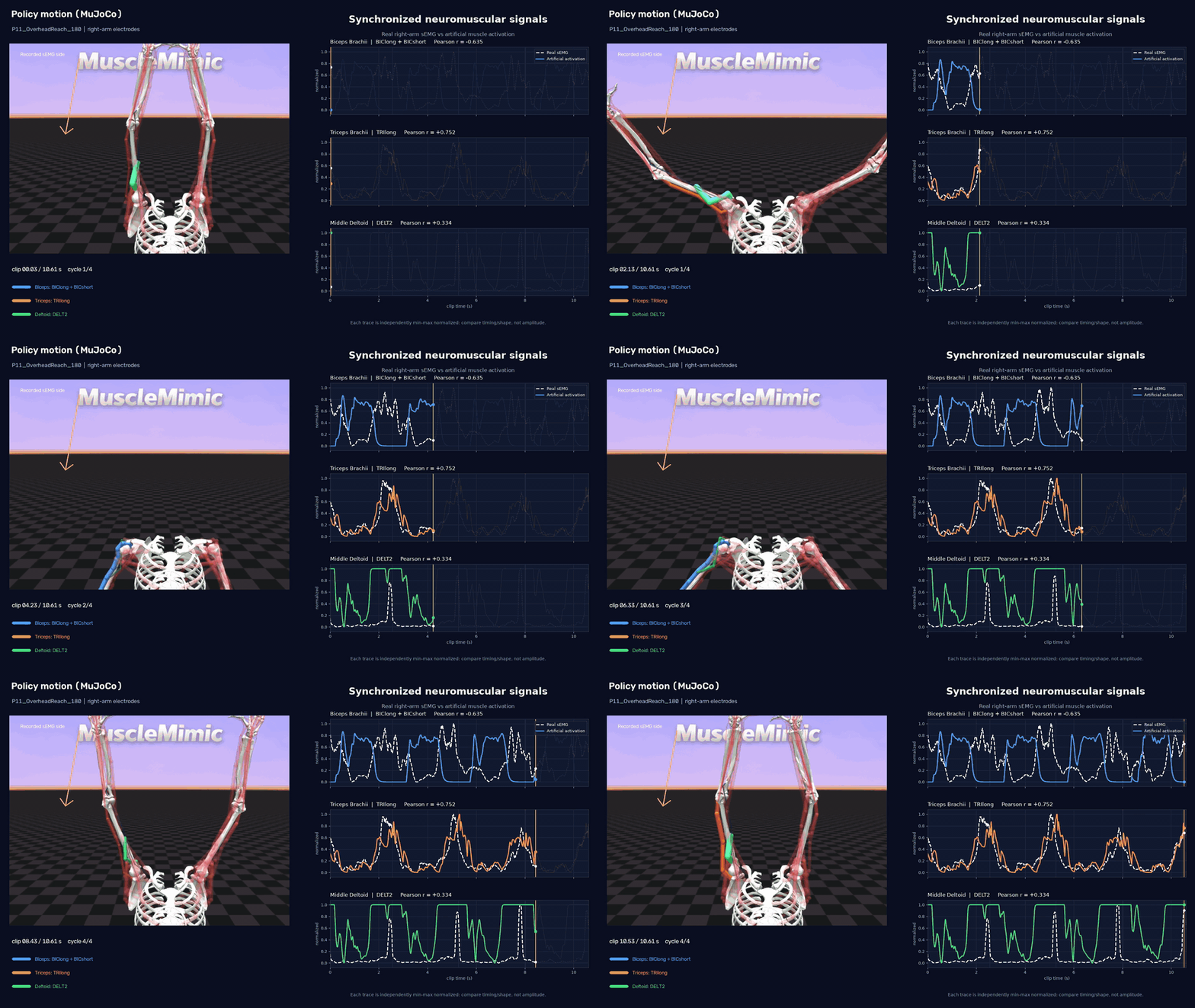
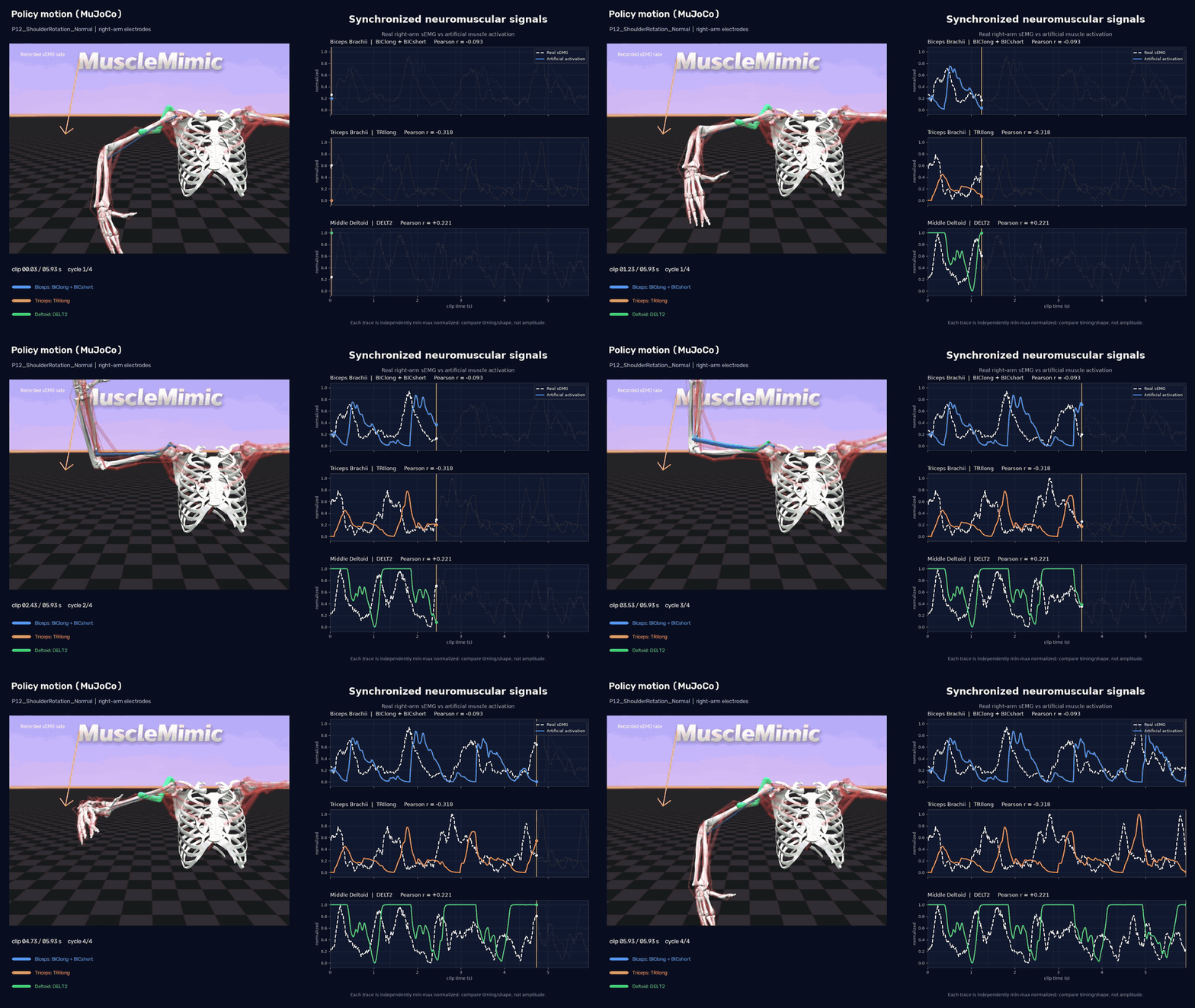
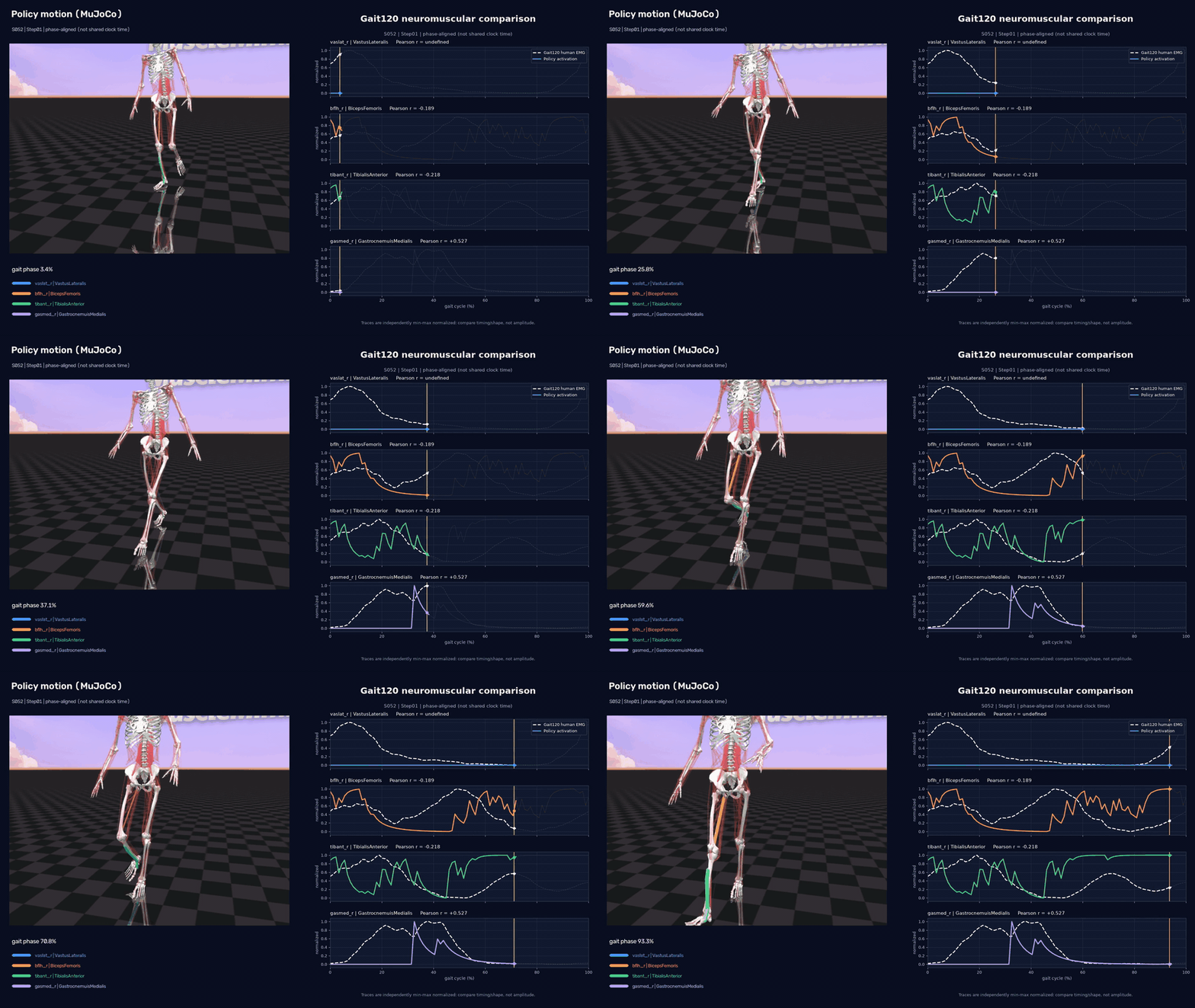
Renderers synchronize policy motion with human and artificial muscle signals:
mm-evalkit render gait120 --help
mm-evalkit render ultra-mocap --helpOverhead reach (P11_OverheadReach_180) · ULTRA-MoCap dataset
Shoulder rotation (P12_ShoulderRotation_Normal) · ULTRA-MoCap dataset
Gait step (S052_step01) · Gait120 dataset
Dataset adapters declare their source contract, workflow, CLI entrypoint, and tests. Keep dataset files outside the repository and document their license and access requirements.
External packages register adapters in pyproject.toml:
[project.entry-points."mm_evalkit.datasets"]
example = "example_package.cli:main"

[project.entry-points."mm_evalkit.renderers"]
example = "example_package.render:prepare_clip"
Validation should cover a minimal valid dataset, malformed inputs, alignment, normalization, metrics, registry discovery, and an end-to-end run. The architecture guide defines the extension boundaries.
git clone https://github.com/amathislab/mm-evalkit.git
cd mm-evalkit
make install-dev
make format
make lint
make test
make precommit
Ruff and pre-commit cover every Python file in the repository.
See Architecture for data flow, module ownership, input contracts, and public extension points.
If you use MM-EvalKit, cite the MuscleMimic paper:
@article{Li2026MuscleMimic,
  title={Towards Embodied AI with MuscleMimic:
    Unlocking full-body musculoskeletal motor learning at scale},
  author={Li, Chengkun and Wang, Cheryl and Ziliotto, Bianca and
    Simos, Merkourios and Kovecses, Jozsef and Durandau, Guillaume and
    Mathis, Alexander},
  journal={arXiv preprint arXiv:2603.25544},
  year={2026}
}
Please also cite every human dataset used in your evaluation:
@article{boo2025comprehensive,
  title={Comprehensive human locomotion and electromyography dataset: Gait120},
  author={Boo, Junyo and Seo, Dongwook and Kim, Minseung and Koo, Seungbum},
  journal={Scientific data},
  volume={12},
  number={1},
  pages={1023},
  year={2025},
  publisher={Nature Publishing Group UK London}
}

@article{wang2023wearable,
  title={A wearable real-time kinetic measurement sensor setup for human locomotion},
  author={Wang, Huawei and Basu, Akash and Durandau, Guillaume and Sartori, Massimo},
  journal={Wearable technologies},
  volume={4},
  pages={e11},
  year={2023},
  publisher={Cambridge University Press}
}

@article{fritsche2026ultra,
  title={ULTRA-MoCap: A multimodal IMU and sEMG dataset for upper body joint kinematics analysis},
  author={Fritsche, Oliver and Camacho, Steven and Hossain, Md Sanzid Bin and Halfpenny, Tyler and Arciniegas, Carlos and Dranetz, Joseph and Hadley, Dexter and Guo, Zhishan and Choi, Hwan},
  journal={Scientific Data},
  volume={13},
  number={1},
  pages={622},
  year={2026},
  publisher={Nature Publishing Group UK London}
}