
The Domain-Driven Design (DDD) pattern is an approach to software development that focuses on modeling software to closely reflect complex business domains. It's not just a set of technical practices, but a way of thinking and a set of priorities aimed at accelerating software projects that deal with complex domains.
DDD Schema (image extracted from zankavtaskin webpage).
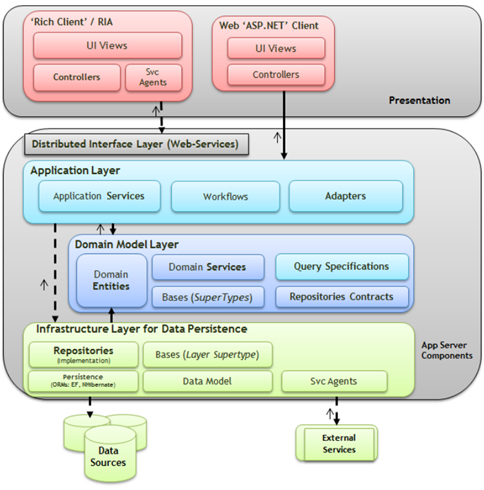
-
Focus on the Core Domain: DDD emphasizes the importance of deeply understanding and focusing on the core domain of the business, as this is where the true value of the software lies.
-
Ubiquitous Language: DDD encourages the use of a common, business-centric language across the team, including both developers and domain experts. This ubiquitous language is used in code, specifications, and discussions, ensuring that everyone has a clear and consistent understanding of the domain concepts.
-
Model-Driven Design: In DDD, the domain model is at the heart of the design. This model is constantly refined and evolved through a close collaboration between domain experts and software practitioners.
-
Bounded Contexts A bounded context is a central pattern in DDD. It defines the limits of a particular model so that models in different contexts do not conflict. This allows teams to work independently without the need for constant communication, and it also helps in managing complexity.
-
Entities and Value Objects: Entities are objects defined by their identity, rather than their attributes. Value objects, on the other hand, are defined by their attributes and have no conceptual identity.
-
Aggregates: An aggregate is a cluster of domain objects that can be treated as a single unit. Aggregates ensure the integrity of data by enforcing invariants for the entire group of objects.
-
Repositories and Domain Services: Repositories are used for retrieving domain objects, while domain services contain business logic that doesn't naturally fit into entities or value objects.
-
Domain Events: These are events that are significant within the domain. They can be used to trigger side effects, integrate with other systems, or inform other parts of the system about important occurrences.
-
Anti-Corruption Layer (ACL): This layer is used to protect your domain from external influences and unwanted concepts from other systems or bounded contexts.
-
Continuous Integration: This is a practice to ensure that the model and the ubiquitous language stay coherent across the entire team.
-
Strategic Design: DDD also involves strategic decisions about how to divide systems into bounded contexts and microservices, and how these should interact.
‼️ Implementing DDD effectively requires a deep understanding of the business domain, strong technical skills, and close collaboration between software developers and domain experts. It is especially beneficial in complex domains where the business logic and rules are intricate and evolving.
The concept of a Bounded Context is a central pattern in Domain-Driven Design (DDD) and plays a crucial role in managing complexity in large systems. Here's a detailed overview:
📛 WIP...