


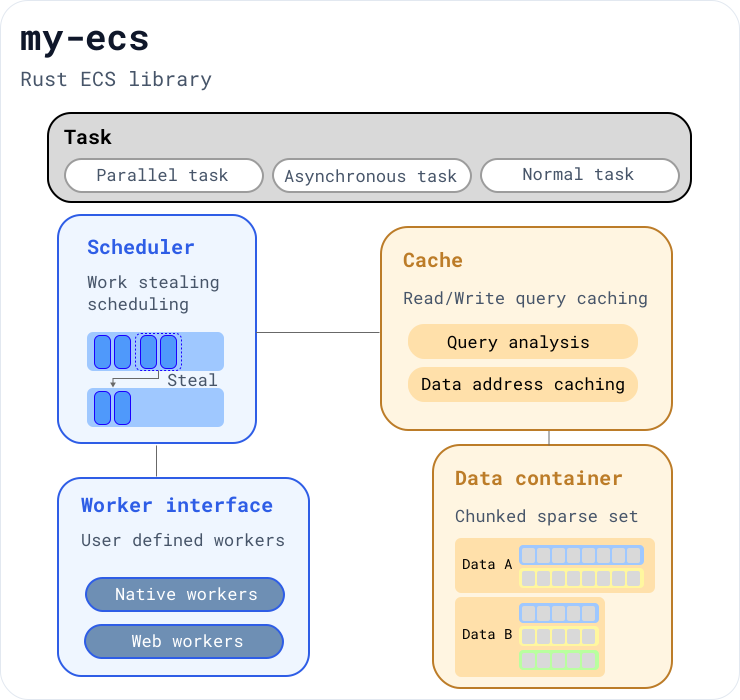
my-ecs is an Entity Component System library for Rust with parallel system
execution, built-in async task integration, and wasm32 support.
- Parallel scheduling by default.
Systems can run across multiple worker threads while
my-ecsenforces data access rules for components, entities, and resources. - Explicit data access. Systems declare what they read or write, and the scheduler uses that information to order execution safely.
- Async integration. Systems can enqueue futures through the built-in posting/execution flow, which makes it practical to mix ECS logic with async work.
- Native and web targets.
The crate supports native workers and includes web-worker support for
wasm32-unknown-unknown.
Component: plain data attached to entities.Entity: a collection of components.System: logic that reads or writes ECS data.Resource: unique global data stored once in the world.Filter/Select: type-level queries created with thefilter!macro.
my-ecs-demo-small.mp4 |
Rendering the Mandelbrot set with multiple threads using my-ecs Try the demo here |
You need Rust's cargo command to run these examples. If cargo is not available yet, install
Rust first.
If you already have this repository checked out, run the smallest example first:
cargo run -p my-ecs --example hello_worldExpected output:
Object: (1, 2)
MovableObject: (3, 4)
Object: (1, 2)
MovableObject: (13, 14)
To try my-ecs in a new Rust project:
cargo new my-ecs-hello
cd my-ecs-hello
cargo add my-ecs
Then replace src/main.rs with this full program:
use my_ecs::prelude::*;

#[derive(Component)]
struct Position {
    x: u32,
    y: u32,
}

#[derive(Component)]
struct Movable;

#[derive(Entity)]
struct Object {
    pos: Position,
}

#[derive(Entity)]
struct MovableObject {
    pos: Position,
    _m: Movable,
}

filter!(AllPositions, Target = Position);
filter!(MovablePositions, Target = Position, All = Movable);

fn main() {
    Ecs::create(WorkerPool::with_len(2), [2])
        .register_entity_of::<Object>()
        .register_entity_of::<MovableObject>()
        .add_once_systems((
            create_objects,
            print_positions,
            move_objects,
            print_positions,
        ))
        .step();
}

fn create_objects(ew: EntWrite<(Object, MovableObject)>) {
    let (mut objects, mut movable_objects) = ew.take_recur();

    objects.add(Object {
        pos: Position { x: 1, y: 2 },
    });

    movable_objects.add(MovableObject {
        pos: Position { x: 3, y: 4 },
        _m: Movable,
    });
}

fn move_objects(mut positions: Write<MovablePositions>) {
    for Position { x, y } in positions.iter_mut().flatten() {
        *x += 10;
        *y += 10;
    }
}

fn print_positions(positions: Read<AllPositions>) {
    for container in positions.iter() {
        for Position { x, y } in container.iter() {
            println!("{}: ({x}, {y})", container.entity_name().unwrap());
        }
    }
}
Run it:
cargo runWhat this program does:
Positionis a component: plain data that can be attached to an entity.ObjectandMovableObjectare entity types: named bundles of components.Movableis a marker component used to select only movable entities.filter!creates reusable queries for systems.Read<AllPositions>reads matching components.Write<MovablePositions>mutates matching components.EntWrite<(Object, MovableObject)>creates entities.
For a slower walkthrough of these Rust and ECS terms, see Getting Started guide.
Parallel execution depends on explicit access declarations. Reads may run together, while writes are exclusive.
fn read_components(v: Read<A>) { /* ... */ }
fn write_components(v: Write<B>) { /* ... */ }
fn read_resource(v: ResRead<C>) { /* ... */ }
fn write_resource(v: ResWrite<D>) { /* ... */ }
fn write_entity(v: EntWrite<E>) { /* ... */ }
Because systems state their access up front, my-ecs can detect dependency
conflicts and schedule safe execution automatically.
examples/hello_world.rs: the smallest complete program for first-time users.examples/parallel.rs: usingrayonwith ECS-aware parallel iteration.examples/async.rs: posting futures and applying their results back into the ECS world.examples/async_io.rs: separating async I/O work from compute-heavy work by worker group.demo/: a browser demo that renders the Mandelbrot set withmy-ecs.
Most applications can start with:
use my_ecs::prelude::*;The prelude re-exports the main ECS API, derive macros, helper macros, and
rayon::prelude::*.