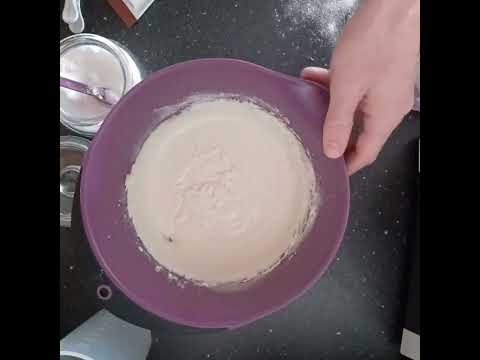
For 320g pizza balls with 60%hydration:
- 120ml water
- 200g Caputo Nuvola flour
- 2g dry yeast for bakery
- a pinch of sugar
- a pinch of salt
- a splash of good quality olive oil
- semolina to extend the dough at the end
- Mix in a bowl
- the water (I prefer to have the water a bit warm, not too hot)
- the sugar
- the dry yeast
- Add half of the flour incrementally while mixing it until the texture is still flowing but with resistance.
- Leave in a warm environment, like the oven with the light on but no additional powere, during a couple of hours.
- This will speed up the transformation of the flour with the yeast into gluten structures.
- You'll see the mix becomes alive, if you try to disolve it with water, it will be very difficult.
- Add the rest of the flour and the salt, and kneed the dough until it is completely homogeneous, and stops sticking to your skin.
- Put the dough in a receipient that can fit in the fridge.
- Cover the dough with a splash of olive oil.
- Cover the receipient with a lid, or plastic wrap.
- Leave it in the fridge for 8 to 12 hours (or even longer if you have time).
- Take it out of the fridge ~6 hours before the baking should start.
- Split the dough into balls.
- Cover the balls to avoid the outer part getting dry.
- Either a tray with a lid or plastic wrap should do.
- Leave them at room temperature for ~2h.
- Fold each ball over itself and cover them again.
- Leave them for ~90min.
- Fold them again and cover them.
- Leave them for ~90min.
- Fold them again and cover them.
- Leave them for ~60min and start pre-heating the oven at 470ºC (or otherwise to its max if 470ºC can't be reached).
- In normal electrical ovens I recommend using a pizza stone leaving 10-15cm to the top of the oven.
- Depending on how long your oven takes to reach the temperature you may adjust the start of the heating to avoid wasting energy.
- The important point is the temperature in the stone when you start baking, it should already be at the desired temperature. You may use a laser thermometer to check it.
- When the temperature is reached switch the oven to produce heat mainly from the upper part, no fan is needed.
When it's time to bake:
- Spread some semolina on a clean surface.
- Put a dough ball on it.
- Extend the dough by gently pressing with your fingers, trying to keep the internal structure of the gluten chains unbroken.
- The fingers should leave a multi crater like surface on the dough, like a moon landscape.
- You may take the extended dough onto your nuckles and use both hands to further extend the pizza base and make it a bit thinner.
- I like to keep the borders a bit thicker, but the rest as thin as possible. It's just a matter of taste.
- Remove the extra semolina from the pizza base, move the semolina on the surface into a corner, and leave the pizza base on the surface without semolina. It shouldn't stick onto the surface.
In order to introduce it into the oven, you can try to build the pizza on top o a cardboard surface. Cardboard makes it super easy to slip the pizza into the pizza stone. With a bit more of practice you may try to use a metal peal to do the same.
Leave the pizza in the oven until baked to your liking. In order to get all the pizza properly baked, I recommend to turn the pizza 180º (not upside-down, please) in the middle of the process so the front and the back are equally baked.
Repeat, try, fail, iterate, improve... But more than anything, enjoy the process, it's awesome. I'm still getting there, and not on a hurry at all to master it.