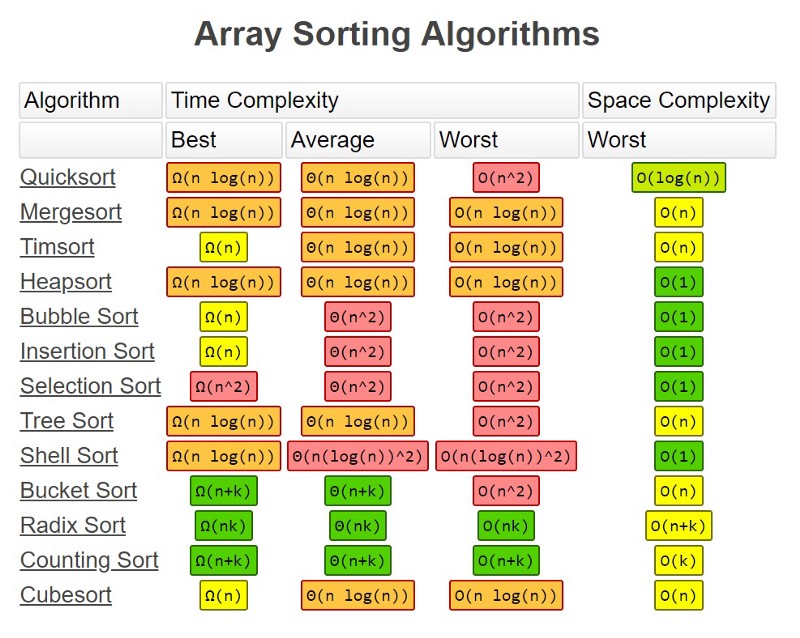
"Transforms input using no auxiliary data structure. It updates input sequence only through replacement or swapping" . In-place means that the algorithm doesn't use extra space for manipulating the input but may requires a small though non-costant extra space for its operations.
- In-Place Algorithm
- O(n²) Quadratic
- 10 items will take 100 steps, n items will take n²
- Non constant extra space O(n) sometime O(logn)
- Stable Sort
- O(n²) Quadratic
- 10 items will take 100 steps, n items will take n²
- Unstable Sort
- In-Place Algorithm
- O(n²) Quadratic
- Stable Sort (It uses shifting)
- Variation of insertion sort
- Less shifting
- Knuth Sequence
- Big gap (K) to validate
- K = n/2 if K is equals to 1 will convert in Insertion Sort ( n length of array)
- In-Place Algorithm
- O(n²) Quadratic
- Unstable Sort
- A lower performance
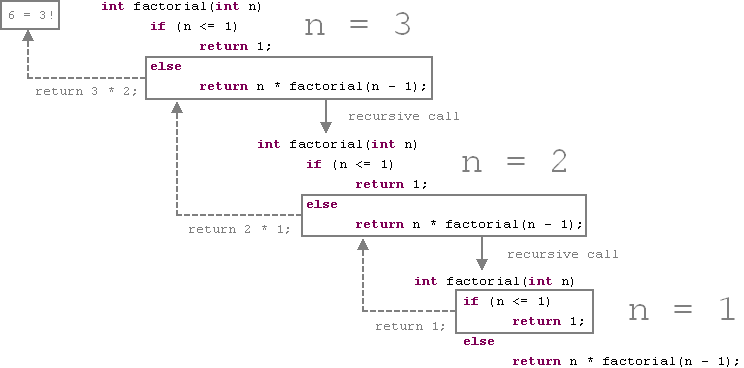
- Your call will be stack
- It's more formal than other ways of coding
- You'll need to use a breaking condition
- Recursive Algorithm
- Splitting and Merging
- Not In-Place Algorithm
- Stable Sort
- O(n log n)
- Recursive Algorithm
- Use Pivot
- In-Place Algorithm
- O(n log n) in the worst case, it makes O(n²)
- Unstable Algorithm
- Recursive Algorithm

- O(n) Linear
- non-describe values
- Not In-Place Algorithm
- Stable Sort
- Data must be integers or strings
- O(n)
- In-Place Algorithm
- as counting sort but with more steps
- In-Place Algorithm
Or pivot element is the element of a matrix, or an array, which is selected first by an algorithm, to do certain calculations.
an in-place algorithm is an algorithm which transforms input using no auxiliary data structure and algorithm which is not in-place is sometimes called not-in-place or out-of-place
Is a method of solving a problem where the solution depends on solutions to smaller instances of the same problem.
Stable is when the algorithm if it maintains the relative order but if the algorithm swap them then it becomes unstable.