The unofficial Agoda API that returns live per-room rates for a specific stay, with the pre-discount price sitting next to the price you would actually pay, and the cancellation terms attached to every offer.
Actor page: apify.com/johnvc/agoda-hotel-api Input schema: apify.com/johnvc/agoda-hotel-api/input-schema
Agoda gates its own developer API behind a partner programme, so most people searching for an Agoda API end up with nothing they can call. This repo shows how to use the Agoda Hotel API on Apify instead: give it a destination and a check-in and check-out date, and it returns each property as structured JSON with a full roomRates table, a lowestPricePerNight lifted to the top of the record, an available flag, and the guest score plus its reviewScoreBreakdown. A second mode pulls hotel reviews from property URLs, one row per review, with what the guest liked and what they disliked kept as separate fields wherever the source splits them that way. Everything here runs from Python with uv, or from Claude, Cursor, and ChatGPT over MCP.

The Agoda API in this repo has three modes, and search is the one that carries pricing. You pass locations (up to 20 destinations, cities or regions or landmarks), a checkIn and checkOut date as YYYY-MM-DD, the number of adults, and optionally a currency and a point-of-sale country. Dates are required, and that is deliberate: a hotel does not have one price, it has a price for a set of nights at a given occupancy, so a dateless search has no meaningful answer. Each property comes back with roomRates, one entry per bookable offer, each carrying roomType, bedConfiguration, pricePerNight, originalPricePerNight, taxesAndFeesIncluded, nights, and a policies list that tells you whether the rate is refundable. The cheapest offer is lifted into lowestPricePerNight so a rate monitor can diff a single number between runs instead of walking the whole tree. The other two modes take hotelUrls: property returns the full property record (description, facilities, coordinates, location rating), and reviews returns guest reviews, which is what you want when an OTA rate monitoring dashboard needs sentiment next to price. A typical job is a scheduled run over one destination and a fixed stay, appending lowestPricePerNight to a table each morning so you can see rates move. Every example in this repo computes its stay dates relative to today, so nothing here asks for a date in the past.
- Python 3.11 or higher
- An Apify account and API key (get a free key here)
-
Clone the repository
git clone https://github.com/johnisanerd/Apify-Agoda-Hotel-API.git cd Apify-Agoda-Hotel-API -
Install dependencies with UV
# Install UV if you do not have it:
curl -LsSf https://astral.sh/uv/install.sh | sh

# Install project dependencies:
uv sync
-
Configure your API key
cp .env.example .env
# Edit .env and add your Apify API key
# Get your free API key at: https://apify.com?fpr=9n7kx3
-
Run the example
uv run python agoda-hotel-api-example.py

# Or pick a recipe:
uv run python agoda-hotel-api-example.py --example rate-watch
uv run python agoda-hotel-api-example.py --example free-cancellation
uv run python agoda-hotel-api-example.py --example property-detail
uv run python agoda-hotel-api-example.py --example reviews
export APIFY_API_TOKEN="your_api_key_here"
uv run python agoda-hotel-api-example.py
The default run searches one destination for three properties on a stay 45 days out. Billing is per result returned, so maxResultsPerInput is your cost dial: it is set to 3 in every example on purpose, and you should raise it only once you know your budget.
You get the rate, not just the listing. Plenty of hotel data sources will hand you a name, an address, and a star rating. This one returns the offer table for a real stay: every bookable room with its nightly price, the tax position, and the cancellation terms. That is the difference between a directory and something you can build a pricing product on.
Both prices, side by side. Each offer carries pricePerNight and originalPricePerNight. The gap between them is the advertised saving, so you can measure how deep a discount really is instead of taking the badge at face value.
Cancellation terms are per offer, not per hotel. The policies list sits inside each roomRates entry, so refundable and non-refundable rates are separable client side. The free-cancellation recipe in this repo does exactly that with one list comprehension.
One number to diff. lowestPricePerNight is the cheapest offer across every room, lifted to the top level. A scheduled OTA rate monitoring job can compare that single field between runs and only dig into roomRates when it moves.
Hotel reviews as structured rows. Reviews mode gives you one row per guest review with rating, authorName, reviewDate, nightsStayed, and reviewLanguage, plus the property's own propertyReviewScore and propertyScoreBreakdown on every row. Where the source splits a review into what the guest liked and what they disliked, you also get reviewPositive and reviewNegative as separate fields instead of one blob of text. Property records carry reviewScore, reviewCount, and a reviewScoreBreakdown across cleanliness, comfort, location, facilities, staff, and value for money.
No key to beg for. You do not apply to a partner programme. You bring an Apify token and call it from Python, from a scheduled task, or from an MCP client.
- Three modes in one Actor:
search(destination plus dates, returns live rates),property(full detail from hotel URLs), andreviews(guest reviews from hotel URLs) - Up to 20 destinations or 200 hotel URLs per run
- Rates quoted in the
currencyand point-of-salecountryyou choose, so cross-market comparisons are like for like adultsoccupancy is part of the query, because occupancy changes the ratemaxResultsPerInputcaps properties per destination or reviews per hotel, and doubles as the cost control- Results push in chunks as they complete, so rows arrive during the run rather than all at the end
- Every row carries a
result_typeofproperty,review, orerror, so partial failures never look like missing data - Inputs that return nothing produce an explicit error row with a plain-language
error_message - Dates are validated before anything is sent upstream, so a bad stay window fails in seconds instead of hanging
- Every row carries
fetched_at, a UTC timestamp, which is what makes a time series out of repeated runs - Property and review rows both include a one-line plain-language
summary
Each recipe is a named function in agoda-hotel-api-example.py. All of them keep maxResultsPerInput at 3 or less and compute stay dates from today.
uv run python agoda-hotel-api-example.py --example rate-watchSearches one destination for a fixed stay with currency and country pinned, then prints one CSV line per property: fetched_at, name, stay window, currency, lowestPricePerNight, available. Append that to a file on a schedule and you have a price history.
uv run python agoda-hotel-api-example.py --example free-cancellationRuns a search, then filters each property's roomRates down to offers whose policies mention free cancellation, dropping anything marked non-refundable. Prints the room type, nightly price, and the exact policy text with its cancel-by date.
uv run python agoda-hotel-api-example.py --example property-detailProperty mode takes hotelUrls and needs no dates. You get the address, coordinates, description, popularFacilities, locationRating and its label, and the whatsNearby groups. There is no rate table in this mode, because rates only exist for a specific stay.
uv run python agoda-hotel-api-example.py --example reviewsReviews mode returns one row per guest review with rating, authorName, reviewDate, nightsStayed, and reviewLanguage, alongside the property's own score and breakdown. Where the source splits the review, reviewPositive and reviewNegative come through as separate fields, and ownerReply appears where the property replied. Reviews are slower than search, so allow several minutes per batch and keep maxResultsPerInput low while testing.
Schedule tip: save any of these inputs as an Apify Task and schedule it to run daily or weekly. Rate monitoring is only useful as a series, and a scheduled task means the dataset keeps growing without anyone touching it.
{
  "mode": "search",
  "locations": ["Singapore"],
  "checkIn": "2027-03-14",
  "checkOut": "2027-03-17",
  "adults": 2,
  "currency": "USD",
  "country": "US",
  "maxResultsPerInput": 3
}{
"mode": "search",
"locations": ["Bangkok", "Tokyo", "Seoul"],
"checkIn": "2027-03-14",
"checkOut": "2027-03-19",
"adults": 2,
"currency": "EUR",
"country": "DE",
"maxResultsPerInput": 25
}{
"mode": "reviews",
"hotelUrls": [
"https://www.agoda.com/village-hotel-bugis/hotel/singapore-sg.html"
],
"maxResultsPerInput": 50
}Replace the dates above with dates in your own future. Rates exist only for a stay that has not happened yet, so a check-in in the past returns nothing useful.
| Parameter | Type | Required | Default | Description |
|---|---|---|---|---|
mode |
str |
YES | search |
search finds properties with live room rates from a destination and dates. property collects full detail from hotel URLs. reviews collects guest reviews from hotel URLs. |
locations |
list[str] |
in search mode | ["Singapore"] |
Cities, regions, or landmarks to search. Up to 20 per run. |
checkIn |
str |
in search mode | 2026-09-15 |
Check-in date as YYYY-MM-DD. Room rates only exist for a specific stay. |
checkOut |
str |
in search mode | 2026-09-18 |
Check-out date as YYYY-MM-DD, later than check-in. |
adults |
int |
no | 2 |
Number of adults, which changes the rates returned. Range 1 to 20. |
currency |
str |
no | source default | Three-letter currency code for the rates, for example USD or EUR. |
country |
str |
no | source default | Two-letter country code for the point of sale. Rates can differ by market, so set this when comparing like for like. |
hotelUrls |
list[str] |
in property and reviews modes | - | Agoda property URLs. Up to 200 per run. |
maxResultsPerInput |
int |
no | 20 |
Properties per destination in search mode, or reviews per hotel in reviews mode. Range 1 to 2000. You are charged per result returned, so this is also your cost control. |
sortReviewsBy |
str |
no | source default | Optional sort order for reviews mode, passed through to the source, for example Most recent. |
A real property row from a search run, trimmed for length. Long arrays are shown with a single element.
{
  "result_type": "property",
  "propertyId": "254056",
  "propertyName": "V Hotel Lavender",
  "propertyUrl": "https://www.agoda.com/v-hotel-lavender/hotel/singapore-sg.html",
  "location": "70 Jellicoe Road, Kallang, Singapore, Singapore, 208767",
  "city": "Singapore",
  "country": "Singapore",
  "latitude": 1.3078066110610962,
  "longitude": 103.86276245117188,
  "checkIn": "2026-09-22T00:00:00.000Z",
  "checkOut": "2026-09-30T00:00:00.000Z",
  "available": true,
  "lowestPricePerNight": 92.21,
  "currency": "USD",
  "roomRates": [
    {
      "roomType": "Superior Twin",
      "bedConfiguration": "2 single beds",
      "adults": 2,
      "children": 0,
      "pricePerNight": 92.21,
      "originalPricePerNight": 323.51,
      "currency": "USD",
      "taxesAndFeesIncluded": true,
      "nights": 8,
      "policies": [
        "Non-refundable (Low price!)",
        "Book and pay now",
        "Free WiFi",
        "Limited Time Offer. Price includes 15% discount!"
      ]
    }
  ],
  "roomsAvailable": [
    { "roomType": "Superior Twin", "roomSize": "14 m²/151 ft²", "beds": "2 single beds" }
  ],
  "reviewScore": 7.9,
  "reviewCount": 66927,
  "reviewScoreBreakdown": {
    "cleanliness": 7.9, "comfort": 7.9, "location": 9.1,
    "facilities": 7.6, "staff": 7.8, "value_for_money": 7.8
  },
  "locationRating": 9.1,
  "locationRatingLabel": "Exceptional",
  "propertyHighlights": ["Ideal location", "Great swimming pool", "Top value"],
  "popularFacilities": ["Free Wi-Fi ", "Swimming pool", "Car park"],
  "whatsNearby": [
    { "name": "Popular landmarks", "value": ["Singapore Flyer", "Gardens By The Bay"] }
  ],
  "walkablePlaces": [{ "name": "Seven eleven - 7-11", "value": "0.04" }],
  "images": ["https://pix8.agoda.net/hotelImages/254056/-1/3a2de50482d1ce38dd0aed52bf5ba03b.jpg"],
  "finePrint": "Distances shown are straight-line distances on the map.",
  "summary": "V Hotel Lavender in Singapore. Scored 7.9 from 66,927 reviews, from usd 92.21 per night.",
  "fetched_at": "2026-08-09T01:01:40.910640+00:00"
}
A real review row from a reviews run:
{
  "result_type": "review",
  "reviewId": "578078942",
  "propertyId": "185945",
  "propertyName": "Marina Bay Sands",
  "propertyLocation": "10 Bayfront Avenue, Marina Bay, Singapore, Singapore, 018956",
  "propertyType": "Hotel",
  "propertyStarRating": 5,
  "propertyReviewScore": 8.8,
  "propertyReviewCount": 35400,
  "propertyScoreBreakdown": {
    "cleanliness": 9.3, "location": 9.2, "service": 9,
    "value_for_money": 8, "comfort": 8.6
  },
  "rating": 7.6,
  "reviewDate": "2022-12-17T04:49:00.000Z",
  "reviewLanguage": "en",
  "authorName": "Sheena",
  "nightsStayed": 1,
  "summary": "7.6-out-of-10 review of Marina Bay Sands by Sheena after 1 night(s).",
  "fetched_at": "2026-08-09T01:16:42.269032+00:00"
}
Notes on reading the output. Fields are omitted rather than set to null when the source has nothing, so use .get() in Python and expect gaps rather than assuming every key is present. On a property row, checkIn and checkOut are the stay window the source quoted these offers for, and each offer carries its own nights count, so read nights when you need the length of stay a price applies to. whatsNearby, walkablePlaces, amenities, and faq arrive as lists of {name, value} groups rather than flat lists of strings. On a review row, reviewPositive, reviewNegative, and ownerReply appear only where the source splits the review that way or the property replied, and plenty of reviews carry none of the three, so treat them as optional and lean on rating, reviewDate, and nightsStayed for anything you need on every row. An input that returns nothing produces a row with result_type of error and a readable error_message, which is also what you get if a single property's pages are temporarily unreadable while the rest of the batch succeeds.
Both descriptions get used. People search for an Agoda scraper when what they want is programmatic access to hotel prices and reviews; this repo teaches the Agoda Hotel API on Apify, which returns structured JSON you can call from Python, from a scheduled task, or over MCP. There is no HTML parsing on your side.
Clone this repo, run uv sync, put your Apify token in .env, and run uv run python agoda-hotel-api-example.py. The call is three lines with the Apify client: build a run_input dict, call client.actor("johnvc/agoda-hotel-api").call(run_input=run_input), then iterate client.dataset(run.default_dataset_id).iterate_items(). See Quick Start above.
Run search mode on a schedule with the same destination, dates, currency, and country, then compare lowestPricePerNight between runs. Every row carries fetched_at, so appending each run to one dataset gives you a price series without extra bookkeeping. The rate-watch recipe prints rows in exactly that shape.
Pin currency and country explicitly so both sides of the comparison are quoted in the same terms, and compare the same stay window and occupancy. Then match on property name and city, or on coordinates, since property IDs differ between sites. For the other half of the comparison, the Google Hotels API covers aggregated hotel prices.
Every property row carries an available boolean for the stay you asked about, alongside roomsAvailable and the roomRates offer table. A property with available true and an empty rate table is sold out for that occupancy, which is worth checking separately when you are monitoring availability rather than price.
Not in one run. Rates come from search mode and hotel reviews come from reviews mode. Run search first, take propertyUrl from the results, and feed those into a reviews run.
Yes. Use the install sections below to add the Actor as an MCP tool in Claude Code (free trial), Claude Cowork (free trial), Claude on the web, Cursor, or ChatGPT, then ask in plain language for the cheapest refundable rate in a city for your dates.
Each offer says so in taxesAndFeesIncluded. Do not assume it is consistent across the offers on one property, because it is not.
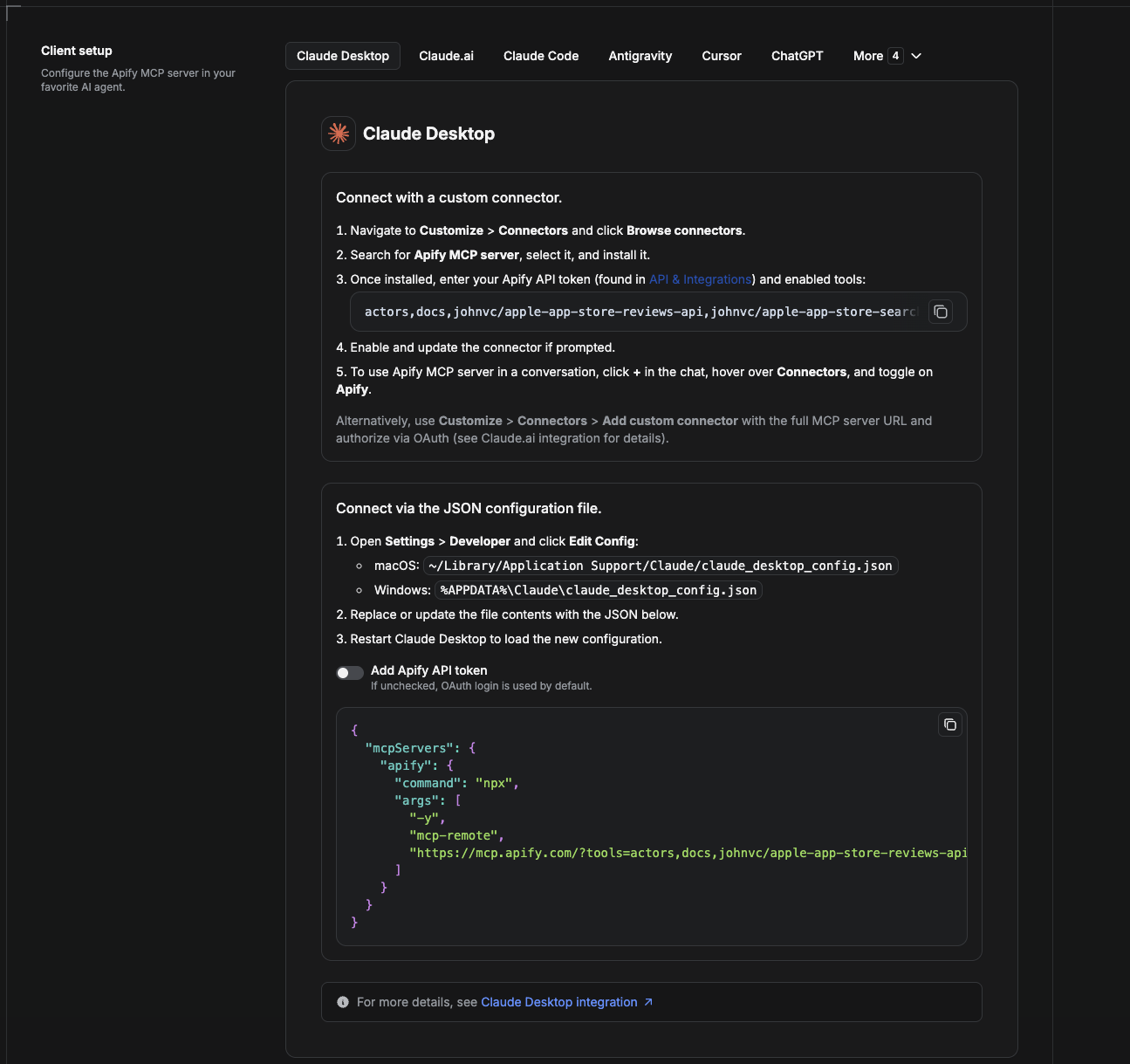
Cowork is the desktop app's automation mode. To give it the Agoda Hotel API as a tool, add the Apify MCP server as a connector.
- Open the Claude desktop app and go to Settings → Connectors (or Settings → Developer → Edit Config to edit
claude_desktop_config.jsondirectly).- macOS:
~/Library/Application Support/Claude/claude_desktop_config.json - Windows:
%APPDATA%\Claude\claude_desktop_config.json
- macOS:
- Add the Apify MCP server, preloaded with only this Actor:
{
  "mcpServers": {
    "apify": {
      "command": "npx",
      "args": [
        "-y",
        "mcp-remote",
        "https://mcp.apify.com/?tools=actors,docs,johnvc/agoda-hotel-api"
      ]
    }
  }
}- Restart the app. When Cowork first calls the tool, complete the OAuth prompt in your browser, or add your Apify API token in the connector settings to skip OAuth.
- In a Cowork chat, confirm the tool is available and ask it to run the Agoda Hotel API.
Download the desktop app and start a free trial: https://claude.ai/referral/uIlpa7nPLg More help: https://docs.apify.com/platform/integrations/claude-desktop
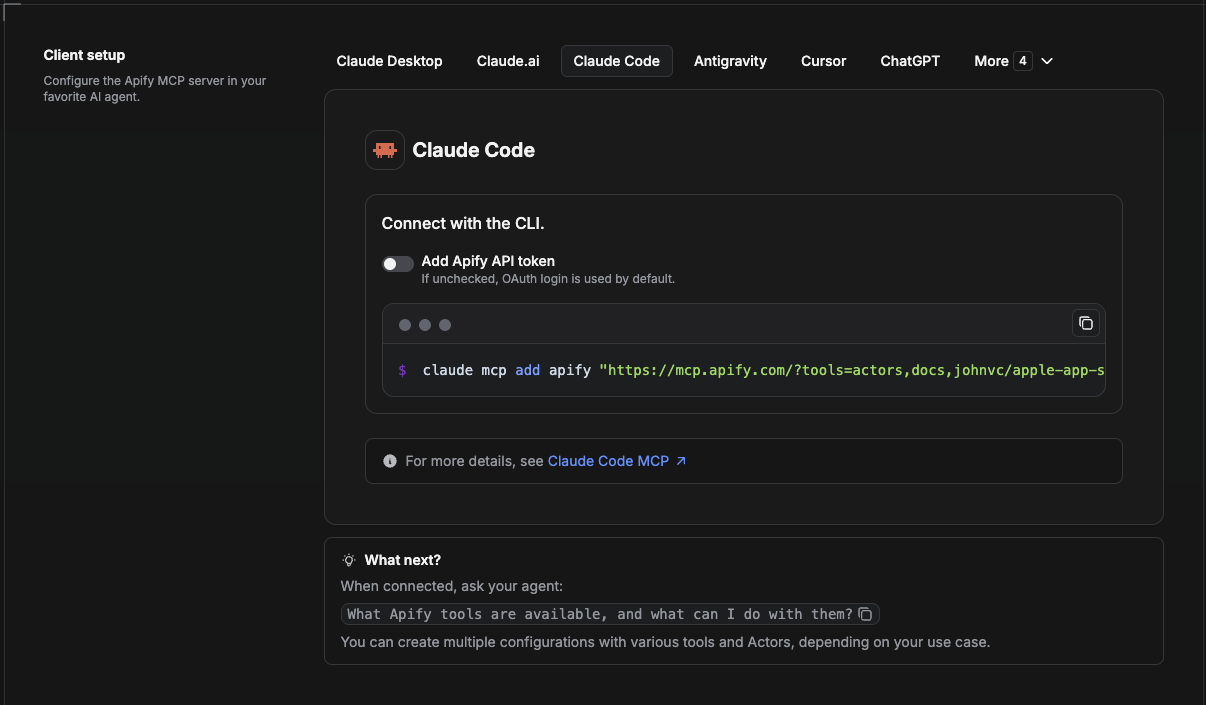
Claude Code is the command-line tool. Add the Actor's MCP server with one command:
claude mcp add --transport http apify \
  "https://mcp.apify.com/?tools=actors,docs,johnvc/agoda-hotel-api"
To use a token instead of browser OAuth:
claude mcp add --transport http apify \
  "https://mcp.apify.com/?tools=actors,docs,johnvc/agoda-hotel-api" \
  --header "Authorization: Bearer YOUR_APIFY_TOKEN"
Then verify with claude mcp list, or run /mcp inside a session. Ask Claude Code to call the Agoda Hotel API.
Try Claude Code free: https://claude.ai/referral/uIlpa7nPLg Claude Code MCP docs: https://code.claude.com/docs/en/mcp
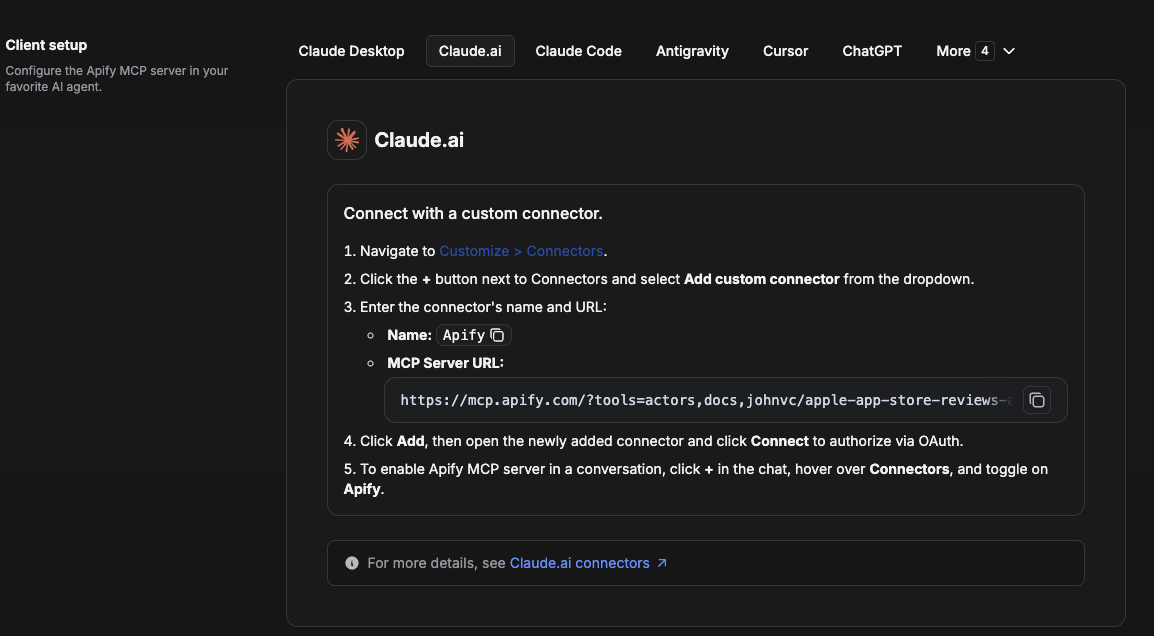
On claude.ai you add Apify as a connector, then enable just this Actor's tool.
- Go to Settings → Connectors → Browse connectors and search for Apify MCP server. Install it (enable or update if prompted).
- When connecting, authenticate with your Apify API token, and enable the tool
johnvc/agoda-hotel-api. - In any chat, open + → Connectors and turn on Apify.
- Alternatively, choose Add custom connector and paste the full MCP URL
https://mcp.apify.com/?tools=actors,docs,johnvc/agoda-hotel-api, using OAuth when prompted. - Ask Claude to run the Agoda Hotel API.
Open Claude on the web: https://claude.ai
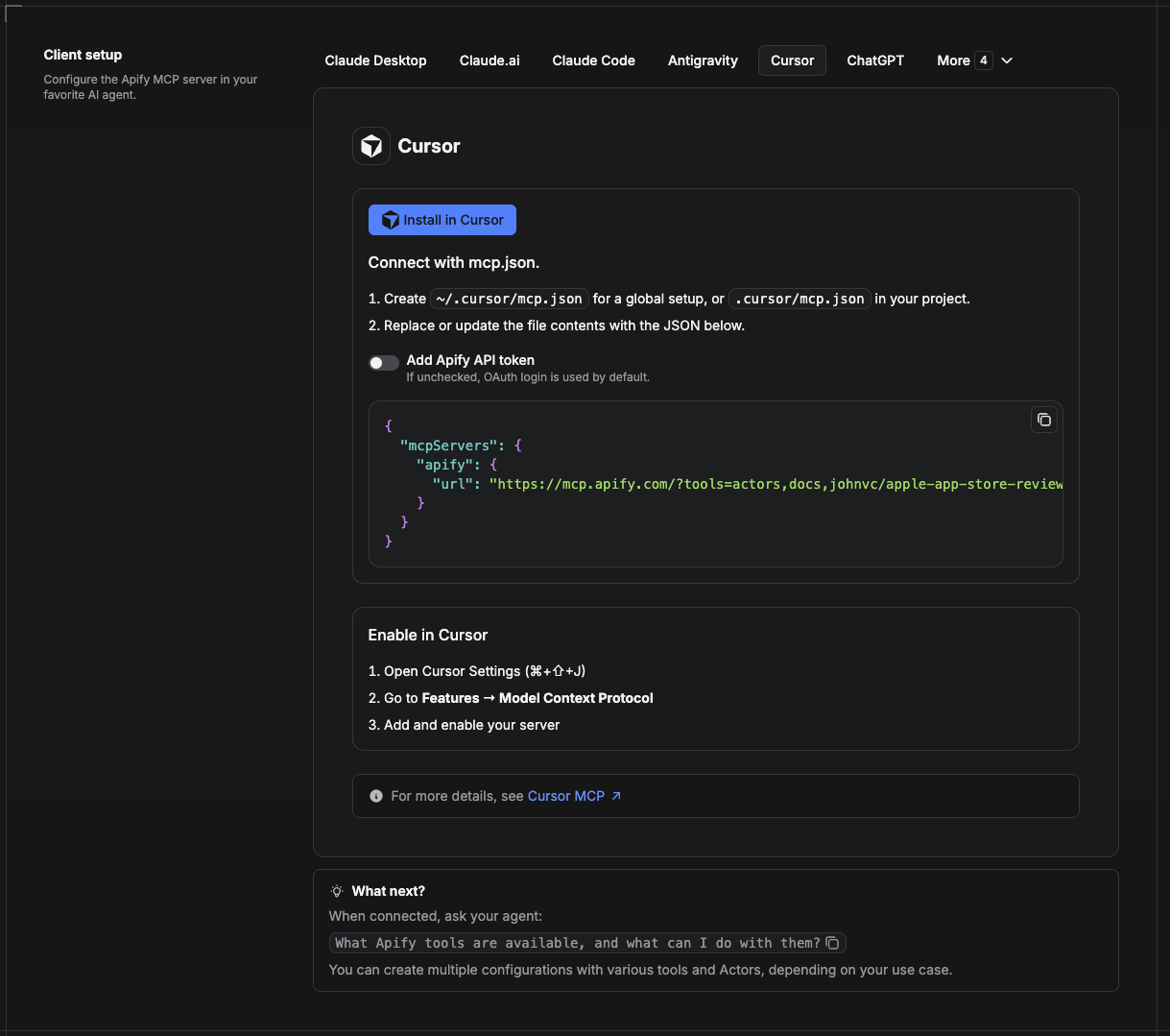
Cursor reads MCP servers from a project file at .cursor/mcp.json.
- In your project, create
.cursor/mcp.json:
{
  "mcpServers": {
    "apify": {
      "url": "https://mcp.apify.com/?tools=actors,docs,johnvc/agoda-hotel-api"
    }
  }
}- If you prefer token auth over browser OAuth, add a header:
{
  "mcpServers": {
    "apify": {
      "url": "https://mcp.apify.com/?tools=actors,docs,johnvc/agoda-hotel-api",
      "headers": { "Authorization": "Bearer YOUR_APIFY_TOKEN" }
    }
  }
}- Open Cursor → Settings → MCP and confirm the apify server is connected (green dot).
- In Composer or Chat, ask Cursor to call the Agoda Hotel API.
New to Cursor? Get it here: https://cursor.com/referral?code=XQP4VBLI3NNX
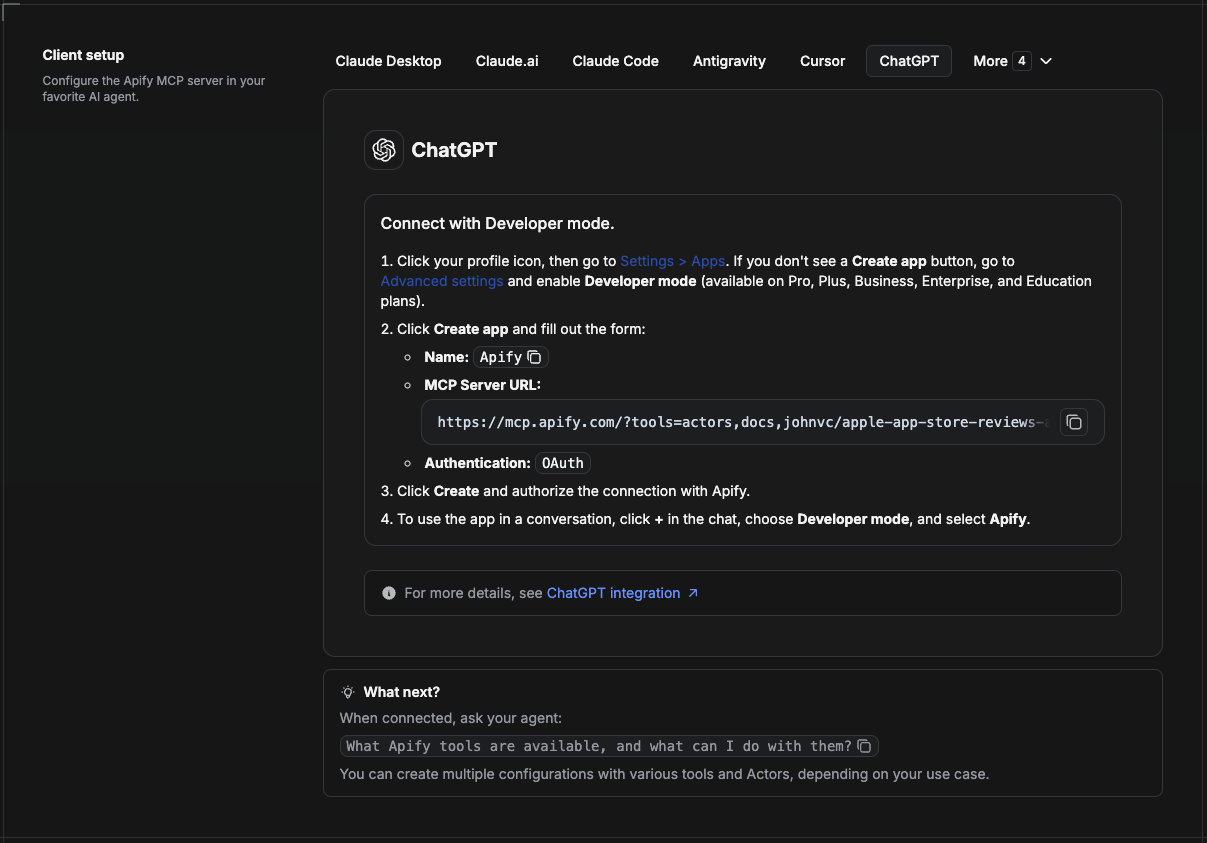
ChatGPT connects to the Apify MCP server through Developer mode (available on ChatGPT Pro, Plus, Business, Enterprise, and Education plans).
- Click your profile icon, then go to Settings > Apps. If you do not see a Create app button, open Advanced settings and enable Developer mode.
- Click Create app and fill out the form:
- Name: Apify
- MCP Server URL:
https://mcp.apify.com/?tools=actors,docs,johnvc/agoda-hotel-api - Authentication: OAuth
- Click Create and authorize the connection with Apify.
- To use the app in a conversation, click + in the chat, choose Developer mode, and select Apify.
More help: https://docs.apify.com/platform/integrations/mcp
- Google Hotels API for aggregated hotel prices across sites
- Google Flights API for the flights half of a trip
- Google Travel Explore API for destination discovery
- Google Maps Places API for what is around a property
This example repo is part of Alpha OSINT, toolset of financial and operations data sources and APIs. For support or requests for this actor, please start a ticket directly on our support page.
Use the Agoda Hotel API to power your rate monitoring, travel research, and hotel reviews workflows with reliable, structured results.
Last Updated: 2026.08.13