Actor: johnvc/bing-search-api · Input schema
This repo shows two ways to use the Bing Search API on Apify: a Python quick start and MCP installs for five AI clients. Query Bing, get organic results with real destination URLs, optionally the ads, and track where a domain ranks by city and device. If you were about to scrape Bing search results yourself, this is the page as JSON with the redirect wrappers already unwound.
The bing search api takes a query plus max_pages, which is also the billing unit: you pay per page of results, whatever that page holds, because the engine controls its own depth. Each organic row carries position, page, title, snippet, the real url rather than an expiring tracking link, displayedUrl and date. Set location to a city and device to desktop or mobile for bing rank tracking, the rank_tracking recipe in this repo; combine page and position for an absolute rank. Switch include_ads on and the paid placements come back too, marked as ads, at no extra charge.
You need Python 3.11+ and a free Apify API key: sign up at apify.com, then copy your token from Console Settings.
git clone https://github.com/johnisanerd/Apify-Bing-Search-API.git
cd Apify-Bing-Search-API
uv sync
cp .env.example .env   # then paste your APIFY_API_TOKEN
uv run python bing-search-api-example.py
Run a specific recipe:
uv run python bing-search-api-example.py --example rank_tracking- Organic results with the real destination URL, not an expiring redirect wrapper
- position plus page combine into an absolute rank for tracking
- Ad placements included free when you want competitor ad monitoring
- City-level location and device targeting for local and mobile rank checks
- Bing operators pass straight through: site:, filetype:, OR, NOT
The example script ships ready-made recipes that mirror this API's main use cases:
- Bing rank tracking (
--example rank_tracking): Runs one query with a city and device and prints ranked results; schedule it for a rank history. - SERP with ad placements (
--example serp_with_ads): Pulls a page with ads included for competitor ad monitoring.
Schedule tip: save any of these inputs as a task in the Apify Console and attach a schedule. A daily or weekly run turns a one-off pull into a pipeline with zero manual work.
Basic input:
{
  "query": "project management software",
  "max_pages": 1
}
Advanced input:
{
  "query": "coffee shops",
  "max_pages": 2,
  "location": "Seattle, Washington",
  "device": "mobile",
  "include_ads": true
}| Parameter | Type | Required | Default | Description |
|---|---|---|---|---|
query |
string | yes | none | REQUIRED. |
max_pages |
integer | no | 1 |
How many pages of results to fetch. |
include_ads |
boolean | no | false |
Also return the paid placements on each page, marked with resultType 'ad'. |
country |
string | no | none | Optional two letter country code such as us, gb or de. |
market |
string | no | none | Optional language and country pair such as en-US or de-DE. |
location |
string | no | none | Optional city to search from, such as 'Seattle, Washington'. |
safe_search |
string | no | "Moderate" |
Optional adult content filter. |
device |
string | no | "desktop" |
Optional device to emulate. |
One row from a real run:
{
  "resultType": "organic",
  "query": "project management software",
  "page": 1,
  "position": 1,
  "title": "Best Project Management Software Compared For 2026",
  "snippet": "A side by side comparison of the leading project management platforms.",
  "url": "https://example.com/blog/project-management-software/",
  "displayedUrl": "https://example.com",
  "date": "Apr 13, 2026"
}Available as an n8n community node, n8n-nodes-bing-search-api. In n8n: Settings, Community Nodes, install n8n-nodes-bing-search-api, then use it in any workflow (it also works as an AI Agent tool).
Use it wherever you would scrape Bing search results, but it returns the page as JSON in one call, with the redirect wrappers replaced by real destination URLs.
Run the rank_tracking recipe on a schedule with your keyword, city and device, and store position and page per run. The series is your rank history.
Bing gives no page-size control and organic depth swings between 2 and 10 results per page. Per-page billing means a thin page never costs more than it is worth.
Yes, set include_ads to true. They are on the page you already paid for, so including them costs nothing extra.
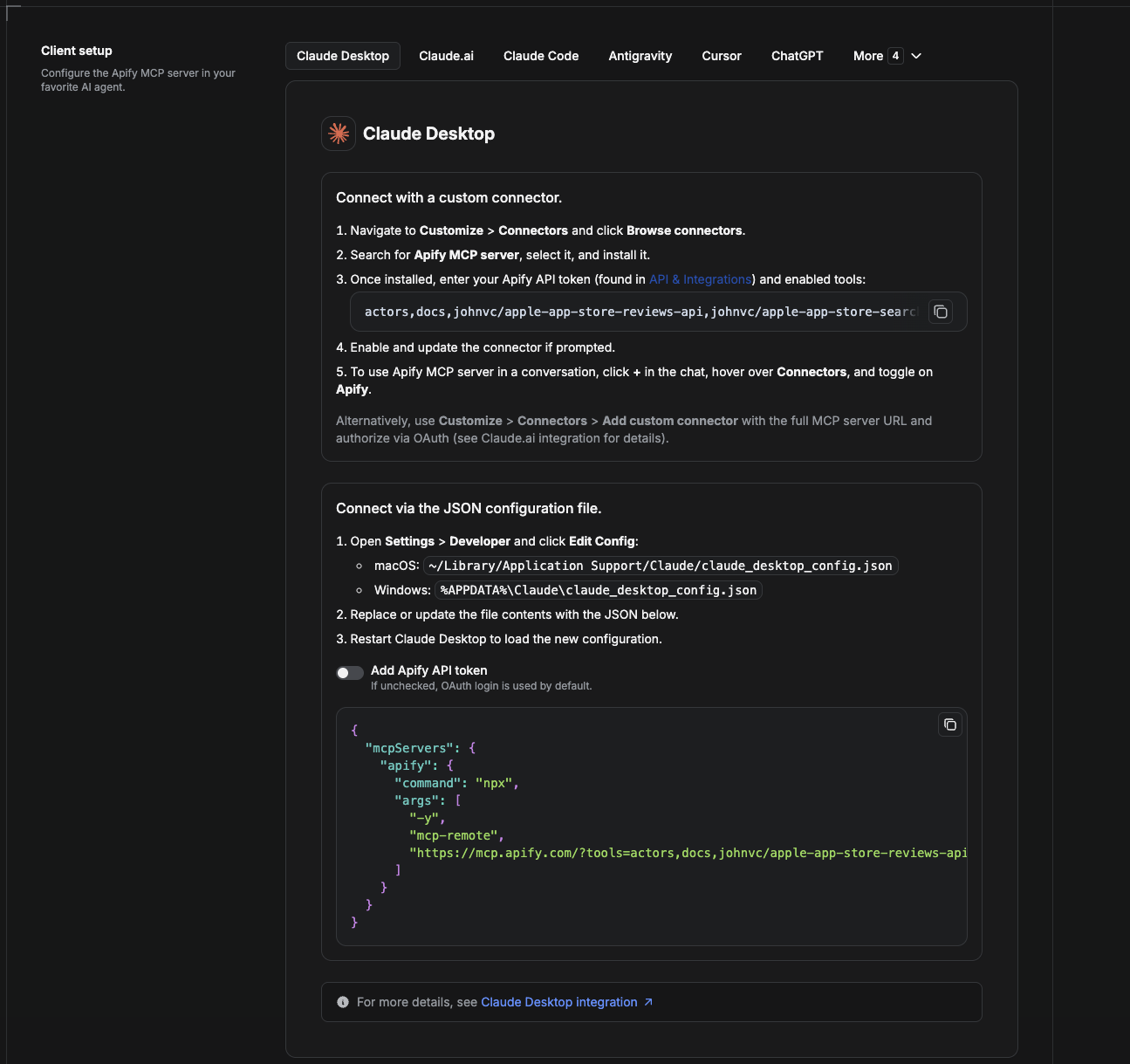
Cowork is the desktop app's automation mode. To give it the Bing Search API as a tool, add the Apify MCP server as a connector.
- Open the Claude desktop app and go to Settings -> Connectors (or Settings -> Developer -> Edit Config to edit
claude_desktop_config.jsondirectly).- macOS:
~/Library/Application Support/Claude/claude_desktop_config.json - Windows:
%APPDATA%\Claude\claude_desktop_config.json
- macOS:
- Add the Apify MCP server, preloaded with only this Actor:
{
  "mcpServers": {
    "apify": {
      "command": "npx",
      "args": [
        "-y",
        "mcp-remote",
        "https://mcp.apify.com/?tools=actors,docs,johnvc/bing-search-api"
      ]
    }
  }
}- Restart the app. When Cowork first calls the tool, complete the OAuth prompt in your browser, or add your Apify API token in the connector settings to skip OAuth.
- In a Cowork chat, confirm the tool is available and ask it to run the Bing Search API.
Download the desktop app and start a free trial: https://claude.ai/referral/uIlpa7nPLg More help: https://docs.apify.com/platform/integrations/claude-desktop
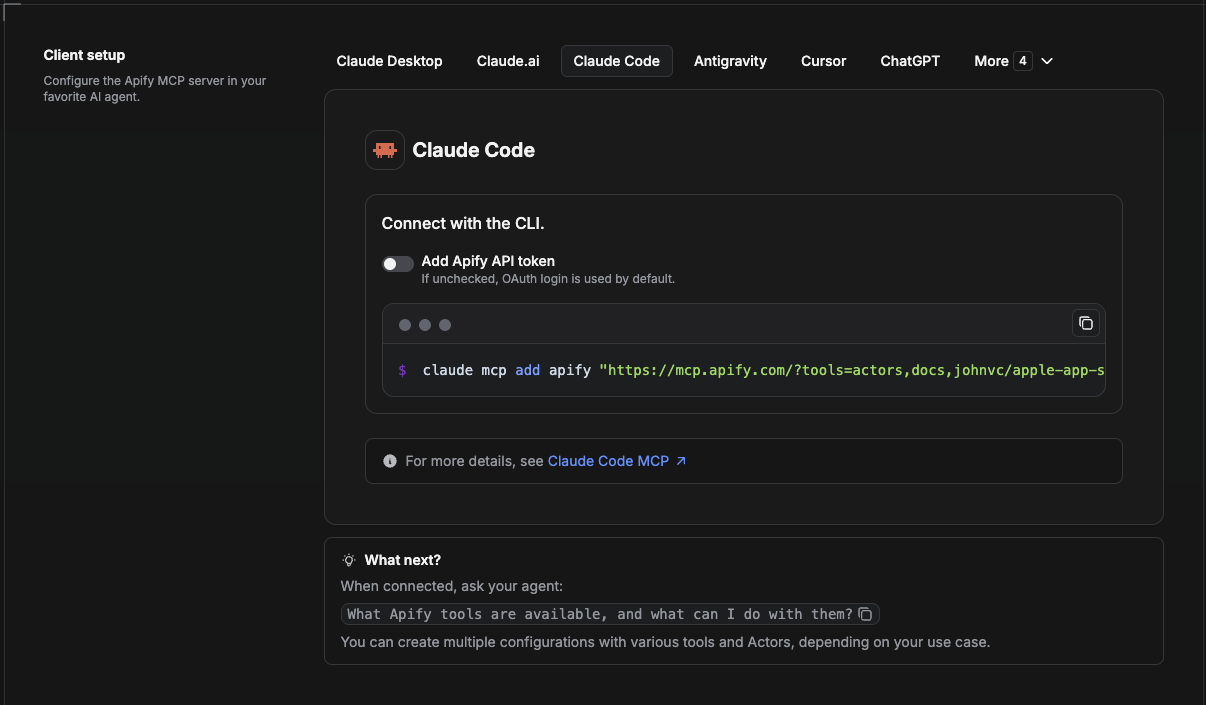
Claude Code is the command-line tool. Add the Actor's MCP server with one command:
claude mcp add --transport http apify \
  "https://mcp.apify.com/?tools=actors,docs,johnvc/bing-search-api"
To use a token instead of browser OAuth:
claude mcp add --transport http apify \
  "https://mcp.apify.com/?tools=actors,docs,johnvc/bing-search-api" \
  --header "Authorization: Bearer YOUR_APIFY_TOKEN"
Then verify with claude mcp list, or run /mcp inside a session. Ask Claude Code to call the Bing Search API.
Try Claude Code free: https://claude.ai/referral/uIlpa7nPLg Claude Code MCP docs: https://code.claude.com/docs/en/mcp
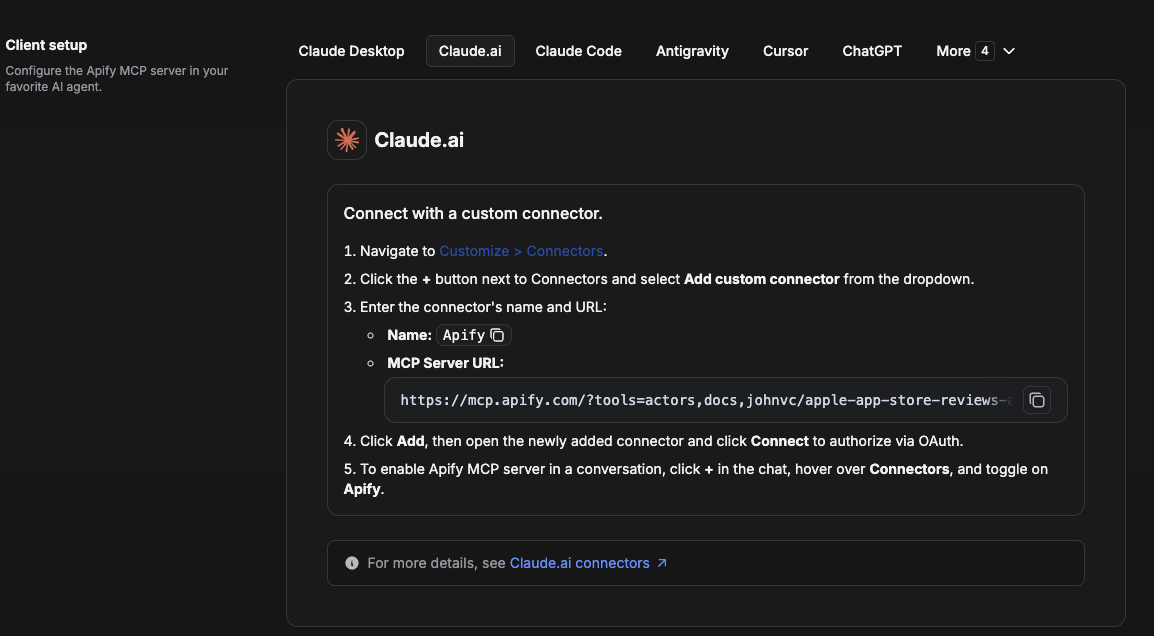
On claude.ai you add Apify as a connector, then enable just this Actor's tool.
- Go to Settings -> Connectors -> Browse connectors and search for Apify MCP server. Install it (enable or update if prompted).
- When connecting, authenticate with your Apify API token, and enable the tool
johnvc/bing-search-api. - In any chat, open + -> Connectors and turn on Apify.
- Alternatively, choose Add custom connector and paste the full MCP URL
https://mcp.apify.com/?tools=actors,docs,johnvc/bing-search-api, using OAuth when prompted. - Ask Claude to run the Bing Search API.
Open Claude on the web: https://claude.ai
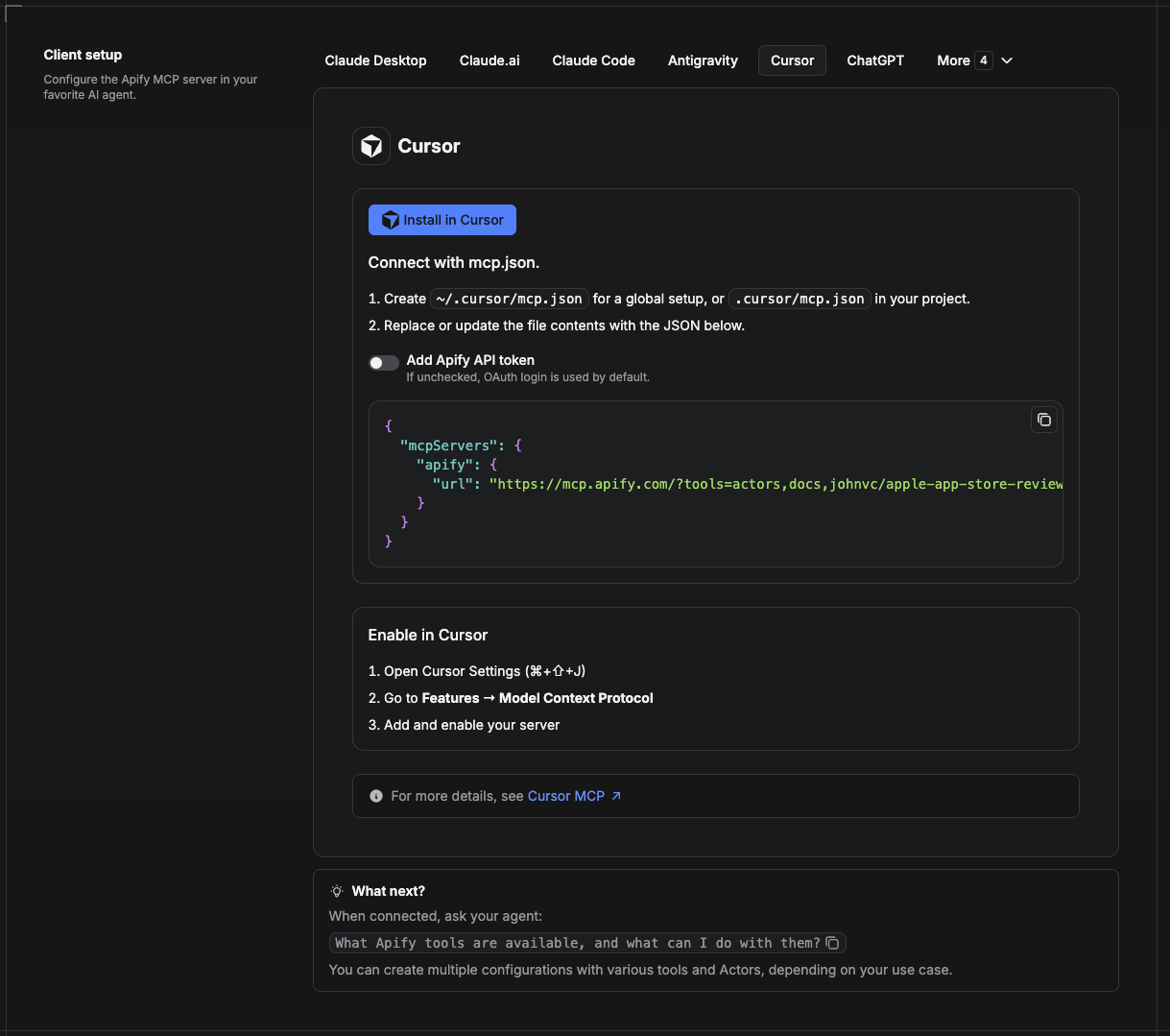
Cursor reads MCP servers from a project file at .cursor/mcp.json.
- In your project, create
.cursor/mcp.json:
{
  "mcpServers": {
    "apify": {
      "url": "https://mcp.apify.com/?tools=actors,docs,johnvc/bing-search-api"
    }
  }
}- If you prefer token auth over browser OAuth, add a header:
{
  "mcpServers": {
    "apify": {
      "url": "https://mcp.apify.com/?tools=actors,docs,johnvc/bing-search-api",
      "headers": { "Authorization": "Bearer YOUR_APIFY_TOKEN" }
    }
  }
}- Open Cursor -> Settings -> MCP and confirm the apify server is connected (green dot).
- In Composer or Chat, ask Cursor to call the Bing Search API.
New to Cursor? Get it here: https://cursor.com/referral?code=XQP4VBLI3NNX
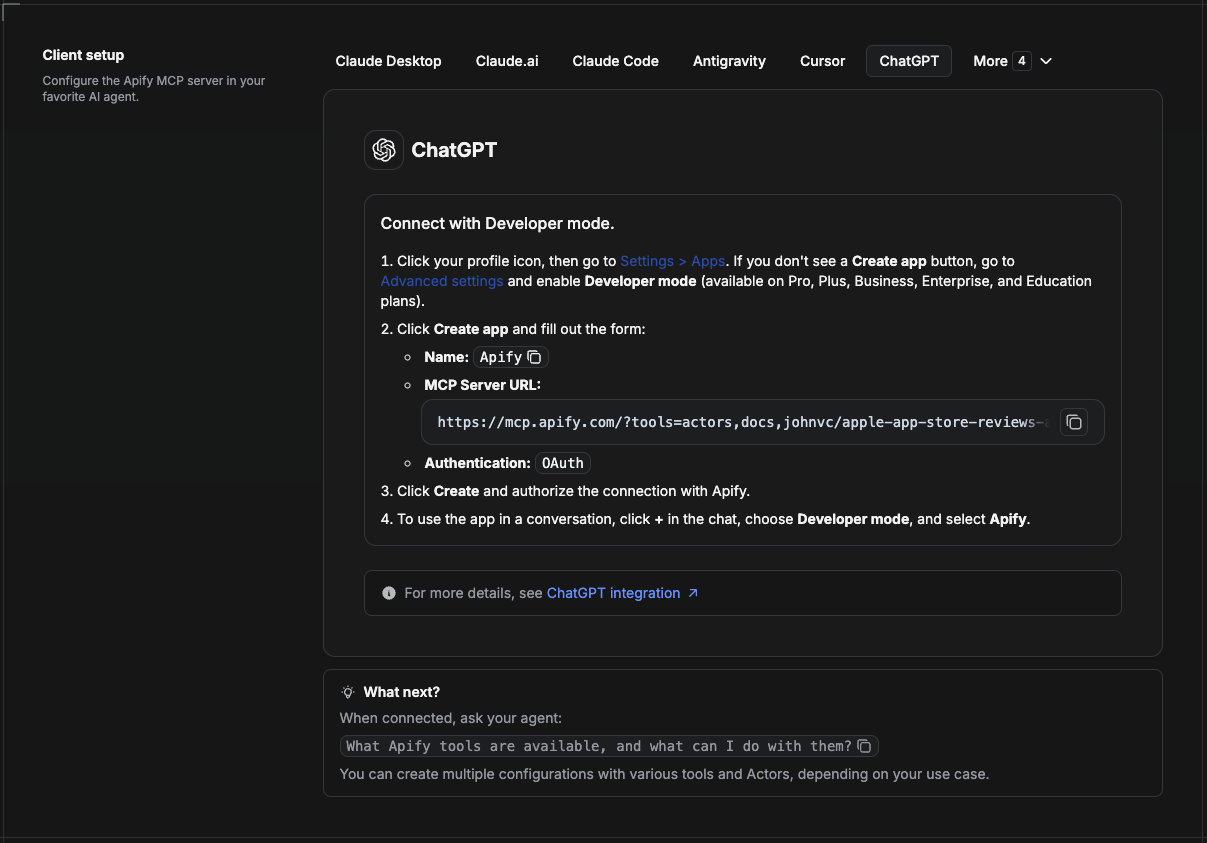
ChatGPT connects to the Apify MCP server through Developer mode (available on ChatGPT Pro, Plus, Business, Enterprise, and Education plans).
- Click your profile icon, then go to Settings > Apps. If you do not see a Create app button, open Advanced settings and enable Developer mode.
- Click Create app and fill out the form:
- Name: Apify
- MCP Server URL:
https://mcp.apify.com/?tools=actors,docs,johnvc/bing-search-api - Authentication: OAuth
- Click Create and authorize the connection with Apify.
- To use the app in a conversation, click + in the chat, choose Developer mode, and select Apify.
More help: https://docs.apify.com/platform/integrations/mcp
Made with care by johnvc on Apify. This example repo is part of Alpha OSINT, toolset of financial and operations data sources and APIs.
Last Updated: 2026.08.06