

Pixie is a C# library for building polished command-line applications. It gives you a high-level API for terminal output, diagnostics, help text, and GNU-style option parsing, then renders the best output your terminal can support.
Pixie is a good fit when you want to:
- print structured, readable console output instead of hand-formatting strings,
- show rich diagnostics with source context and caret highlights,
- generate help output from the same option definitions you parse, and
- keep CLI output readable across terminals with different Unicode and styling support.
Install Pixie:
dotnet add package PixieThen write and log a message:
using Pixie;
using Pixie.Terminal;

var log = TerminalLog.Acquire();

log.Info("Hello from Pixie.");
TerminalLog.Acquire() is the usual entry point for diagnostics and other CLI feedback. It writes to standard error by default, which is often what you want for warnings, errors, and help output.
If you want to write normal program output to standard output instead, use:
using Pixie.Terminal;

var log = TerminalLog.AcquireStandardOutput();
In most applications, you should acquire a log once and reuse it.
Pixie is split into a small set of packages and assemblies:
| Package | Purpose |
|---|---|
Pixie |
Core logging, markup, diagnostics, option parsing, and terminal integration. |
Pixie.Terminal |
Terminal rendering types. This assembly ships with the Pixie package, so you usually do not install it separately. |
Pixie.Loyc |
Optional Loyc interoperability for translating Loyc diagnostics into Pixie output. |
Install Loyc support only if you need it:
dotnet add package Pixie.LoycUse this as a quick decision guide:
| If you want to... | Start with... |
|---|---|
| Write regular terminal output with wrapping and layout | TerminalLog.AcquireStandardOutput() |
| Write diagnostics, warnings, or help text | TerminalLog.Acquire() |
| Turn ordinary log entries into compiler-style diagnostics | log.WithDiagnostics("program") |
| Parse GNU-style options and read typed values back | CommandLine + OptionParseResult |
Generate --help output from option definitions |
CommandLine.WithHelp(...) or HelpMessage |
| Control styling, encoding, or terminal capabilities manually | TextWriterTerminal + TerminalLog.Acquire(...) |
| Translate Loyc diagnostics into Pixie output | PixieMessageSink from Pixie.Loyc |
For a fuller walkthrough, see docs/getting-started.md.
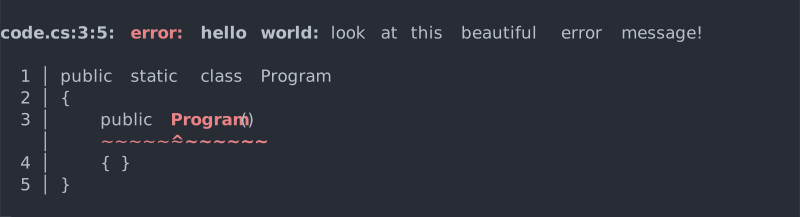
Pixie has built-in support for compiler-style diagnostics. In Pixie, a diagnostic is a message with:
- an origin, such as a file location or application name,
- a kind, such as
errororwarning, - a short title, and
- an optional body with extra context, such as highlighted source code.
That means Pixie can render both the diagnostic header, like code.cs:3:5: error: expected token, and the caret-highlighted snippet underneath it.
Pixie can parse GNU-style command-line options and report mistakes in a user-friendly way, including usage guidance and option name suggestions.

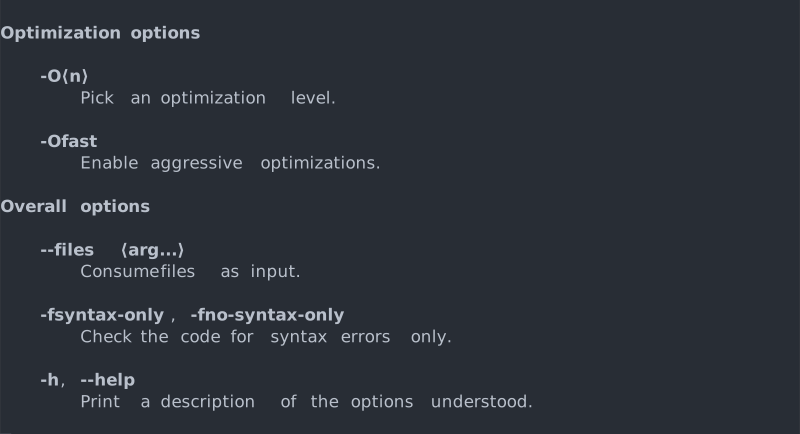
Pixie can generate help output from the same option definitions you use for parsing, so parsing and documentation stay in sync.
Pixie tries to produce the nicest output your terminal can handle. When Unicode characters or ANSI styling are unavailable, it falls back to simpler representations instead of breaking formatting.
Unicode-rich rendering:

Simpler fallback rendering:

Pixie supports alignment, wrapping, and reusable markup nodes for common CLI output patterns.
Without careful layout, terminal messages can become awkward:

With Pixie, the same message can be wrapped and structured more cleanly:

If you use Loyc libraries such as EC# or LeMP, Pixie.Loyc can translate their diagnostics into Pixie markup so they render consistently with the rest of your application output.

Pixie's main output abstraction is ILog. Logs accept LogEntry values, which are self-contained messages with a severity and a markup tree.
For terminal applications, TerminalLog.Acquire() is the usual choice when you want output on standard error:
using Pixie.Terminal;

var log = TerminalLog.Acquire();
If you want standard output instead, use TerminalLog.AcquireStandardOutput().
Plain strings can be used directly as markup, so the smallest useful example is:
using Pixie;
using Pixie.Terminal;

var log = TerminalLog.Acquire();

log.Error("Something went wrong.");
If you need full control, log.Log(new LogEntry(...)) is still available. For explicit markup nodes, use types from Pixie.Markup, such as Text, Sequence, BulletedList, or HighlightedSource.
Pixie includes GNU-style option parsing. You define options once, then parse arguments and read back typed values.
using Pixie;
using Pixie.Options;
using Pixie.Terminal;

var log = TerminalLog.Acquire();

var helpFlag = Option.Flag("-h", "--help");
var filesOption = Option.StringSequence("--files")
    .WithParameter("file");

var commandLine = new CommandLine(
    new Option[] { helpFlag },
    filesOption);

var parsedArgs = commandLine.Parse(new[] { "input.cs", "-h" }, log);

bool showHelp = parsedArgs.GetValue<bool>(helpFlag);
string[] files = parsedArgs.GetValue<string[]>(filesOption);

if (!parsedArgs.IsSuccess)
{
    return;
}
If you want the common --help and --version flow handled for you:
var commandLine = new CommandLine(filesOption)
    .WithHelp("Example program.", "example [files-or-options]")
    .WithVersion("example 1.0.0");

var result = commandLine.Parse(args, log);
if (result.WasHandled)
{
    return;
}
For custom typed parsing, use the generic builders:
var portOption = Option.Value(
    (OptionForm form, string argument, ILog log) => int.Parse(argument),
    8080,
    "--port")
    .WithParameter("n");
When parsing fails, Pixie can report errors to the log and also capture them in the returned OptionParseResult. The same result can also tell you whether built-in help or version handling already printed output via WasHandled. In other words, WasHandled is for parser-managed early exits like help/version, not for parse failures.
Parse(...) returns an OptionParseResult, so applications can inspect typed values, see whether parsing succeeded, and decide what to do next. A common pattern is to stop when parsing failed or when Pixie already handled a built-in early-exit flow:
using Pixie;
using Pixie.Options;
using Pixie.Terminal;

var log = TerminalLog.Acquire();

var commandLine = new CommandLine(new Option[] { helpFlag }, filesOption);
var parsedArgs = commandLine.Parse(args, log);

if (!parsedArgs.IsSuccess || parsedArgs.WasHandled)
{
    return parsedArgs.ExitCode;
}
If you prefer exceptions in tests or strict tooling, TestLog can turn selected severities into failures.
Options can carry categories, descriptions, and parameter metadata. That same information can then be used to generate help output.
using Pixie.Markup;
using Pixie.Options;

var xOption = SequenceOption.CreateStringOption(OptionForm.Short("x"))
    .WithCategory("Input and output")
    .WithDescription(
        "Specify explicitly the language for the following input files.")
    .WithParameters(
        new SymbolicOptionParameter("language"),
        new SymbolicOptionParameter("file", true));

var help = new HelpMessage(
    "An example application built with Pixie.",
    "example [files-or-options]",
    new Option[] { xOption });
To see a more complete example, check Examples/PrintHelp/Program.cs.
Pixie's diagnostic model is especially useful when you already know the source span you want to highlight.
There are two layers here:
HighlightedSourcerenders a code snippet with line numbers and caret/squiggle markers.WithDiagnostics(...)wraps log entries as full diagnostics so they also get a header likecode.cs:3:5: error: Expected constructor name.
In practice, most applications want both, so the usual setup is to enable diagnostics once on the log and then log HighlightedSource nodes normally.
using Pixie;
using Pixie.Code;
using Pixie.Markup;
using Pixie.Terminal;
using Pixie.Transforms;

var log = TerminalLog.Acquire().WithDiagnostics("program");

const string source = "public static class Program\n{\n    public Program()\n    { }\n}";
var document = new StringDocument("code.cs", source);
var nameOffset = source.IndexOf("Program()");

var focusRegion = new SourceRegion(
    new SourceSpan(document, nameOffset, "Program".Length));

log.Log(new LogEntry(
    Severity.Error,
    "Expected constructor name",
    new HighlightedSource(focusRegion, focusRegion)));
This works because log.WithDiagnostics("program") converts each LogEntry into a diagnostic before rendering it. When the entry contains a HighlightedSource, Pixie uses that source span as the diagnostic origin, which is what makes the filename and line/column information appear in the header.
If you log a raw LogEntry with new HighlightedSource(...) but do not wrap the log with WithDiagnostics(...), Pixie will still render the snippet and caret, but it will not render the code.cs:line:column: error: ... header.
For a fuller version with transforms and custom renderer configuration, see Examples/CaretDiagnostics/Program.cs.
Pixie is enough for most applications. It includes the core APIs plus the Pixie.Terminal assembly, so you can use TerminalLog, terminal renderers, and terminal device helpers after installing the main package.
Pixie.Loyc is optional. Install it only when you already use Loyc libraries and want their diagnostics to flow through Pixie. For a dedicated walkthrough, see docs/loyc.md.
The repository includes small example programs you can run directly:
dotnet run --project Examples/PrintHelp/PrintHelp.csproj
dotnet run --project Examples/ParseOptions/ParseOptions.csproj -- --helo file.cs
dotnet run --project Examples/CaretDiagnostics/CaretDiagnostics.csproj
Available examples:
| Example | What it demonstrates |
|---|---|
Examples/SimpleErrorMessage |
A minimal diagnostic-style message. |
Examples/FormattedList |
Titles, colors, wrapping, bullets, and manual terminal configuration. |
Examples/PrintHelp |
Building help output from option definitions. |
Examples/ParseOptions |
GNU-style parsing, typed values, suggestions, and diagnostic feedback. |
Examples/CaretDiagnostics |
Source snippets, focus regions, and compiler-style diagnostic headers. |
Examples/LoycInterop |
Translating Loyc parser diagnostics into Pixie output. |
For a more guided tour, see docs/examples.md.
Build the solution:
dotnet build Pixie.slnRun the test suite:
dotnet test Tests/Tests.csproj| Path | Contents |
|---|---|
Pixie/ |
Core library: logs, markup nodes, diagnostics, options, and transforms. |
Pixie.Terminal/ |
Terminal rendering and device-specific behavior. |
Pixie.Loyc/ |
Loyc interoperability layer. |
Examples/ |
Small runnable sample applications. |
Tests/ |
NUnit test suite. |
docs/img/ |
SVG assets used in this README. |
Pixie is designed to be extensible. You can:
- compose markup trees from reusable node types,
- configure or replace renderers,
- wrap logs in transforms, and
- define your own markup elements and rendering behavior.
The examples in Examples/CaretDiagnostics/Program.cs and Examples/ParseOptions/Program.cs show some of that flexibility in practice.
Issues, questions, and pull requests are all welcome.
If you want to contribute code:
- Open an issue first for larger changes so the direction is clear.
- Build the solution with
dotnet build Pixie.sln. - Run tests with
dotnet test Tests/Tests.csproj.
Bug reports and usage questions are also welcome in the issue tracker.