

kmOS is a general-purpose UNIX-like monolithic operating system written from scratch. Its primary aim is to have interoperability with existing software and architectures; be maintainable, modular and quick.
On the backend, since kmOS is monolithic, it contains a very quick driver model between device drivers and the kernel. This enables the drivers to be written in a forward compatible manner so that the kernel level components can be upgraded without necessarily requiring a recompilation of all device drivers.
kmOS is event-driven, preemptible, SMP-ready, and network ready.
Completed Features:
- Memory Management: Full demand paging system with virtual memory
- Copy-on-Write (COW): Efficient fork() implementation with shared pages
- Memory Allocators: Buddy, slab, SLOB, SLUB, and unified allocation systems
- Architecture: x86-32 support with interrupt handling and successful boot
- Build System: Cross-compilation with i686-elf toolchain and dual-mode QEMU support
- CI/CD Pipeline: Automated testing with GitHub Actions and QEMU
- Kernel Core: Monolithic kernel with modular driver model
- Process Management: Basic process structures and scheduling framework
- Boot System: Multiboot-compliant kernel with VGA and serial console output
In Development:
- Filesystem support (EXT2/3/4 planned)
- Device drivers (IDE, VGA, etc.)
- Userland applications and shell
Planned:
- x86-64 architecture support
- SMP and networking capabilities
- Advanced security features
- Language: C/C++
- Architecture: x86-32 (x86-64 planned)
- Bootloader: GRUB-compatible
- Design: UNIX-like monolithic kernel
- Memory: Demand paging with 4KB pages
- Build: Cross-compilation with GCC toolchain
- Kernel
- Filesystems PLANNED
- VFS (Virtual File System) architecture
- EXT2/3/4 support (read-only EXT2 partially implemented)
- FAT32 and NTFS support
- XFS support
- Memory management IMPLEMENTED
- Demand paging: Full virtual memory system with page fault handling
- Physical frame management: Bitmap-based allocator supporting up to 4GB RAM
- Virtual memory mapping: Complete page table management
- Memory layout:
- Kernel identity map: 0x0 - 0x400000 (4MB)
- Kernel heap: 0x200000 - 0x800000 (demand-allocated)
- User space: 0x40000000+ (planned)
- Shared memory support (planned)
- Advanced allocators (buddy/slab planned)
- Process and thread management IN DEVELOPMENT
- Process structures: Architecture-specific process management
- Scheduling framework: Basic scheduler infrastructure in place
- Context switching: x86 task switching implemented
- Multithreading in userland (POSIX threads planned)
- Locking primitives (mutex, semaphore, condition variable planned)
- SMP support and kernel preemption (planned)
- Security PLANNED
- User privilege model with memory protection
- Mandatory Access Control (MAC) system
- Kernel-level ASLR and exploit mitigations
- Networking PLANNED
- TCP/IP stack implementation
- IPv4 and IPv6 protocol support
- UDP, TCP, ICMP protocols
- Network utilities (ARP, DHCP, DNS)
- POSIX socket API
- Filesystems PLANNED
- Hardware Support PLANNED
- Device drivers: Basic VGA, IDE/SATA, USB (HID, mass storage)
- Power management: ACPI/APM support for shutdown and power states
- Virtualization: QEMU/KVM paravirtualization support
- Userland PLANNED
- Shell: UNIX-like shell with scripting support
- Utilities: Basic UNIX tools (ls, cat, grep, etc.)
- Libraries: LibC implementation with POSIX compatibility
- Binary support: ELF executable format
- GUI: Simple framebuffer-based windowing system
- Package management: Simple package system for applications
- Developer tools PLANNED
- Build tools: GCC/Clang native compilation
- Development libraries and POSIX APIs
- Kernel module interface (DKMS-like)
- System monitoring and debugging tools
- Kernel tracing capabilities
kmOS has a demand paging virtual memory system implemented from scratch:
0x00000000 - 0x00400000  |  Kernel Identity Map (4MB)
0x00200000 - 0x00800000  |  Kernel Heap (6MB, demand-allocated)
0x40000000+              |  User Space (planned)
- Demand Paging: Pages allocated automatically on memory access
- Page Fault Handling: Integrated with x86 interrupt system (INT 14)
- Physical Frame Management: Bitmap-based allocator supporting up to 4GB RAM
- 4KB Pages: Standard x86 page size with full page table hierarchy
- Memory Protection: Foundation for user/kernel space isolation
- Page Directory & Tables: Complete x86 paging data structures
- Frame Allocation: Efficient bitmap tracking of physical memory
- Virtual Mapping: Dynamic page mapping/unmapping functions
- Heap Integration: Seamless integration with kernel memory allocator
- i686-elf cross-compiler toolchain (GCC, binutils)
- NASM assembler
- Make build system
- QEMU for testing (optional)
make all
make clean
make run
make debugmake -C src/kernel
make -C src/kernel debug
make -C src/kernel dasm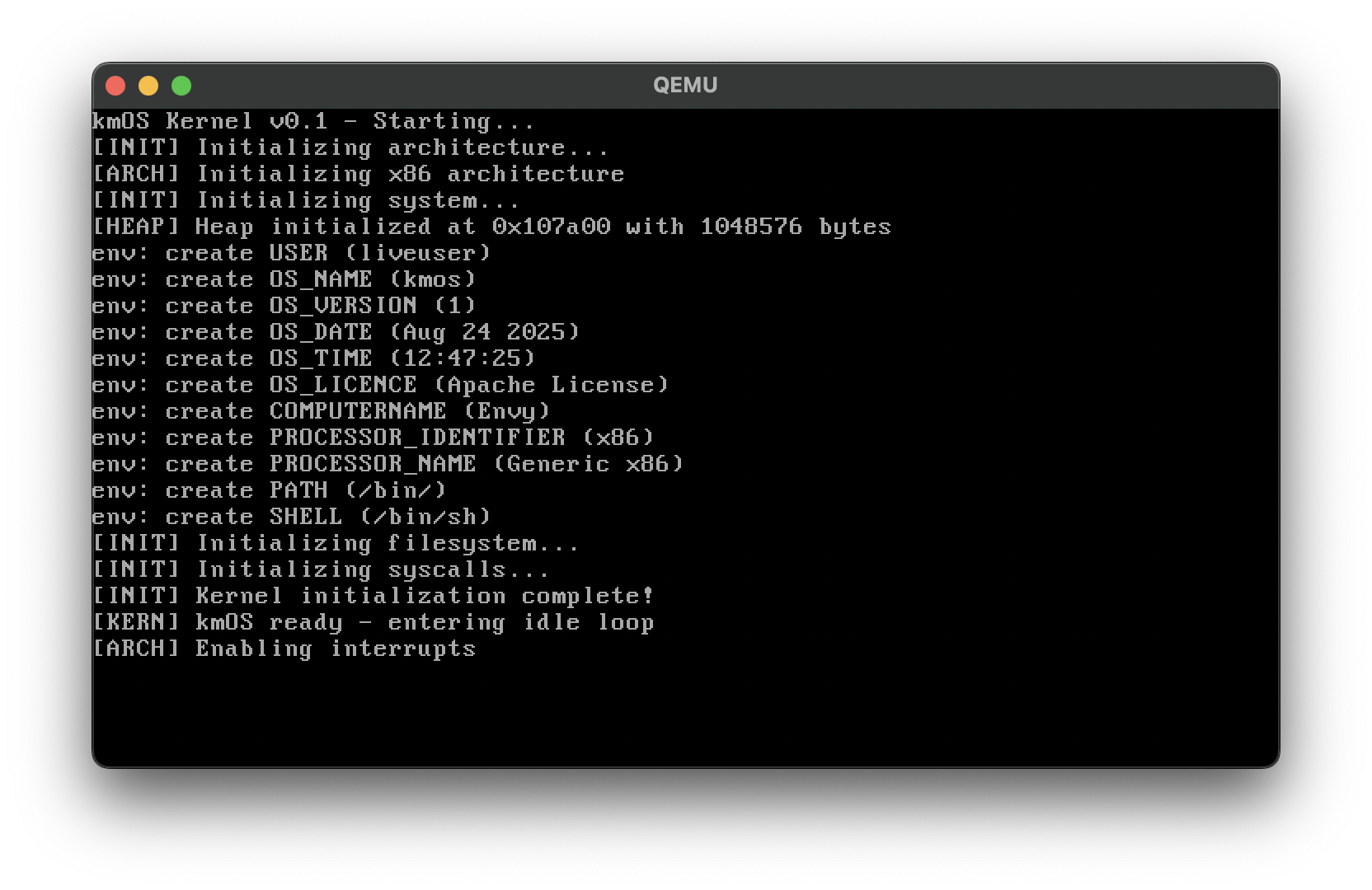
kmOS v0.1 - Early boot with basic kernel initialization and memory management
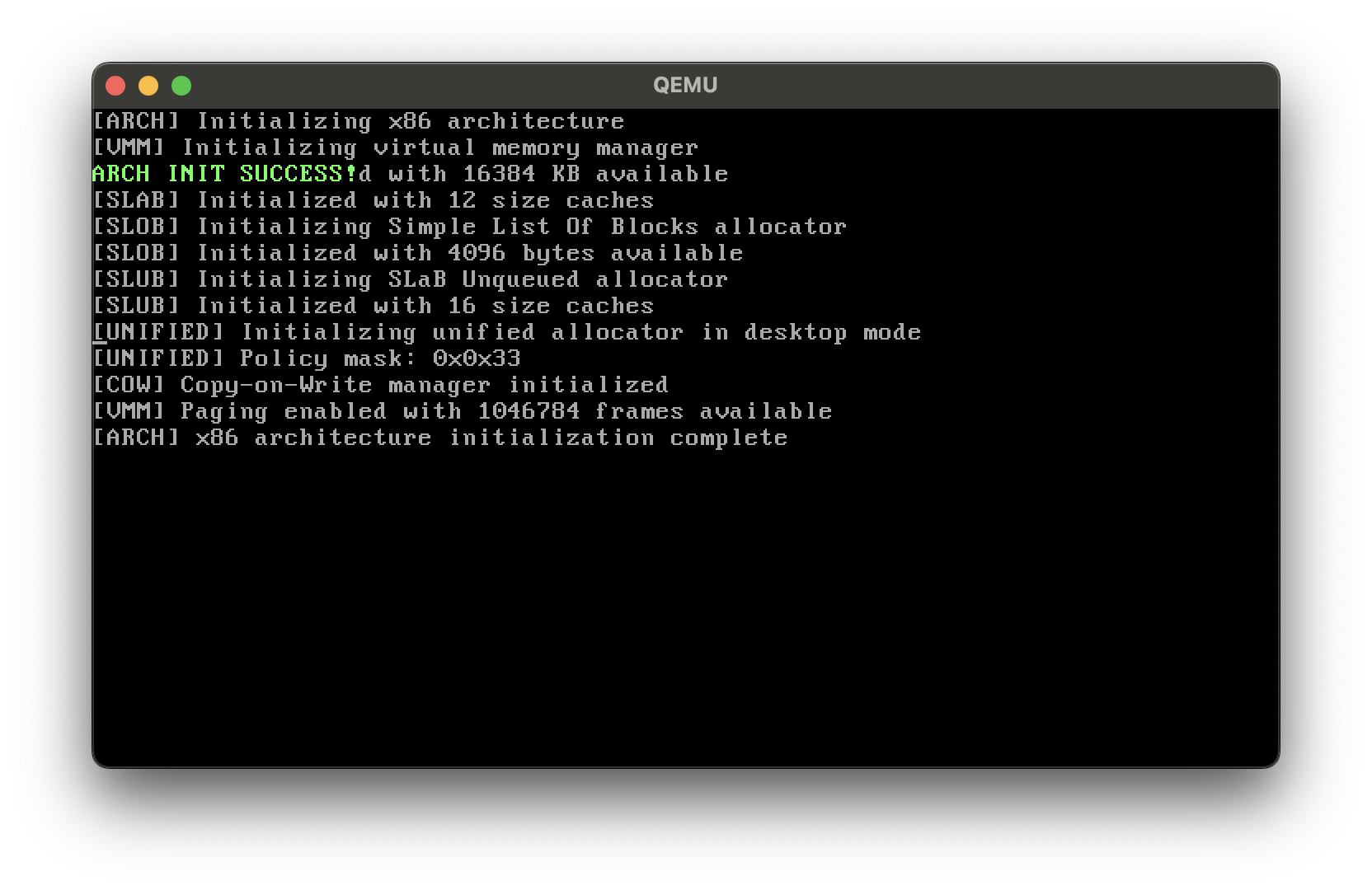
kmOS v0.1.1 - Successful kernel boot with architecture initialization and memory management
The kernel now supports dual-mode execution:
- GUI Mode (
make run): QEMU window with VGA display showing boot messages - Debug Mode (
make debug): Terminal output with detailed serial debugging information
Apache License 2.0.