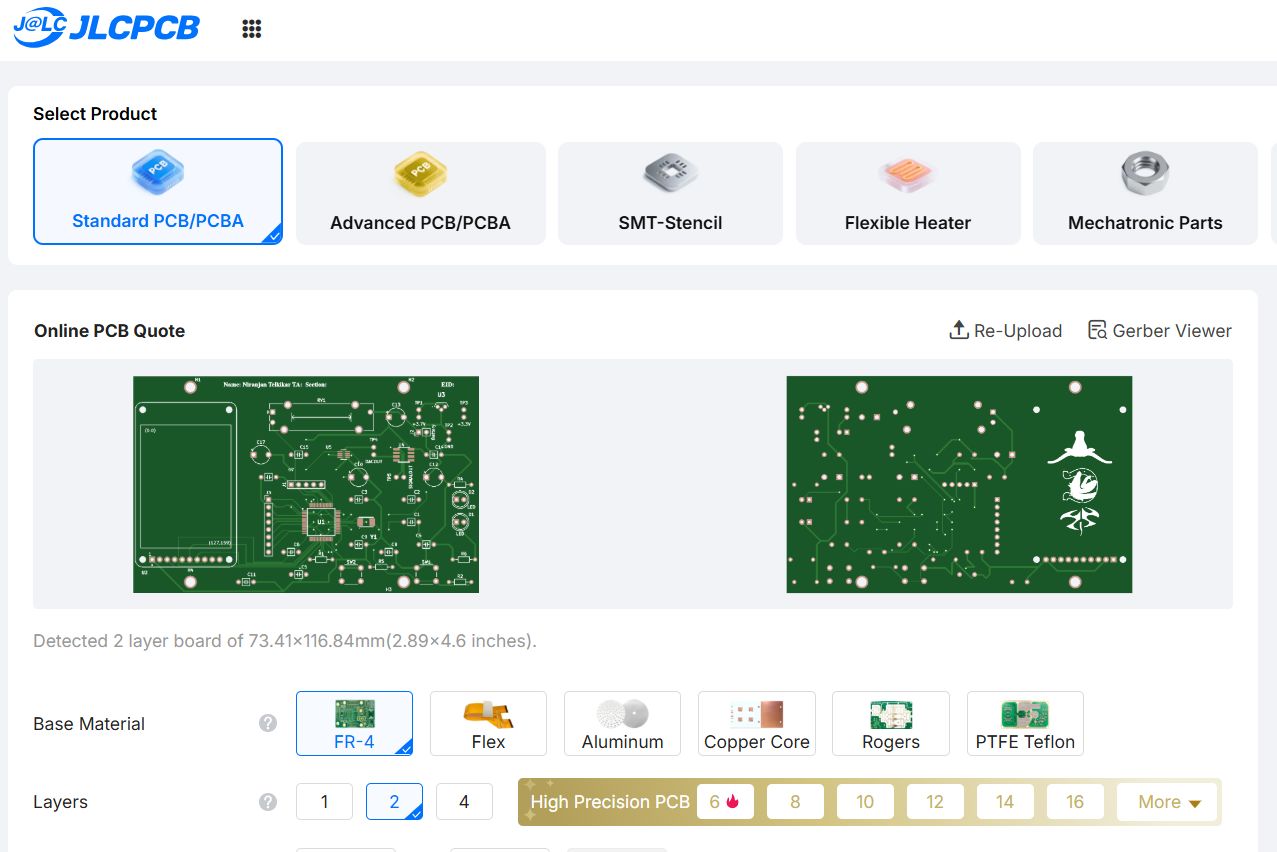
This project involved designing a PCB for an analog signal generator using a TM4C123GH6PM microcontroller, an AD5061BRJZ-1500RL7 SPI DAC, and an AD822ARZ op-amp in unity gain configuration. The system allows users to generate various waveforms and adjust amplitude and frequency via a potentiometer and mode selection button.
- Analog Signal Output: Generate multiple waveforms through the DAC and op-amp while monitoring values on a TFT display.
- Debugging Tools: Integrated test points, logic analyzer connections, and status LEDs for easier system verification.
- Power Regulation: Linear voltage regulation with an LP2950-33 low-dropout regulator to convert a 3.7V battery to a stable 3.3V supply.
- PCB Trace Design: Trace widths calculated based on current to ensure proper power delivery and minimal voltage drop.
- Component Placement: Careful layout to minimize trace lengths and maintain signal integrity.
- PCB fits into a SERPEC 151 enclosure, including battery mounting.
- Full schematic and PCB layout generated after thorough review of component datasheets.
- Bill of Materials (BoM) created to estimate cost for scaled production.
- Electrical Rules Check (ERC) performed in KiCad to ensure proper connections and correct component specifications. Unnecessary warnings (e.g., button with no value) were approved when appropriate.
- KiCad ensures common mistakes, such as near-missed connections, are caught before fabrication.
- Embedded systems programming and interfacing
- Analog-to-digital signal handling
- PCB design and layout
- Power supply design and regulation
- Practical trace planning and signal integrity
- BOM creation and cost estimation