The open code health benchmark for any public GitHub repo.
Paste a URL. Get a grade. Share the report.
stackhealth.dev · Leaderboard · Methodology · CLI · Action · Contributing


StackHealth scores public GitHub repositories on Security, Quality, Hygiene, and Community using a fully open scoring formula. Every weight, every threshold, every engine output is documented and inspectable. The goal is to give code what Lighthouse did for websites: a defensible, public, reproducible health rating that maintainers and adopters can both point at.
github.com/pallets/click → stackhealth.dev/pallets/click
That's the whole interaction. Submit a URL on the site, or just
replace github.com with stackhealth.dev in any repo URL. Within
~30–90 seconds you get a letter grade backed by seven engines.
Go to stackhealth.dev and paste any github.com URL — or just edit the URL bar. The leaderboard at stackhealth.dev/leaderboard shows the highest-graded repos across languages.
$ npx stackhealth fastapi/fastapi
  fastapi/fastapi
  A   91/100

    Security   ████████████████████  100/100
    Quality    █████████████████···   85/100
    Hygiene    ████████████████████  100/100
    Community  ████████████████····   80/100
Pipe-friendly (--json), CI-friendly (--min-grade B returns
non-zero), and ref-aware (--ref v8.0.0). Full reference in
apps/cli/README.md.
Drop this workflow into .github/workflows/stackhealth.yml and every PR
gets a sticky comment showing the base vs. PR grade, sub-dimension
breakdowns, and the delta.
on:
  pull_request:
    types: [opened, reopened, synchronize]

permissions:
  contents: read
  pull-requests: write

jobs:
  health:
    runs-on: ubuntu-latest
    steps:
      - uses: santosh3743/stackhealth@v0
        with:
          email: ${{ secrets.STACKHEALTH_EMAIL }}
          min-grade: B    # optional gate
Full reference in apps/action/README.md.
| Dimension | Weight | What feeds it |
|---|---|---|
| Security | 30% | OpenSSF Scorecard · Semgrep (p/security-audit) · Trivy CVE scan |
| Quality | 25% | Cyclomatic complexity (lizard) · Lint density (ruff / eslint / golangci-lint) · Duplication (jscpd) · Test signal · File size |
| Hygiene | 25% | 13-point binary checklist: README, LICENSE, CONTRIBUTING, CI, tests, etc. |
| Community | 20% | Recent activity · Contributor count (log₂) · Stars (log₁₀) · Issue responsiveness |
The full formula lives in three sync'd places:
docs/03-SCORING-METHODOLOGY.md
(human-readable), packages/formula-spec/v1.0.md
(machine-readable, frozen), and
apps/api/stackhealth/formula/v1.py
(executable).
Every scan stores the formula version, scanned commit SHA, and tool versions. Raw engine outputs are kept so anyone can recompute the score from scratch. If the score doesn't match what the formula says it should, that's a bug.
StackHealth/
├── apps/
│   ├── web/                    Next.js 15 frontend (TypeScript + Tailwind)
│   ├── api/                    FastAPI + RQ worker (Python 3.12)
│   │   ├── stackhealth/
│   │   │   ├── api/            HTTP routes (incl. discover, scans, badge)
│   │   │   ├── engines/        Scanning engines (semgrep, trivy, …)
│   │   │   ├── formula/        The open scoring formula
│   │   │   └── worker/         RQ jobs and the scan pipeline
│   │   └── alembic/            Database migrations
│   ├── cli/                    `npx stackhealth` — TypeScript, zero deps
│   └── action/                 GitHub Action — PR grade comments
├── packages/
│   └── formula-spec/           Frozen, machine-readable formula
├── docs/                       Vision, methodology, architecture, API design
├── infra/                      Dockerfile + docker-compose + Caddyfile
└── .github/                    CI, issue templates, dependabot, CODEOWNERS
A few documents that go deeper than this README:
docs/01-VISION.md— why this existsdocs/03-SCORING-METHODOLOGY.md— the open formuladocs/04-ARCHITECTURE.md— system designdocs/09-API-DESIGN.md— every endpointdocs/12-SECURITY-AND-PRIVACY.md— sandbox + threat modelCONTRIBUTING.md— how to set up and submit changesSECURITY.md— responsible disclosureCHANGELOG.md— what's shipped
- Node.js 20+ and
pnpm9+ - Python 3.12+ and
uv - Docker 24+ (for Postgres + Redis + the production-style local run)
This is the closest path to how it runs in production. Spins up Postgres, Redis, the API, the worker, the web app, and Caddy.
git clone https://github.com/santosh3743/stackhealth.git
cd stackhealth
cp infra/.env.prod.example .env
# Fill in DOMAIN, ACME_EMAIL, POSTGRES_PASSWORD, GITHUB_TOKEN
docker compose -f infra/docker-compose.prod.yml --env-file .env up -d --build
See infra/README.md for the full deploy
walkthrough.
If you'd rather hack on the API or web without Docker:
./scripts/setup.sh    # copies env templates, runs pnpm install + uv sync

# Terminal 1 — web
cd apps/web && pnpm dev                # http://localhost:3000

# Terminal 2 — API
cd apps/api && uv run uvicorn stackhealth.api.main:app --reload --port 8000

# Terminal 3 — worker
cd apps/api && uv run python -m stackhealth.worker.main
You'll need Postgres + Redis running somewhere (Docker, Homebrew,
managed services — your call). Set DATABASE_URL and REDIS_URL in
apps/api/.env.local. A GITHUB_TOKEN is optional but recommended
(lifts the GitHub API limit from 60/hr anonymous to 5,000/hr).
cd apps/api
uv run alembic upgrade head                           # apply
uv run alembic revision --autogenerate -m "describe" # new revisioncd apps/api && uv run pytest -q
cd apps/web && pnpm typecheck && pnpm lint && pnpm buildThe hosted API is at https://api.stackhealth.dev. Auto-generated
OpenAPI docs at /api/docs.
# Submit a scan
curl -X POST https://api.stackhealth.dev/api/scans \
  -H 'Content-Type: application/json' \
  -d '{"repo_url": "https://github.com/pallets/click"}'

# Poll its status
curl https://api.stackhealth.dev/api/scans/<scan_id>

# Get the latest scan for a repo
curl https://api.stackhealth.dev/api/repos/pallets/click/latest

# Public feed
curl https://api.stackhealth.dev/api/discover/recent
curl https://api.stackhealth.dev/api/discover/top?language=Python

# Embeddable badge
https://api.stackhealth.dev/r/pallets/click/badge.svg
Full reference: docs/09-API-DESIGN.md.
Two flavors, both always-latest, embed-and-forget:
<!-- compact badge — fits anywhere alongside other shields -->
[](https://stackhealth.dev/r/OWNER/REPO)
<!-- rich scorecard — 440 × 220 with sub-dimension bars -->
[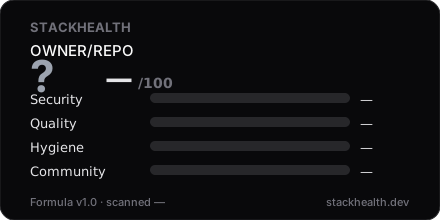](https://stackhealth.dev/r/OWNER/REPO)The scorecard shows the overall grade, score, and all four
sub-dimensions in one image — what you see at the top of this README
is the live card.svg for the StackHealth repo itself.
The CLI can spit out the badge markdown for you:
$ npx stackhealth OWNER/REPO --badge
[](https://stackhealth.dev/r/OWNER/REPO)The most useful contributions right now are:
- Bug reports with a reproducer URL.
- Calibration data — repos whose scores feel wrong, with a rationale.
- Pull requests improving engines, tightening sandbox boundaries, or polishing the report UI.
- Proposals against the formula — these go through a documented review process. See Changing the scoring formula.
Before opening anything substantial, please read
CONTRIBUTING.md and the
Code of Conduct.
Security issues go through the private disclosure flow in
SECURITY.md — please don't open public issues for
them.
MIT, with the explicit requirement that the original copyright notice and attribution to Santosh Jha be preserved in any copy or substantial portion. You may use, fork, modify, and redistribute, including commercially — credit the author and don't remove the copyright notice.
The scoring methodology, documentation, and source code are all covered by this license; copyright is retained by the author.