

Give your AI a memory. Smart Memory is a SillyTavern extension that quietly works in the background, keeping your AI oriented in long stories, aware of what happened this session, and grounded in facts it has learned across every previous chat with a character - even after weeks away.
It runs automatically. You don't have to do anything special to use it. Just chat, and it takes care of the rest.
This is an independent extension for SillyTavern and is not affiliated with the SillyTavern development team.
Note: Smart Memory currently supports 1:1 chats only. Group chat support is planned for a future release.
I'm a solo developer building tools to make AI roleplay better for everyone. Smart Memory is maintained in my free time, and as I'm currently navigating some financial challenges, any support means a lot.
If this extension adds something to your stories, please consider:
- Sponsoring me on GitHub
- Buying me a coffee on Ko-fi
- Bitcoin:
bc1qjsaqw6rjcmhv6ywv2a97wfd4zxnae3ncrn8mf9 - Starring this repository to help others find it.
- In SillyTavern, open the Extensions menu (the stack of cubes icon)
- Click Install extension
- Paste:
https://github.com/senjinthedragon/Smart-Memory - Click Install just for me (or for all users if you're on a shared server)
Restart SillyTavern. Smart Memory will appear in your Extensions panel.
Smart Memory runs several memory tiers in the background, each focused on a different slice of your story's history.
When your conversation grows long enough to approach your AI's context limit, Smart Memory automatically summarizes everything so far and keeps that summary injected at the top of context. Older messages can fall out of the window without the AI losing the thread of the story.
After the first summary exists, only new messages are processed and folded in - the summary grows with your story rather than being rewritten from scratch every time.
Facts, relationship history, preferences, and significant events are extracted from your chats and stored per character. These memories survive across all sessions - when you open a new chat with a character, everything the AI has learned about them is already there waiting.
Over time, memories are automatically consolidated so the same information doesn't pile up in slightly different forms. You end up with a clean, rich picture of the character rather than a cluttered list.
Granular details from the current session - scene descriptions, things that were revealed, how the relationship shifted, specific objects or places that were mentioned. More detailed than long-term memory, and scoped to this chat only. It doesn't carry over to future sessions, but it keeps the AI grounded in the specifics of what's happening right now.
Smart Memory watches for scene transitions - time skips, location changes, those little --- dividers authors use between scenes. When one is detected, a short summary of the completed scene is saved. The last few scene summaries are kept in context so the AI always knows where the story has been, not just where it is.
Unresolved narrative threads - promises made, character goals, mysteries introduced, tensions left hanging - are tracked and kept in context. When the story resolves one, it gets marked closed. This keeps the AI oriented toward where the story is going, not just reacting to the last message.
Come back after a long break and not quite remember where you left off? Smart Memory generates a short "Previously on..." recap and quietly injects it so you and the AI pick up in the right place. It disappears after the first response - just a gentle reminder, not a permanent fixture.
A manual tool you can reach for when something feels off. Click Check Last Response (or use /sm-check) and Smart Memory asks the AI whether the last response contradicts anything in your established facts. Useful for catching drift in long stories - the AI suddenly forgetting a character detail, reversing a decision that was made, that kind of thing.
Note: The continuity checker is only as good as the model doing the checking, and it only knows what is stored in Smart Memory - not what is on the character card by heart. Think of it as a sanity check, not a guarantee.
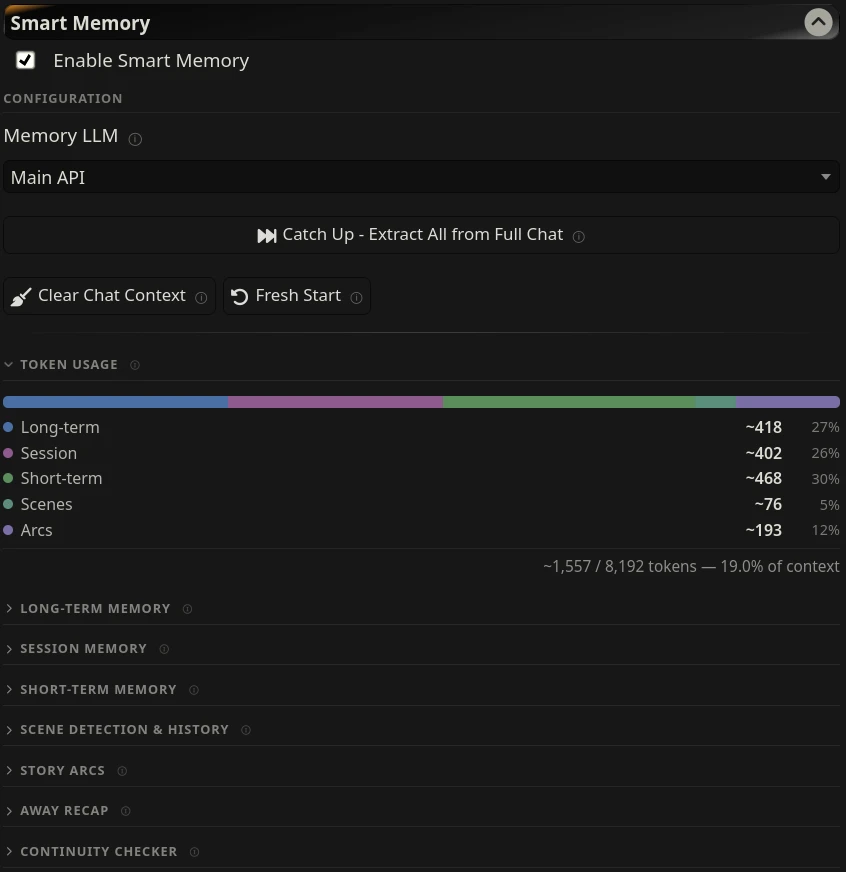
A small bar in the settings panel shows how many tokens each memory tier is currently injecting. It updates after every generation, so you can see at a glance whether Smart Memory is taking up a sensible amount of your context budget.
Smart Memory is designed to work alongside SillyTavern's built-in vector storage, not replace it. Think of them as complementary layers:
| Layer | What it does |
|---|---|
| Message Limit extension | Hard cap on raw messages in context - your VRAM budget |
| Vector storage | Retrieves specific details on demand when they're relevant |
| Smart Memory - session | Always-present curated details from the current chat |
| Smart Memory - short-term | Always-present narrative summary of everything before the window |
| Smart Memory - long-term | Always-present character facts from all previous sessions |
If you're on limited VRAM (8GB or less), keep the Message Limit extension enabled and consider lowering Max session memories to around 15 to keep prompt size comfortable.
Smart Memory's defaults are designed to layer cleanly alongside vector storage. Depth is distance from the user's last message - depth 0 is right before the AI responds, higher numbers are further back.
| Tier | Position | Depth | Notes |
|---|---|---|---|
| Recap | In-chat | 0 | Temporary - cleared after first response |
| Arcs | In-chat | 2 | Shares depth with ST chat vectors intentionally |
| Session | In-chat | 3 | Just above ST's default vector depth |
| Scenes | In-chat | 6 | Further back - past scene context |
| Long-term | In-prompt | - | Near character card |
| Short-term | In-prompt | - | Narrative background |
If you change ST's vector storage depth, set session memory one higher so it still layers above vectors.
All settings are saved automatically per profile.
Selects which LLM handles all Smart Memory work - summarization, extraction, and recap generation. Setting this to a lighter model leaves your main roleplay LLM free for the actual story.
Options: Main API or WebLLM Extension.
| Setting | Default | Description |
|---|---|---|
| Enable auto-summarization | On | Summarize automatically at threshold |
| Context threshold | 80% | Summarize when context reaches this % of the model's limit |
| Summary response length | 1500 tokens | Length budget for the summary - also acts as the injection cap |
| Injection template | [Story so far:\n{{summary}}] |
Wrapper text around the summary |
| Injection position | In-prompt | Where in the prompt the summary appears |
| Setting | Default | Description |
|---|---|---|
| Enable long-term memory | On | Extract and inject persistent character facts |
| Carry over to new chats | On | Inject memories when starting a new chat with the same character |
| Auto-consolidate | On | Periodically merge near-duplicate entries |
| Fresh start (per-chat) | Off | Suppress memory injection for this specific chat |
| Extract every N messages | 3 | How often automatic extraction runs |
| Max memories per character | 25 | Hard cap - oldest entries dropped when exceeded |
| Injection token budget | 500 | Oldest memories dropped first if total would exceed this |
| Injection template | [Memories from previous conversations:\n{{memories}}] |
Wrapper text |
| Injection position | In-prompt | Where in the prompt memories appear |
| Setting | Default | Description |
|---|---|---|
| Enable session memory | On | Extract and inject within-session details |
| Extract every N messages | 3 | How often automatic extraction runs |
| Max session memories | 30 | Consider lowering to ~15 on limited VRAM |
| Injection token budget | 400 | Oldest memories dropped first if exceeded |
| Injection template | [Details from this session:\n{{session}}] |
Wrapper text |
| Injection position | In-chat @ depth 3 | Sits just above ST's default vector depth |
| Setting | Default | Description |
|---|---|---|
| Enable scene detection | On | Detect breaks and store scene history |
| AI detection | Off | More accurate but costs an extra model call per message |
| Keep last N scenes | 5 | How many scene summaries to retain |
| Injection token budget | 300 | Oldest scenes dropped first if exceeded |
| Injection position | In-chat @ depth 6 | Further back in context |
| Setting | Default | Description |
|---|---|---|
| Enable arc tracking | On | Extract and inject open narrative threads |
| Max tracked arcs | 10 | Oldest arcs dropped when limit is exceeded |
| Injection token budget | 200 | Oldest arcs dropped first if exceeded |
| Injection position | In-chat @ depth 2 | Near current action, alongside chat vectors |
| Setting | Default | Description |
|---|---|---|
| Enable recap | On | Generate a recap when returning after a gap |
| Threshold | 4 hours | Minimum time away before a recap is generated |
| Injection position | In-chat @ depth 0 | Right before the AI responds; cleared after first response |
All manual operations are in the Configuration section at the top of the panel, or inside their respective tier sections.
Processes the entire chat history in chunks, running every enabled extraction tier across the backlog. Use this when you load an older chat that Smart Memory hasn't seen yet, or when you want to build up a character's long-term memory from previous sessions.
A Cancel button appears during processing. Cancelling stops the loop cleanly between chunks - partial results are saved.
To build long-term memory from multiple older chats, simply open each one and run Catch Up. Memories accumulate and deduplicate automatically. Skip any chats you'd rather not include.
Clears Smart Memory's state for the current chat - summary, session memories, scene history, and story arcs. Long-term memories are not touched. Useful before a Catch Up run to re-derive everything cleanly from scratch.
Clears everything, including long-term memories for the current character, and suppresses future memory injection for this chat. Use this after test or throwaway sessions to make sure nothing bleeds into future chats. Asks for confirmation before proceeding - this cannot be undone.
Each memory tier has its own Extract Now or Extract button that processes a recent window of messages - not the full chat. Useful for pulling in the latest exchanges outside the automatic schedule.
| Button | Window |
|---|---|
| Long-term Extract Now | Last 20 messages |
| Session Extract Now | Last 40 messages |
| Extract Arcs Now | Last 100 messages |
| Extract Scene | Scene buffer or last 40 messages |
For the full chat backlog, use Catch Up instead.
- Summarize Now - forces a short-term summary right now, ignoring the threshold
- Generate Recap Now - generates and injects a recap on demand
- Check Last Response - runs the continuity check against the last AI response
- Clear buttons on each tier - remove all stored data for that tier
| Command | Description |
|---|---|
/sm-check |
Check the last AI response for contradictions against established facts |
/sm-summarize |
Force a short-term summary generation now |
/sm-extract |
Run long-term, session, and arc extraction against the current chat now |
/sm-recap |
Generate and inject a "Previously on..." recap now |
Long-term memories are tagged by type:
fact- established truths about the character, world, or settingrelationship- the current state and history of the relationshippreference- what the user demonstrably enjoys (themes, tone, pacing)event- significant events that should be recalled in future sessions
Session memories are tagged by type:
scene- current or recently completed scene detailsrevelation- something discovered or revealed this sessiondevelopment- how the relationship or situation changeddetail- specific facts, names, objects, or places mentioned
Licensed under the GNU Affero General Public License v3.0.

