


Demo: https://markdonish.github.io/round-table-workspace/
Make your AI coding agents hold a review round table before you trust the output.
Star this repo if you want a local-first review gate before merging AI-generated work. Try the 60-second demo, see the AI feature review example, use the 5-minute evaluation path, open the review packet, open the repo preview card, read how the review room works, or read why this is worth starring. No provider key is required for the default demo path.
From a fresh clone, try the pre-merge gate first:
git clone https://github.com/MarkDonish/round-table-workspace.git
cd round-table-workspace
./rtw ship-check "Should we merge this AI-generated feature?"
./rtw doctor --quick
In the JSON output, look for the decision and panel votes:
{
  "decision": "revise",
  "panel_votes": [
    {"agent": "product", "vote": "revise"},
    {"agent": "engineering", "vote": "ship"},
    {"agent": "risk", "vote": "revise"},
    {"agent": "user-advocate", "vote": "revise"}
  ],
  "next_actions": [
    "Run ./rtw doctor --quick and the unit test suite."
  ]
}
Star it if that is the pause you want before trusting generated work.
Round Table Workspace is a local-first decision layer for Codex, Claude Code, and other CLI agents. It turns vague product or engineering questions into structured /room exploration, escalates risky choices into /debate, and adds a ship-check gate before you accept AI-generated work.
Instead of taking one confident agent answer at face value, you get a small panel of roles that review the work from product, engineering, risk, and user perspectives, then return a practical ship, revise, or reject decision.
This is not a random multi-agent chat. It is a bounded review gate:
| Move | Plain meaning | What you get |
|---|---|---|
| Create reviewer candidates | Start from the question or generated change and ask which review angles could catch failure modes. | Possible product, engineering, risk, and user-facing reviewers. |
| Select reviewers for this decision | Keep the reviewers that add useful pressure to this exact decision. | A small panel instead of a noisy crowd. |
| Bound the debate | Make the panel argue about value, evidence, risk, and next action. | Clear disagreement instead of one confident answer. |
| Write a decision record | Turn the discussion into a local artifact. | ship, revise, or reject, plus risks, missing evidence, and next steps. |
The point is to make the moment before merge, launch, or trust auditable.
If you use AI coding agents for real work, this repository is for the moment right before you merge, publish, or trust their output.
Use it when you want to:
- catch weak reasoning before it becomes a real engineering decision
- turn one confident agent answer into a small review panel
- keep a local evidence trail instead of relying on a chat transcript
- decide whether generated work should ship, be revised, or be rejected
Without a review gate, the handoff often looks like this:
AI agent: The feature is implemented and ready to merge.
Human: Sounds good.
Result: unclear risk, no evidence trail, public claims may be too broad.
Round Table Workspace slows that moment down:
ship-check: revise
Product: the user value is still vague
Engineering: the change is small enough after tests pass
Risk: the launch claim needs current evidence
User advocate: the README needs a concrete example
Next: revise the claim, run validation, then decide again
The value is not "more agents for the sake of it." It is a repeatable pause between a confident AI answer and a real merge, launch note, architecture choice, or public claim.
The mechanism is intentionally simple:
- Create candidate reviewers for the question.
- Keep the reviewers that add real signal.
- Bring them into a round-table discussion.
- Return a decision gate with risks, missing evidence, and next steps.
git clone https://github.com/MarkDonish/round-table-workspace.git
cd round-table-workspace
./rtw ship-check "Should we merge this AI-generated feature?"
./rtw room "What is the smallest useful MVP for this idea?"
./rtw debate "Is this launch ready?"
./rtw doctor --quick
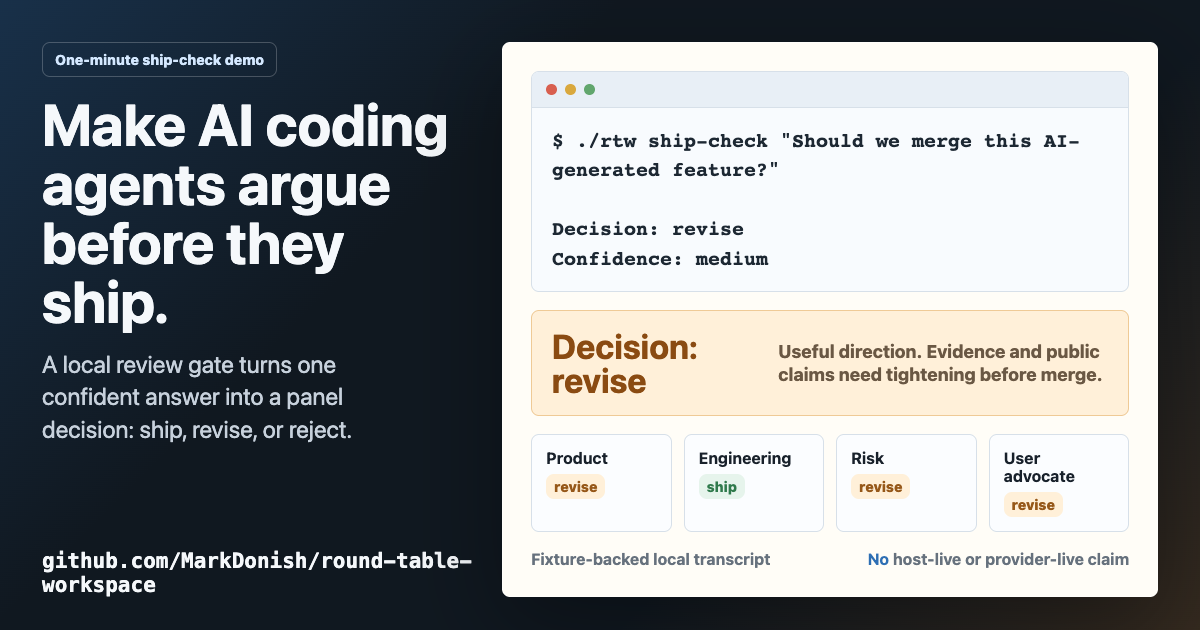
A ship-check result looks roughly like this:
Decision: revise
Panel: product, engineering, risk, user-advocate
Why: useful direction, but public claims and evidence need tightening
Next: run tests, add a visible demo, keep claims local-first unless validated
For a concrete pre-merge example, see
docs/ai-generated-feature-review-demo.md
or the Pages demo:
https://markdonish.github.io/round-table-workspace/ai-generated-feature-review-demo.html.
For workflow fit, see docs/use-cases.md or the Pages
use-cases page:
https://markdonish.github.io/round-table-workspace/use-cases.html.
For the shortest output sample, see
docs/one-minute-demo.md or the screenshot-ready
Pages transcript:
https://markdonish.github.io/round-table-workspace/one-minute-demo.html.
For a static social preview, use the checked-in image:
https://markdonish.github.io/round-table-workspace/one-minute-demo-card.png.
For an architecture decision example, see
examples/transcripts/ship-check-architecture-decision.md.
For a one-page evaluator packet, see
docs/review-packet.md or the Pages packet:
https://markdonish.github.io/round-table-workspace/review-packet.html.
Star this repo if you want a local-first review layer for AI coding workflows, especially if you use Codex, Claude Code, or other CLI agents and want a repeatable decision gate before trusting generated work.
The current best path to try is:
./rtw demo startup-idea
./rtw ship-check "Should we merge this AI-generated feature?"
./rtw doctor --quick
No provider key is required for the default demo path.
New contributors can start with small, claim-safe tasks, read the completed architecture-decision transcript, or share the AI workflow this review gate should cover next:
- Architecture-decision
ship-checktranscript - Screenshot-ready one-minute demo
- Real-world failure mode in the community share kit
- Contributor starter issue guide
- Share an AI workflow example
See all
good first issue
tasks or read CONTRIBUTING.md.
AI coding agents are fast. Sometimes too fast.
They can write code, docs, launch copy, or plans before the real decision has been tested:
- Should this actually be built?
- What evidence would change the decision?
- What user or maintenance risk are we ignoring?
- Is this ready to ship, or does it only sound plausible?
- Are we claiming host-live or provider-live support without current evidence?
Round Table Workspace adds a decision protocol before execution. It is not another chat UI. It is a repository-friendly protocol, CLI surface, schema set, fixture-backed runtime, and evidence trail for reviewing AI-assisted decisions.
Run the pre-ship decision gate:
./rtw ship-check "Launch the new AI-generated onboarding flow"Run a quick local health check after cloning:
./rtw doctor --quickTry the fixture-backed room and debate surfaces:
./rtw room "I want to build an AI study product for college students"
./rtw debate "Should this MVP be shipped this week?"
Run the golden-path demo without configuring a provider:
./rtw demo startup-ideaMost commands support automation-friendly output:
./rtw ship-check "Should we merge this?" --output-json /tmp/ship-check.json --quiet
./rtw room "topic" --json
./rtw release-check --include-fixtures --quiet --output-json /tmp/rtw-release-check.jsonflowchart TD
A[Vague idea or AI-generated change] --> B[/room exploration]
B --> C[Summary + handoff packet]
C --> D[/debate decision review]
D --> E{ship-check gate}
E -->|ship| F[Proceed with evidence]
E -->|revise| G[Fix risks or add evidence]
E -->|reject| H[Stop or redefine the problem]
F --> I[JSON + Markdown artifacts]
G --> I
H --> I
Core command surface:
| Command | When to use it | Output |
|---|---|---|
ship-check |
Before trusting AI-generated work | panel vote, risks, missing evidence, next steps |
/room / ./rtw room |
When the topic is still exploratory | selected panel, structured turns, summary, optional handoff packet |
/debate / ./rtw debate |
When a risky decision needs review | launch bundle, round-table record, reviewer result, allow/reject/follow-up outcome |
doctor |
When you want to know whether a fresh clone can run locally | JSON / Markdown evidence under the selected state root |
release-check |
When you need release-scope readiness evidence | aggregated readiness evidence without relying on old reports |
- Pre-merge review for AI-generated code or docs
- MVP decision review before building
- Architecture tradeoff review before refactoring
- Risk review before public launch claims
- Local-first agent workflow experiments
- Decision evidence for Codex and Claude Code projects
- Training teams not to blindly trust a single confident agent answer
The current release is v0.2.3-mechanism-clarity.
This repository currently provides:
- Codex local-mainline
/room - Codex local-mainline
/debate - Codex local-mainline
/room -> /debate - Fixture-backed
ship-checkdecision gate scaffolding - Committed protocol docs, prompts, skill entries, runtime bridge, and validation harnesses
- Claude Code project-level skill discovery structure as an adapter layer
- Fixture-validated generic local agent adapter contract
- Fresh-clone checks and post-release consumer audit paths
- Host / provider live-lane evidence reports
- Chat Completions compatible fallback and mock regression tools
This repository does not currently claim:
- Universal support for every local agent host
- OpenCode host-live support
- Gemini CLI, Aider, Goose, or Cursor Agent host-live support before their validation rows report
live_passed - Real Chat Completions compatible provider-live support before a valid
.env.room/.env.debateexists and live validation passes - General production stability across all machines and account environments
The project is intentionally conservative about public claims. Passing fixtures, having wrappers, or passing config preflight is not described as real host-live or provider-live support unless matching validation evidence exists.
round-table-workspace/
├─ README.md
├─ LAUNCH.md
├─ AGENTS.md
├─ CHANGELOG.md
├─ docs/
├─ schemas/
├─ agents/
├─ config/
├─ roundtable_core/
├─ scripts/
├─ skills_src/
├─ evals/
├─ prompts/
├─ examples/
├─ .codex/skills/
├─ .claude/skills/
├─ reports/
└─ artifacts/
Current source-of-truth areas:
AGENTS.mdLAUNCH.mddocs/schemas/agents/config/roundtable_core/scripts/skills_src/evals/prompts/examples/.codex/skills/.claude/skills/as an adapter layer
Historical or generated material:
reports/artifacts/
If a report or artifact exposes a still-valid rule, migrate that rule into an active source file instead of treating historical output as an authority.
| Document | Purpose |
|---|---|
LAUNCH.md |
Shortest safe path for a fresh clone |
docs/index.md |
Documentation map by user, protocol, runtime, validation, and history areas |
docs/quick-evaluation.md |
5-minute local trial and star decision path for new visitors |
docs/why-star-this-repo.md |
Quick evaluator guide for deciding whether the repo is worth starring |
docs/comparison-guide.md |
Plain comparison against direct agent answers, CI, manual review, and multi-agent frameworks |
docs/ai-failure-modes.md |
Concrete failure modes this workflow is designed to catch before trust |
docs/demo-recording-guide.md |
Short recording plan for visual X, LinkedIn, newsletter, or README demos |
docs/short-video-script-kit.md |
Copy-ready short video scripts for X, LinkedIn, Product Hunt, and forums |
docs/repo-card.html |
Pages-hosted GitHub-style repo preview card for sharing and directory submissions |
docs/repo-card.png |
1200x630 repo preview image used for social cards and directory previews |
docs/one-minute-demo.html |
Screenshot-ready Pages transcript for the one-minute ship-check demo |
docs/one-minute-demo-card.png |
1200x630 social image for the one-minute ship-check demo |
docs/one-minute-demo.md |
Markdown source for the one-minute demo transcript |
docs/use-cases.html |
Pages-ready use-case guide for practical AI coding workflows |
docs/use-cases.md |
Markdown source for concrete Round Table Workspace use cases |
docs/community-share-kit.md |
Claim-safe community sharing guide and short blurbs |
docs/directory-submission-kit.md |
Copy-ready fields for open-source directories and community roundups |
docs/distribution-checklist.md |
Step-by-step public distribution checklist for star-focused promotion |
docs/public-submission-targets.md |
Current public submission targets, entry points, and tracking fields |
docs/developer-forum-feedback-kit.md |
Feedback-first Reddit, forum, Discord, Slack, and discussion post kit |
docs/show-hn-submission-draft.md |
Claim-safe Show HN title, first comment, reply bank, and tracking notes |
docs/newsletter-roundup-pitch-kit.md |
Newsletter and roundup pitches for AI agent and developer-tool curators |
docs/product-hunt-launch-kit.md |
Product Hunt launch fields, maker comment, FAQ, assets, and guardrails |
docs/promotion-feedback-template.md |
24h and 72h feedback template for deciding the next promotion angle |
docs/ai-generated-feature-review-demo.html |
Pages-ready demo for reviewing AI-generated work before merge |
docs/ai-generated-feature-review-demo.md |
Concrete pre-merge demo for reviewing AI-generated work |
docs/user-entry-guide.md |
Plain-language guide to the repository model |
docs/agent-consumer-quickstart.md |
Command guide for Codex, Claude Code, and generic local agents |
docs/source-truth-map.md |
Boundary between source files and historical / generated material |
docs/release-readiness.md |
Release gate rules |
docs/release-candidate-scope.md |
Support scope and public claim boundaries |
docs/roadmap.md |
Roadmap and release horizon |
docs/milestones/v0.2.0.md |
v0.2.0 milestone scope and issue breakdown |
docs/launch-copy.md |
Launch copy for X, Hacker News, Reddit, and community posts |
docs/demo.html |
Static visual demo for GitHub Pages or screenshots |
docs/protocol-spec.md |
/room, /debate, and handoff protocol overview |
docs/protocol-versioning.md |
Release, protocol, schema, runtime, prompt, and fixture version boundaries |
docs/decision-quality-rubric.md |
Machine-checkable decision quality rubric |
docs/schema-validation-subset.md |
Draft 2020-12 fallback validator boundary |
docs/skill-generation.md |
Skill generation summary and drift-check maintenance |
docs/agent-factory-architecture.md |
Agent Factory manifest, profile, and registry lifecycle |
agents/registry.json |
Machine-readable agent registry used by the runtime bridge |
config/agent-registry.json |
Agent Factory custom / candidate registry |
schemas/room-session.schema.json |
Portable /room session state schema |
schemas/debate-session.schema.json |
Portable /debate session state schema |
schemas/debate-result.schema.json |
Portable /debate result schema |
schemas/room-to-debate-handoff.schema.json |
Portable /room -> /debate handoff schema |
schemas/agent-manifest.schema.json |
Agent Factory manifest schema |
schemas/agent-registry.schema.json |
Agent Factory custom / candidate registry schema |
schemas/agent-selection-request.schema.json |
Future selection bridge request schema |
docs/room-architecture.md |
/room protocol and behavior |
docs/debate-skill-architecture.md |
/debate protocol and behavior |
docs/room-to-debate-handoff.md |
Handoff contract from exploration to review |
docs/generic-local-agent-adapter.md |
Generic local CLI agent contract |
examples/transcripts/ |
Example walkthroughs for ship-check, /room, /debate, and handoff |
reports/claim-boundary-dashboard.md |
Generated snapshot only; for current status, run ./rtw evidence or ./rtw release-check |
CHANGELOG.md |
Release history |
The default path is local-first. Provider URLs are optional and only belong to the Chat Completions compatible fallback or live validation lane.
Before making host or provider support claims, generate evidence:
python3 .codex/skills/room-skill/runtime/live_lane_evidence_report.py \
  --state-root /tmp/round-table-live-lane-evidence
Codex local-mainline regression:
python3 .codex/skills/room-skill/runtime/local_codex_regression.py \
  --state-root /tmp/round-table-local-codex-regression
Release-scope check:
./rtw release-check --include-fixtures --state-root /tmp/round-table-release-checkContributions are welcome, but keep the claim boundary intact: do not describe fixture success as host-live or provider-live support.
Start with CONTRIBUTING.md, keep the default path local-first, and include new validation evidence in your pull request.
Repository-level rules live in AGENTS.md. For follow-up development, read these first:
AGENTS.mddocs/source-truth-map.mddocs/development-sync-protocol.mddocs/release-readiness.md
Default development loop:
- develop locally
- validate locally
- commit verified changes
- push to
origin/main - report what changed, what was verified, and what remains outside the claim boundary