Background, motivation, and learnings: blog post.
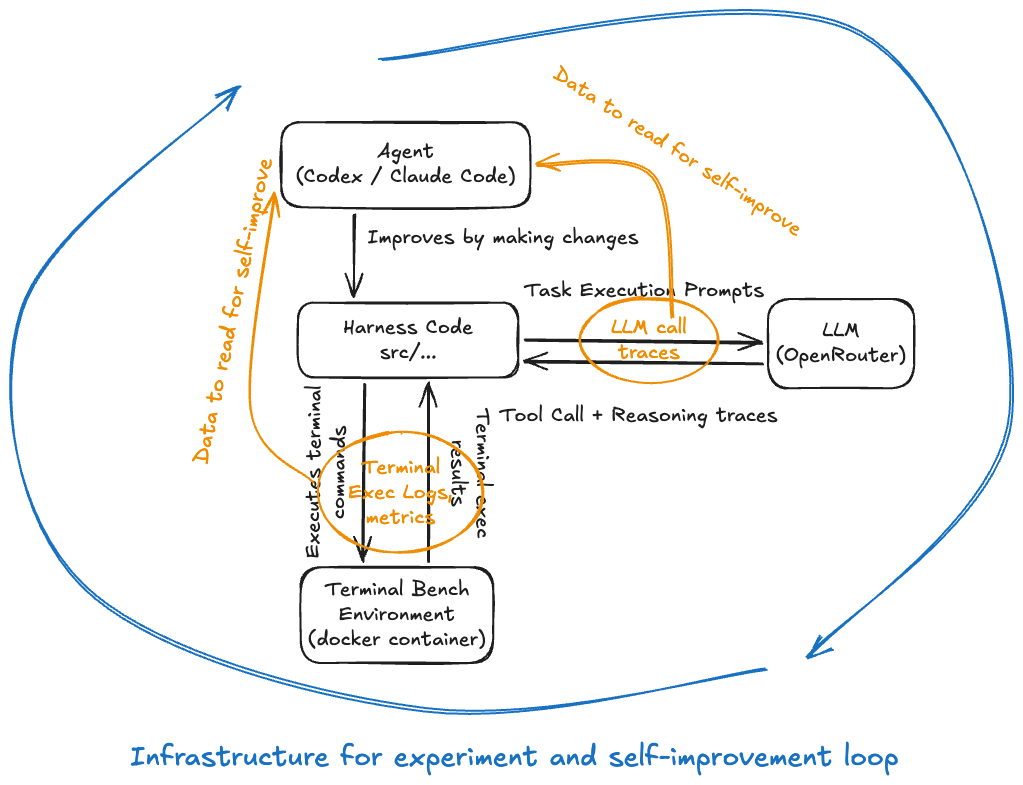
A self-improvement experiment in two layers:
- Inner — the harness (
src/harness/core.py): an LLM shell agent that solves tasks behind a commonHarnessEnvinterface. The checked-in default uses SWE-bench Verified; Harbor/Terminal-Bench remains available via config. - Outer — the supervisor (
uv run auto): a coding agent (Codex or Claude Code) that proposes one focused change to the inner harness per cycle, measures it against the current baseline, and keeps or discards it on statistical evidence.
Architecture: TECH_DESIGN.md. Operating policy the outer agent follows: program.md.
Requires Python 3.13+, Docker, uv, and a source checkout.
uv sync
source .venv/bin/activate
Configure the harness in config/harness_config.json; config/harness_config.template.json is the commented reference. uv run exp and uv run auto always read config/harness_config.json; switch substrates by editing its env_backend.
Backend task names:
env_backend: "swe":task_namesare SWE-bench Verifiedinstance_ids from thetestsplit at https://huggingface.co/datasets/princeton-nlp/SWE-bench_Verified.env_backend: "harbor":task_namesare Terminal-Bench 2 task IDs from https://www.tbench.ai/benchmarks/terminal-bench-2, with localtask_overrides/<task_id>/taking precedence.
Credentials, per layer:
- Task-solving LLM (required for everything — every task step calls a model):
openrouter: setOPENROUTER_API_KEYin your shell or a repo-local.env. If the checked-in provider routing is unavailable to your account, adjustllm_provider_config.provider_kwargs.provider.chatgpt_codex: runcodex loginonce; auth is read fromCODEX_HOME/auth.jsonor~/.codex/auth.json.- Local or other models: implement
src/llm/base.py.
- Outer agent (only for
uv run auto): an authenticatedcodex(default) orclaudeCLI.
uv run exp runs the configured task panel against whatever code is checked out and writes one raw record to experiments/<id>/experiment.json — no baseline, no gating.
It uses paid/quota-limited LLM calls, needs Docker running, and requires a clean worktree (EXP_ALLOW_DIRTY_WORKTREE=1 bypasses, for throwaway runs only).
uv run expProgress streams to the terminal:
[####--------------------] 10/49 tasks (20%) | trials 28/105 | solved 9/12 | errors 0 | active 8 | 1m12s elapsed, ~4m40s left
uv run auto                 # codex agent (default)
uv run auto --agent claude
Each cycle: the outer agent edits src/harness/core.py in a sparse worktree → the candidate runs in a throwaway sibling worktree → a statistical gate keeps (fast-forwards onto the primary) or discards → the agent writes a diagnosis.
Use a dedicated checkout. uv run auto:
- has no budget cap — it runs until Ctrl+C or an error, spending on both the outer agent and the task-solving LLM
- runs agent CLIs without permission prompts
- requires a clean, committed
HEAD; working dirs (worktrees, an isolated codex-home symlinked to your~/.codexauth) live under../harness-experiment_supervisor/
It streams the agent's thinking and tool calls, then the same per-run progress bar as exp:
[supervisor] loop_iteration_started
[claude] I'll read the authoritative files to understand the current state...
  [toolcall] read .../workspace/program.md
  [toolcall] read .../workspace/src/harness/core.py
experiments/learning.md— the cumulative agent-written diagnosis memo. Start here.experiments/<id>/experiment.json— a run's raw outcome;loop.jsonnext to it — the keep/discard decision with per-task evidence.- Full artifact tree (per-trial logs, verifier output, supervisor dirs): TECH_DESIGN.md → Artifact layout.
Local package caches
For multi-trial runs, scripts/setup-apt-cache.sh reduces repeated apt bootstrap stalls. For ML-heavy tasks, scripts/setup-pypi-cache.sh reduces repeated verifier dependency downloads.
Task overrides
For env_backend: "harbor", drop a valid Harbor task layout under task_overrides/<task_id>/ to shadow a Terminal-Bench task or run a local task. Configure or disable overrides in config/harbor_config.toml.