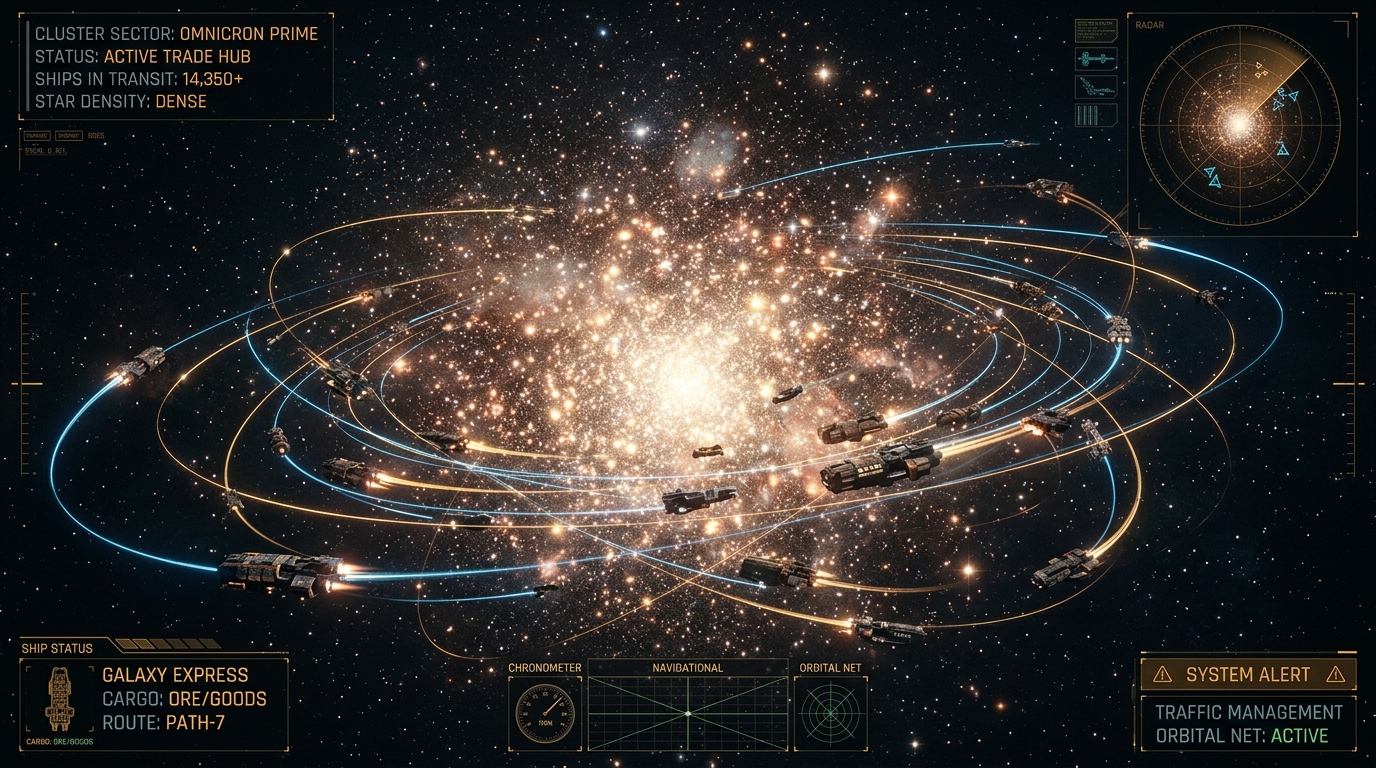
[





Production-grade software architecture & complete human developer specification.
🌐 Open Live Showcase · 📊 Architectural Diagram · 📜 Developer Specs



This repository contains Jirnyak/starcluster. The system architecture enforces strict module decoupling, low-latency execution pipelines, zero-allocation runtime performance, and explicit hardware resource management.
graph TD
    A[Stellar Initializer 10,000 Bodies] --> B[Barnes-Hut Octree Gravity Quad]
    B --> C[Sublight Vector Velocity Integrator]
    C --> D[Orbital Trading Economy Engine]
-
Barnes-Hut Octree:
$O(N \log N)$ gravitational force computation for 10,000 active stellar bodies. - Sublight Relativistic Vectors: Precise trajectory updates for inter-system freighter logistics.
⚙️ Core System Configuration Parameters (Click to Collapse)
| Parameter Key | Type | Default Value | Description |
|---|---|---|---|
MAX_BUFFER_SIZE |
SizeT | 65536 |
Maximum pre-allocated memory buffer in bytes |
FRAME_RATE_TARGET |
Int | 60 |
Target loop frequency in Hz |
ENABLE_TELEMETRY |
Bool | true |
Emit real-time JSON metrics to stdout |
THREAD_POOL_COUNT |
Int | 8 |
Worker thread allocations for parallel processing |
The section below contains 100% of the true, un-truncated, original human developer documentation created for this repository:
Starcluster is a real-time C++/SDL2 space economy sandbox set inside one dense globular star cluster. The simulation is deliberately sublight: ships travel in 3D space at fractions of light speed, signals move at light speed, and remote information becomes stale instead of instantly updating a global map.
The player is not a unique hero object. The player starts as one ship and one small faction inside the same market, travel, contract, colony, faction, signal, and fleet rules used by NPC agents.
The current executable prototype contains:
- a deterministic 8,192 star cluster (
STAR_COUNT = 8192); - local markets for all 118 chemical elements;
- six NPC factions plus the player faction;
- traders, patrol ships, colonists, scouts, pirates, adventurers, and the player;
- 3D ship positions, velocity, acceleration, fuel, mass, cargo, and route travel;
- local market memory, faction knowledge, and light-speed signal packets;
- delivery, courier, scout, bounty, escort, raid, and colony supply contracts;
- buying whole systems outright, colony vaults, and a free market at home;
- faction relation drift, strategic orders, budgets, and influence overlay;
- a trading licence with a millennial turnover quota (see below);
- a high-tech second floor of trade - antimatter, neutronium and coherent condensate, each born at its own rare kind of star - with a containment bay, neutronium hull plating and a forge that grants the chromocore you pick;
- shares in the powers, priced on their published books and paying dividends into the light-speed account;
- an autopilot for any hull of your fleet that is docked alongside;
- a first-person local flight mode inside any star system (
L); - save/load to the OS user data directory;
- SDL2 map rendering, HUD panels, draggable system/trade/contract windows, and a smoke mode for short launch checks.
The cluster is populated with roughly 1000 NPC ships and 320 open contracts,
scaled from world size (AGENT_TARGET_FULL, CONTRACT_TARGET_FULL in game.h).
World seed. Every new game picks a random seed, prints it as world seed: N
on startup, and stores it in the save. Passing --seed N reproduces that exact
world, which is how player bug reports are reproduced. The same seed always
yields a bit-identical world.
The prototype is still early. Some documents describe target systems that are only partially implemented, especially full combat modules, ship upgrades, diplomatic UI, OpenGL rendering, and large-scale performance passes.
- C++ compiler with C++11 support.
- SDL2 development package providing
sdl2-config. make.
Examples:
# macOS with Homebrew
brew install sdl2

# Debian/Ubuntu
sudo apt install build-essential libsdl2-dev
The active build path is the root Makefile. It compiles:
main.cpp shell.cpp game.cpp cluster.cpp resource.cpp market.cpp ship.cpp
agent.cpp colony.cpp faction.cpp ui.cpp
Build and run:
make
./game
Clean generated executable:
make cleanSmoke launch:
./game --smoke

# useful on headless machines
SDL_VIDEODRIVER=dummy ./game --smoke
0mac_make/Makefile and 0windows_make/Makefile are legacy build sketches that
still reference uni.cpp; they are not the current project build path.
The same sources also build for Android (arm64) through android/, which holds a
gradle project wrapping the root Makefile source list in an Android.mk. Input
is the system on-screen keyboard, so the game's keyboard bindings work unchanged;
touch doubles as mouse for the windowed UI. See android/README.md for the build
steps, the asset-extraction layer, and the list of keys the IME cannot produce.
Left mouse: select a star, agent, window, or UI button.Right mouse: route the player ship to the clicked star.Middle mouse drag: pan the camera.Mouse wheel: zoom.A/D: rotate yaw.W/S/X: rotate pitch.- Arrow keys: pan.
0: reset view.Space: pause or resume.1,2,3,4: set simulation speed to1x,2x,5x,10x.F1: open or close the controls card (also shown once before the game starts).Esc: close the top window; with nothing open, press it twice to save and quit.
Tab: select next visible agent.P: select and follow the player ship.F: follow selected agent.I: open the transaction journal (it opens with a net-worth summary).G: route the player ship to the selected star.X: stop the ship.N: switch to another hull of your fleet.L: enter or leave local flight mode (first-person flight inside the system).E: open the brokerage (route board, trading licences, faction shares).[/]: change selected element.
B: buy the selected element at the player ship's current system. It respects theAMOUNTfield and keeps back enough credits to fuel the next leg.Q: sell current cargo. (Vused to do this;Vis now Timertia's advisor, which burns reactor fuel to re-run the market model.)T: run auto-trade for the player ship.O: open theHOLD / TANKSwindow.U: open the shipyard.C: open the ownership window for the current system (price breakdown andBUY SYSTEM, or the colony vault once it is yours).Y: open the high-tech exchange, where exotic matter is traded and chromocores are forged. Only systems that actually have such a market respond.M: mine ore at the current system.J: repair hull.K: scan a local anomaly.R: rob the selected agent. Two presses: the first one reports your odds, because on the starting hull they are about one in seven.F2: buy back a revoked trading licence.F5: save.F9: load.
System windows expose route, trade, and contract actions through mouse buttons.
The trade window uses the periodic table layout for element selection and an
amount field; an empty amount means MAX. Cells carry two frames: the outer one
is about the market (cyan for what the system mines, red for what it needs), the
inner green one about your ship - it marks what is currently in the hold, so
selling a delivered cargo does not mean hunting for its symbol among 118 cells.
SELL ALL empties the hold in one click; the bunker and the propellant tank are
not cargo and are drained from the HOLD / TANKS window instead.
cluster.cpp generates a spherical 3D cluster with a dense core and sparse
outer halo:
- hard radius: about 100 light years;
- core radius: about 18 light years;
- deterministic RNG seed for reproducible starts;
- per-star role, population, industry, habitability, defense, owner, resources, demand bias, resource focus, and demand focus;
- a spoken name plus the star number —
Varen-417. The name is built from syllables (onset + vowel + optional coda) rather than letters, so it is pronounceable in any language, and the same syllable table carries a Cyrillic spelling: in Russian the very same system readsВарен-417. Names come from their own hash of(seed, index)and never touch the cluster RNG stream.
The current economic roles are:
habitat, refinery, shipyard, research, military, frontier
Ships are nuclear. That means two DIFFERENT substances, and the distinction drives everything:
- Fuel is the energy source. It stays in the reactor core and transmutes, so spent fuel drops back into your hold as a new element you can sell.
- Propellant is reaction mass. It goes out the nozzle and is gone.
Both are ordinary elements from the same 118-entry table as trade goods, kept in the same kind of container as cargo. Any element can go anywhere: there are no whitelists. Quality is a gradient, not a permission.
Nuclear energy comes from one formula covering both branches — distance to the peak of the binding-energy curve, which is zero at iron and rises in both directions:
specificEnergy(Z) = bindingPeak - bindingPerNucleon(Z) // MeV per nucleon
That single line makes fusion of light nuclei and fission of heavy nuclei naturally profitable while the iron peak is dead. The trade-off that keeps the choice alive: fusion wins per unit mass (H beats U 7.7x), fission wins per unit volume (U beats H 12.6x) — and tanks are limited by volume. This is exactly why the starting ship is a thorium reactor heating hydrogen: compact fuel, light propellant. A real NERVA.
Three drive families, each with different propellant preferences:
| family | exhaust velocity | thrust | wants |
|---|---|---|---|
| Thermal (NTR) | ~sqrt(T/A) |
high | light: H, He, Li |
| Ion (NEP) | set by voltage | tiny | dense, easily ionized: Xe, Cs, Hg |
| Fusion Torch | from the reaction | high | fuel is the exhaust |
Only propellant leaves through the nozzle; fuel transmutes into ash of nearly the same mass and stays aboard. So the fuel has to accelerate itself, and the rocket equation becomes self-referential with a closed-form solution — and a hard wall where the fuel needed to carry the fuel eats itself, making the manoeuvre impossible at any loadout. That single term is why fission cannot sustain relativistic exhaust velocities and fusion can.
Propellant is consumed by the real Tsiolkovsky equation, and exhaust velocity
is a free parameter with a genuine cost optimum that depends on local fuel
and propellant prices — so the best engine setting changes from system to
system. A THROTTLE slider in the hold picks a point in that band: all the way
left you pay in propellant mass and fly heavy, all the way right you pay in fuel
and fly light, and the midpoint is the cost optimum among settings that actually
fit your tanks. Load iron as propellant and the reactor will happily melt it and throw
it away at a terrible exhaust velocity. Nothing stops you.
Velocities do not add; rapidity does. Route budgets are 2*artanh(peak) and
in-flight burn charges dv / (1 - v^2), so the same speed increment costs more
the closer you already are to light. Exhaust kinetic energy is gamma - 1
rather than v^2/2. The correction is small at these speeds (+2.7% at 0.28c)
but it removes the nonsense of a "0.5c cruise plus braking" budget summing to
exactly 1.0c.
One deliberate fudge is documented rather than hidden: DELTAV_SCALE compresses
route delta-V 250-fold. Honest Tsiolkovsky for a 0.28c cruise at 0.0264c exhaust
demands a mass ratio of e^21.2 — 1.6 billion kilograms of propellant per
kilogram of ship. Interstellar flight is impossible on any fuel without it,
which is also true of reality. The compression preserves the entire shape of the
physics — the exponential, the optimum, the reachability wall — and moves only
the scale.
Hull top speed is part of the ladder rather than a constant, and it is derived from the class table's own fields — price tier for the overall level, thrust to dry mass for the role within it. The starter Hauler runs at 0.121c and a Titan at 0.488c, freighters always trailing fighters of the same tier, with no gap wider than 0.052c anywhere in the spectrum so speed can be grown gradually.
Flight inside a system is free: fuel and propellant are spent only on interstellar legs.
STOP brakes rather than teleports to rest — the ship kills its speed on its own thrust, burns both consumables doing it, and coasts a real distance meanwhile. A ship halted between systems is docked at none of them, so routes are measured from where it actually is rather than from the port it left, trading is out of reach until it makes port again, and it can depart for any system at all.
Mixtures average strictly by mass, so blending never beats its best component: there is no exploit hiding in there.
resource.cpp defines all 118 chemical elements. Element identity is atomic
number; symbol and name are labels. Gameplay traits are derived from universal
formulas rather than one-off resource branches:
- approximate atomic mass;
- shell fill and noble stability;
- oxidizer, reducer, metallic, structural, conductor, and catalyst traits;
- fusion and fission fuel traits;
- nuclear stability, activation cost, and handling risk;
- abundance weight, demand weight, and base price.
Markets, cluster generation, cargo mass, fuel selection, material requirements, and route costs consume these traits.
There is no global market. Every star has one local Market:
- supply and demand vectors for every element;
- production and demand rates;
- local role-driven demand;
- price pressure from scarcity;
- slow-ticked updates rather than a full update of all markets every frame.
Price is derived from local supply/demand pressure against each element's base price. Trader scoring uses known or remembered destination markets, fuel cost, route risk, stale information penalties, and cargo capacity.
The player holds a trading licence. Every sale withholds a tariff, and each reporting period the player must have paid at least the quota in tariffs or the licence is revoked.
The period is a millennium (LICENCE_PERIOD_YEARS). That is not arbitrary:
the cluster is about 100 light years across, so prices at opposite ends drift
apart for centuries and can only be reconciled by a relativistic correction once
every thousand years. Quotas are revised at the same moment. At one simulated
year per real second this is roughly seventeen minutes of play at 1x.
- the first period's quota is 10 000 Cr and grows by 1% every period, so a single worked-out route cannot support the player forever. Measured with the starting hull on short hauls (~105 Cr of tariff per run, ~47 years per run), that is a whole-millennium obligation rather than something closed in the first fifth of the period — expect the first period to end with a credit settlement and later ones to be traded off as hull capacity grows;
- the tariff rate tracks the cluster-wide money level (
marketClusterLevel(), a slow average with a ~250 year time constant), clamped to 5%..14%; - missing the quota freezes buying and selling until the licence is bought back
with
F2for twice the shortfall; mining, contracts, and local flight keep working, so the player always has a way out; - the HUD shows
QUOTA n/N CR nY LEFT TARIFF n%in the player status panel.
E, or the BROKER button on a system window, opens the brokerage for the current system.
It does two things.
Route board. It lists concrete deals - buy element X here, sell it at system Y - built only from markets the player has actually surveyed. The board starts empty - the player begins knowing one system, their own - and fills in with every system visited, without limit, up to the whole cluster. The price map is not issued; it is earned.
Prices on the board are what the player saw when they were last there, not a live feed: there is no faster-than-light market ticker, and light from a distant system takes decades to arrive. Each row therefore carries the age of that survey and a confidence value. Docking at a system again refreshes its entry. The list is scrollable and ranked by expected profit. Each row carries the age of that survey and a confidence value, and rows are tinted by confidence, so stale intelligence is visible at a glance. Unsurveyed systems do not appear at all: knowing where the money is is the resource.
The board estimates realistically. It accounts for slippage on both ends and searches for the profit-maximising volume, so it tells you how much to carry, not just where to go. Carrying a full hold into a market that only turns over a fraction of it is a loss, and the board says so. Measured against actually executing the top deal, a fresh survey predicts within roughly 20%, while a forty-year-old one can be off by half - which is exactly what its confidence value reports.
Licences. Buying a licence raises the quota and permits one more hull; each is priced above the last, so expanding the fleet is a deliberate bet rather than a free upgrade. The second licence costs a million credits: a second hull is a change of scale, not an upgrade, and is meant to be a goal measured in hundreds of runs. Buying an additional ship requires a free licence. The quota's remainder can also be settled directly in cash at a premium, for players who would rather pay than wait for tariffs to accumulate.
The periodic table ends where chemistry ends: the binding curve caps what a nucleus can give at about 8 MeV per nucleon. Everything the late game runs on lies past that line, and it is not "rare goods" but three states of matter, each born at its own rare kind of star:
| What it is | Where it is born | Share of systems | |
|---|---|---|---|
ANTIMATTER |
antihydrogen, 1863 MeV per nucleon pair | manufactured: a plant plus a bright star | market 8.9%, sources 275 of 8192 |
NEUTRONIUM |
degenerate matter | scooped from a neutron star's crust or a black hole's disc | market 3.6%, sources 37 |
CONDENSATE |
coherent substrate | only a system around a dead star (white dwarf) | market 4.9%, sources 28 |
Sources have to be found, which is what finally gives exploration a late-game purpose. Prices come from the same two quantities as any other market - how much of the stuff appears here and how much is spent here - with a spread of up to 8.6x between a pure source and a pure consumer. Stock is computed lazily and recovers over 260 years, so a source you strip does not run out, it gets expensive.
Each substance closes its own loop:
- Antimatter rides in the bunker with the fuel and joins the mixture. No new physics: the mixture is already mass-weighted, this component simply carries 1863 MeV per nucleon instead of 1-8. A thousandth by mass triples the energy of the blend and burns off with the trip.
- Neutronium is welded onto the hull in layers: +120 armour and +900 hull per layer, but also +60 dry mass, because one unit of it outweighs any element in the table. Adding another layer is always a trade between staying alive and accelerating.
- Condensate is the body of a chromocore. The forge grants a core of the stat you pick, unlike the lottery that research rolls. What pays for it is not the purse but the trip to a dead star.
A containment bay is the entry ticket: without it there is nothing to carry exotic matter in. Neither the bay nor the plating occupies a module slot, and both live on the hull, so they survive switching captains but not losing the ship.
Buying a system is possible but it is a billion credits and it is a place: the vault has to be flown to. A share in a power has no geography and sells at any moment; it pays distinctly worse, because an owner takes the whole duty on the turnover while a shareholder only takes the quarter that the power distributes rather than spending on fleets and wars. A system pays back in about half a century, a share in 279 years by measurement.
A share is a claim on future payouts, so its price is the capitalised income:
(treasury + income * 50) / 1e6 per share. Payback is therefore fixed by
construction rather than tuned.
The books are published, not computed live: one power per faction tick, in turn. The quote lags reality by a few years, and whoever has been there knows about a lost system before the exchange does - which is the whole game in shares. Standing as a carrier (job tier 0.55 and up) keeps a power's report fresh for you. Dividends land on the faction account and therefore obey the light-speed settlement like every other credit.
A hull bought against a second licence used to be furniture: the agent update
skipped every player ship, so it sat in port until you switched to it by hand.
Any hull docked alongside can now be put on autopilot from the HOLD window; it
trades on your faction's knowledge (the fleet is no smarter than its captain),
keeps out of contract cargo, refuels itself, and pays the licence tariff into
your quota. It is deliberately a narrow copy of the NPC trader rather than a call
into it: the NPC path takes contracts on its own and draws from the global RNG,
and one raised flag would have shifted the whole world.
Trades execute at the average price across the trade, not at the pre-trade
price. Selling a large cargo into a thin market pushes the price down while the
sale is happening, exactly as Market::applyTrade already moved it afterwards;
Market::executionPrice integrates that same exponential response over volume
and introduces no new constants.
This makes market depth matter alongside the price spread. Dumping a full hold into a small colony is a loss; sizing the trade to the market is the skill.
A belt is made of the same matter as the system around it. The element of each rock
is drawn from the star's own crust, weighted by four physical quantities that were
already in the element tables: mass share, condensed-phase density, nuclear
stability (a rock is billions of years old, so short-lived nuclides are not ore),
and thermal retention 1 - exp(-A / 24) - an asteroid has no gravity to hold light
species, so hydrogen is rare in a belt because it is light, not because of a price
list. About 84% of belt mass is heavier than magnesium.
That is what makes local mining a way out of poverty rather than a money printer: what you dig up is exactly what the local market is already flooded with, so selling it on the spot pays a pittance. A full hold of ore is worth roughly 0.8 holds of ordinary local goods. To make money on it you have to haul it somewhere, which is just trade.
Drilling is powered by the ship's reactor, so it is not a flat rate:
energy per ton = MINE_ENERGY_PER_MASS / (rock class x seam grade)
drill power    = hull thrust x drive efficiency x (1 + mining rig)
tons per hour  = drill power / energy per ton
fuel per hour  = drill power
A bigger hull with a better drive cuts faster; a mining laser module cuts faster still, but burns fuel proportionally, so a rig buys time rather than margin. Ore runs out only in the sense that fuel does: the belt regenerates whenever local flight is re-entered, and the bunker is the real limit. Volatiles mined out of ice can be transferred into the reactor, which is the survival loop when a refill is unaffordable. An escape pod carries the weakest drill in the game and a 12-ton hold, deliberately: losing your ship must be a long climb, not a dead end.
Ship stores:
- 3D position and velocity;
- max speed as a fraction of light speed;
- acceleration cap;
- dry mass, thrust, drive efficiency;
- drive index (thermal / ion / torch, see
drive.h); - fuel bunker and propellant tank, each a
Resourcemixture with a VOLUME capacity; - throttle (0..1: 0 spends propellant, 0.5 is the cost optimum, 1 spends fuel);
- the drive's fixed operating exhaust velocity, retuned on refuel, transfer and departure;
- cruise speed as a fraction of the hull's cap: flying slower is genuinely cheaper;
- cargo vector and cargo capacity;
- weapons, armor, sensors, and the drilling rig, all baked in from modules;
- owner faction, route target, and en-route state.
Cargo mass comes from resource amount and element atomic mass. Fuel and propellant are the same kind of list as cargo and hold arbitrary mixtures; their properties are mass-weighted averages. Acceleration depends on total ship mass, and manoeuvring consumes propellant via Tsiolkovsky plus the fuel needed to fling it. Cargo capacity is a rated figure, not a wall: you can always overload, you simply cannot depart while overloaded.
An Agent is any moving actor with a ship and decision state. Active role ids
include:
player, trader, military, colonist, scout, pirate, adventurer
Role profiles weight trade, delivery, courier, scout, exploration, patrol, raid, bounty, escort, colony supply, and risk tolerance. NPC agents evaluate contracts, trade opportunities, faction orders, scouting targets, colonization targets, military targets, and piracy opportunities through the same route and fuel model.
Faction stores identity, color, home star, controlled stars, fleet agents,
treasury estimates, budgets, strength, aggression, risk tolerance, trade bias,
expansion bias, defense bias, strategic pressure values, relations, and orders.
Relations live in a dense matrix:
relations[factionA * factionCount + factionB] = -128..128
Factions generate slow-ticked strategic orders for scouting, colonization, attacking/patrolling, and defending. The influence overlay samples known owned systems into a coarse cached screen grid.
Normal gameplay does not show omniscient truth. Game keeps separate knowledge
for factions and the player:
- owner knowledge per faction/star;
- market snapshots per faction/star/element;
- player owner overlay;
- local signal memory;
- pending
SignalPacketqueue.
Signal packets have an observed time, send time, arrival time, origin, destination, hop star, recipient faction, subject star, and typed payload fields. Arrival time is based on 3D light-year distance. Older owner and market reports do not overwrite newer knowledge.
Current signal types:
OwnerReport, MarketReport, ContractReport, CombatReport,
SettlementReport, DiplomacyReport
Contracts are local gameplay hooks and AI work items. Current types:
Delivery, Courier, Scout, Bounty, Escort, Raid, ColonySupply
Contracts store issuer, origin, target, target agent, resource, amount, reward, deposit, deadline, risk, progress, accepted agent, completion state, and signal state. Cargo contracts use normal ship cargo. Scout and report-like contracts interact with the signal system.
Colonies attach long-term ownership and construction to stars. Current colony state includes:
- population and role;
- star and owner faction;
- infrastructure, growth, automation, energy capacity, defense;
- shipyard level, market access, damage, local ledger, stockpile value;
- stockpile and construction queue.
For the player a colony is not a separate mechanic: it is ownership of a
system, bought whole with C / the COLONY button. The price is on the order
of a billion credits (capital-hull tier) and is a product of population,
industry, habitability, the annual credit value of the system's own output,
what is already built there, and a sovereignty premium if a faction has to be
bought out. The full breakdown is shown in the window, and the price is paid in
full into the previous owner's treasury.
An owned system keeps being simulated exactly as before — it grows, earns into
its local ledger and runs its own construction queue. The player deposits into
and withdraws from that vault, but only while docked there, and trades on its
market at price 0 (supply and price still move, so stripping your own colony
starves it). See colonies.md.
The simulation is 3D. The current renderer in main.cpp projects the cluster to
an SDL2 2D orthographic map:
- depth fade for stars and agents;
- known/live owner coloring;
- market color for live local element pressure;
- route lines for visible agents;
- optional faction influence overlay;
- title-bar telemetry with time, selected element, selected star, selected agent, fuel, mass, cargo, money, and last event;
- custom pixel-font HUD and draggable panels in
ui.cpp.
SDL_image and SDL_ttf binaries/frameworks exist in the repository folder, but the active code path draws text with its own bitmap glyphs and links only SDL2.
| File | Responsibility |
|---|---|
main.cpp |
SDL2 window, event loop, camera, map projection, route drawing, influence overlay, frame pacing. |
shell.h, shell.cpp |
Front end before the simulation: studio logo (a cellular field that scatters and rewinds into TENEVIK GAMES, pushable with the cursor), main menu, five-panel comic prologue, and the world-generation screen. World generation and save loading run on a background std::thread, so the ~9 s wait is spent reading the prologue. Uses its own RNG; the simulation's global rng is never touched. |
game.h, game.cpp |
World composition, update order, saves, routes, markets, agents, contracts, factions, signals, player actions. |
cluster.h, cluster.cpp |
Star data and procedural cluster generation. |
resource.h, resource.cpp |
Element definitions, derived traits, resource ids. |
market.h, market.cpp |
Local supply/demand/production/pricing. |
ship.h, ship.cpp |
Ship mass, cargo, fuel and propellant mixtures, Tsiolkovsky route costs, ash. |
drive.h, drive.cpp |
Drive families, exhaust velocity ceilings, ignition fraction. |
exotic.h, exotic.cpp |
The high-tech floor: antimatter, neutronium, condensate. Where each is born, who spends it, what it costs. Pure functions of the star plus a lazily relaxing stock. |
agent.h, agent.cpp |
Agent state and role-profile weights. |
faction.h, faction.cpp |
Faction identity, budgets, relations, strategic fields and orders. |
colony.h, colony.cpp |
Colony state, construction effects, damage, shipyard capacity. |
contract.h |
Contract types and storage. |
ui.h, ui.cpp |
HUD, custom text, panels, trade window, contract window, mouse/keyboard UI handling. |
econ.h, econ.cpp |
Capability matrix: which elements can serve which system needs, and at what quality. |
mining.cpp, combat.cpp, spaceevents.cpp, anomaly.cpp, modules.cpp, chromo.cpp |
Macro-layer gameplay systems: ore extraction, piracy resolution, market events, anomalies, ship modules, chromocore research. |
camera.h, render2d.h, render2d.cpp |
Projection helpers and the custom 5x7 bitmap text renderer. |
local.h |
Local flight mode data model and tuning constants (namespace LocalCfg). |
localgen.cpp |
Procedural generation of a star system for local flight (bodies, belt, traffic). |
localsim.cpp |
Local flight simulation: flight model, NPC AI, combat, mining, docking, write-back to the macro world. |
localdraw.cpp |
Local flight rendering: ray-sphere star plasma, lit planets, rings, asteroids, nebula, HUD. |
soak_test.cpp, shot_test.cpp, ui_click_test.cpp, econ_test.cpp, balance_test.cpp |
Headless harnesses driven by make soak, make shots, make uiclick, make econ, make balance. |
master_prompt.md |
Canonical handoff document: constraints, code map, methodology, roadmap, changelog. Read it first. |
architecture.md |
High-level architecture and data-oriented rules. |
lore.md |
Physical/economic canon and setting constraints. |
agents.md, merge_plan.md |
Early project identity and migration notes. |
elements.md, ship.md, economy.md, factions.md, ai.md, events.md, quests.md, combat.md, colonies.md, expansion_roadmap.md |
Subsystem plans with current status and future work. |
A 2D prototype (civ.*, galaxy.*, graphic.*) that predated this
architecture was deleted in the 2026-08-06 audit: it was never in SOURCES, so
it never compiled.
F5 writes starcluster.save into the OS user data directory reported by
SDL_GetPrefPath (on macOS, ~/Library/Application Support/starcluster/Starcluster/).
It is not written next to the executable: a packaged .app runs with / as its
working directory and cannot write there. F9 reads that path first and falls
back to the working directory so older saves still open.
The file is text and begins with:
STARCLUSTER_SAVE 17
The save stores the world seed, RNG state, time, stars, markets, factions,
relations, colonies, contracts, agents, faction knowledge, player knowledge,
pending signals, signal memory, trading licence state, journal and reputation,
what has already been claimed in local flight, exotic-market depletion, hull
refits, and the share portfolio with the published faction books. F9 loads the
same file and rebuilds runtime caches. Versions 14 through 17 load; anything
older is rejected with a clear message rather than opening corrupt.
Market::update filled needs with
zeros on the first tick and the whole cluster's economy died: demand 81M -> 0,
system turnover down 16x, the millennial audit frozen. A game after its first
load was a different game, and nothing on screen said so.
Any ship field a module writes into has to be saved explicitly: modules bake their
bonuses into the hull's fields and the module list is not re-applied on load.
The same field also has to be cleared in shipApplyClass, or the bonus survives
both a hull swap and the loss of the ship. Chromocores had exactly this bug in
the other direction - baked in, never re-applied - so three of the seven
progression branches died silently on the first hull purchase.
Important rules from the project documents:
- no faster-than-light travel or communication;
- no instant global market or omniscient strategic map;
- all meaningful remote knowledge must be local, stale, signaled, or debug-only;
- elements are data derived from atomic number, not symbol-specific gameplay;
- systems should use numeric ids and contiguous vectors where practical;
- expensive world-wide work belongs in generation, slow ticks, caches, or bounded candidate searches;
- rendering reads state and draws; gameplay decisions stay in simulation code.
make balance runs a headless economic regression. Memory is covered by ASan and the local
flight invariants by the soak test, but the economy had no coverage at all - and that is where
every serious bug turned out to be. Trades once executed with no slippage and returned 44x
capital in a single run; the brokerage board once promised 7869 credits where actually running
the trade returned 285; two seeds in five produced a starting system with no profitable route
at all; and the first two purchasable hulls carried less cargo than the one the player starts
with.
Each of those is now a standing check. The thresholds are deliberately wide: the goal is to catch a mechanism breaking, not to freeze the balance in place.
The propulsion model carries its own checks in the same harness: that the
cargo -> tank loop works end to end, that any element loads into any container,
that ballast dilutes a mixture, that burned fuel comes back as ash nearer to
iron, that fusion wins per mass while fission wins per volume, that iron ignites
nowhere, that self-supplied fuel beats the station markup, that the drive slot
stays exclusive, and that overloading the hold is possible but grounds the ship.
Local mining carries four more: that a hold of ore is worth about one hold of
ordinary local goods rather than a fortune, that the drill burns reactor fuel and
stops dead without it, that drilling scales with the hull and the fitted rig
instead of being a flat rate, and that the rig dies with the hull like every other
baked-in bonus.
make uiclick additionally pins the HOLD window transfer-arrow geometry, because
that interface silently failed twice.
testAdvisorRunsCompound now plays the game instead: ten runs in a row the way a
player would, with no knowledge a player does not have, and it fails if any of
those four pits comes back. If you add a mechanic, the question is not "does it
work" but "does it lock the player in together with the others".
- Full ship modules, weapons, armor, sensors, and upgrade UI are still planned.
- Combat exists through piracy, bounty, raid, threat, and capture pressure mechanics, but not as a detailed ship-module combat simulator.
- OpenGL is an architectural target, not the active renderer.
- Non-player faction memory overlays are not exposed through a debug selector.
- The active build is POSIX/SDL2 via
sdl2-config; the old platform makefiles are not synchronized with the current source list. - Startup generates 8,192 systems and takes several seconds with no loading screen.
- A game-year of simulation costs about 160 ms at 8,192 systems and roughly a thousand agents. That is 16% of a second at 1 year/second and fine, but it cannot sustain the higher speed multipliers: the loop caps its substeps and falls behind instead. Most of what remains is the market substitution model and the RNG, not routing.
- Reputation still tops out at 1000 completed jobs with only two outlets: the size of the jobs offered and a fresh copy of a power's books. Beyond that it buys nothing.
- The introductory novel ends at line 27 and only speaks about the high-tech floor contextually, in the first port that actually has such a market. It says nothing about shares or the fleet autopilot.
addResearchdraws from the global RNG when it crosses a core threshold, and local flight calls it. That is a declared exception, but it does mean the local layer can shift the macro stream.- A colony's own stockpile now speeds its construction, but the player still cannot direct what a colony builds.
- The propulsion model computes several quantities it does not yet spend:
handlingRiskonly trims jet efficiency when it could carry radiation, contraband status and hull wear;nuclearStabilityonly picks the starting fuel when it could decay a stored reserve. Specific heat, melting point and neutron capture cross section are all derivable from the existing shell physics and would give the thermal branch a real material ceiling and a third consumable. See the closing section ofship.md. DELTAV_SCALEcompresses route delta-V 250-fold. The shape of the physics is intact — exponential, cost optimum, reachability wall — but the magnitude is a deliberate, documented fudge, because honest Tsiolkovsky makes interstellar flight impossible on any fuel.
Distributed under the True People's License v2.0 / Open License — Authors: Jirnyak & Adolf Petushkov (2026). Free for all maintainers, developers, and AI research. Zero paywalls.